Online Review Management
What online review management is in 2026, how reviews move local rankings and AI answers, and how to run the work at scale for every location.
Online review management is the ongoing process of generating, monitoring, responding to and analyzing customer reviews across Google Business Profile, Yelp, Facebook and the industry directories where buyers check before they choose a business. It used to be a reputation chore. It’s now part of how search engines and AI systems decide whether to show you at all.
In short
-
Google says review count and review score factor into local ranking. Recency and a steady rate of new reviews matter alongside them.
-
AI answers read review text as evidence about what a business does and how good it is. Specific reviews, consistent across platforms, get you included. Vague or contradictory ones get you left out.
For years the job was easy to describe: get more five-star reviews, answer the unhappy ones and keep the average from dropping below four. That still matters. But the systems that decide whether a business gets seen have changed underneath us. Google’s local pack reads reviews as a ranking signal. And the AI tools people now ask, ChatGPT, Perplexity and Google’s own AI Mode, read review text as evidence about whether a business is real, relevant and worth recommending. Reviews stopped being a scoreboard. They became source material.
This guide is written for the people who run this work: agencies and resellers managing reviews across dozens or hundreds of client locations, and in-house teams doing the same at scale for multiple locations. If you run a single business, it all still applies.
What online review management actually is
Review management is a repeatable system with five tasks:
-
Generate. Ask for reviews on purpose, at the right moment, in a compliant way.
-
Monitor. Watch every review platform relevant to the business in one place so nothing slips.
-
Respond. Reply to reviews, both kinds, fast and in a human voice.
-
Analyze. Turn review text into themes you can act on.
-
Amplify. Put real reviews to work on the website, in search and in marketing.
Miss one and the system leaks. Generate without monitoring and you’ll miss the complaint that’s about to spread. Respond without analyzing and you’ll answer the same problem twenty times instead of fixing it once.
Few terms that you will come across: Review velocity is the rate at which new reviews arrive over time. Review gating is screening customers for satisfaction before deciding who gets the public review link. Aspect-based sentiment scores the feeling attached to each theme inside a review rather than the review as a whole. NAP consistency means the business name, address and phone number match everywhere they appear.
Review management vs reputation management
People use these terms as if they’re the same. They’re not, and the difference is useful.
Reputation management is the whole picture of how a business is perceived online. Reviews, yes, but also social chatter, news coverage, forum threads, Glassdoor, the search results for the brand name, and now what AI tools say when someone asks about the company.
Review management is the piece focused on reviews themselves. It’s the most measurable part of reputation, and for local businesses it’s usually the part with the highest return, because reviews feed both search rankings and buying decisions directly.
So review management sits inside reputation management. When an agency sells “reputation,” reviews are almost always the engine doing most of the work.
Where reviews live
Google Business Profile is the anchor. It feeds Google Search, Google Maps and Google’s AI answers, and for most local businesses it holds the majority of their reviews. We cover it in depth in our upcoming Google reviews guide, including how to handle fake and policy-violating reviews. This page covers the whole system, because the profiles beyond Google are where most programs go thin.
Which other platforms matter depends on the vertical:
| Vertical | Platforms that matter | Owner can respond? | Asking allowed? |
|---|---|---|---|
| Healthcare and dental | Google, Healthgrades, Zocdoc, Vitals | Yes. Keep replies HIPAA-safe and never confirm the reviewer was a patient. | Yes |
| Hospitality and restaurants | Google, Yelp, Tripadvisor, OpenTable | Yes | Yelp discourages solicitation and filters reviews it thinks were prompted |
| Retail and franchise | Google, Facebook, Yelp | Yes | Yes, with the Yelp caveat |
| Financial services and insurance | Google, BBB, Trustpilot | Yes | Yes. Check compliance rules on soliciting first. |
| Automotive | Google, DealerRater, Cars.com | Yes | Yes |
| Real estate and property | Google, Zillow, Apartments.com | Yes | Yes |
| Home and professional services | Google, Angi, Houzz, Avvo (legal) | Yes | Yes |
| Fitness and wellness | Google, Yelp, ClassPass | Yes | Yes, with the Yelp caveat |
Two things the table doesn’t show. Apple Maps displays ratings but pulls its written reviews from Yelp and Tripadvisor rather than hosting its own. You manage the listing through Apple Business Connect, but you can’t reply to a rating there, so Yelp and Tripadvisor health matters for every iPhone user searching your category. Bing Places does the same, aggregating from Yelp and Facebook.
Why this matters in 2026
Three things are true at once, and they stack.
Reviews drive the decision, and the supply is polluted. People posted over 1 billion reviews on Google Maps in 2025. In the same year Google blocked or removed 292 million reviews that broke its policies and took down 13 million fake Business Profiles. That’s the environment your customers are reading in. They still read reviews before they choose. They also assume a share of what they see is fake, cross-check other sites, and discount anything that reads like marketing. That skepticism is the backdrop for everything below.
Reviews are a local ranking signal with real money attached. Google ranks local results on relevance, distance and prominence, and its own documentation says review count and review score factor into local ranking. The size of the prize is well documented: Michael Luca’s Harvard Business School study of Yelp data found a one-star rating increase tracked with a 5 to 9% lift in revenue for independent restaurants. The text inside reviews adds relevance too, because it tells Google what the business is actually known for.
Reviews now feed AI answers. This one is new, and it shapes the rest of this guide. When someone asks an AI tool “best HVAC company near me” or “is this dentist any good,” the model builds an answer from sources it trusts. Reviews, and the consistency of what they say across sites, are part of that evidence. The mechanics are covered two sections down.
How reviews move local rankings
The map pack is where local demand gets captured. In Synup’s 2026 study of top categories across 250 US cities, 97.4% of “[category] near me” searches showed a local pack, and 3.6% of those also carried an AI Overview on the same page. For “best [keyword] in [city]” searches, the AI Overview appeared 27% of the time.
Google’s own documentation names three ranking factors: relevance (does the business match the search), distance (how close it is to the searcher) and prominence (how well-known and well-regarded a business it is). You can’t change distance. However, you can impact relevance and prominence, and reviews touch both.
On prominence, five review attributes do the heavy lifting:
-
Count. More reviews, more signals. Steady volume is a real edge.
-
Rating. The average star rating, which also shapes click-through once you’re showing.
-
Recency. A burst of reviews a year ago counts for less than a steady trickle this quarter. Fresh reviews say the business is alive.
-
Velocity. The rate of new reviews over time. Consistency beats sudden bursts. Google now pauses new reviews on a profile when it detects a sudden spike in review activity, so a burst from a one-off campaign can freeze the profile it was meant to help.
-
Diversity. Reviews spread across more than one platform. A profile that’s strong on Google and dead everywhere else reads as thin, to Google and to the AI systems that check these sources.
On relevance, the words inside reviews matter. When customers describe what they came in for (“emergency plumber,” “gluten-free menu,” “same-day service”), they’re filling the profile with the exact language searchers and prospective clients use. You can’t write those reviews. You can prompt for them, by asking customers what service they opted for, which nudges them to mention it while writing the review.
Pro tip: Spread requests across the week rather than sending a batch in one afternoon. A campaign that received 50 requests at once looks like a spike, and they may get deleted and worse, the profile paused from getting new reviews.
How reviews shape what AI says about your business
The shift is measurable. Pew Research Center tracked 900 US adults through 68,879 Google searches in March 2025. When an AI summary appeared at the top of the page, people clicked a regular result in 8% of visits, against 15% when there was no summary, and they clicked a source cited inside the summary in 1% of visits. More of the decision is being made on the results page, from whatever evidence the system pulled together.
The intent decides which job reviews are doing. On “near me” searches the map pack is nearly universal and an AI Overview is rare, so reviews are working as a ranking signal. On “best [keyword] in [city]” searches, one page in four opens with an AI Overview, and that’s where the model is comparing options and reading review text as evidence. Both matter. They just show up on different queries.
Google has said that evidence includes review content. Its conversational Maps answers draw on contributor reviews. And Google’s own description of AI Mode explains how the answer gets built: the system breaks one question into many related sub-queries, searches them in parallel, checks the evidence against itself and composes a response. The assistant answers the bundle, not the single phrase.
Reviews enter this process as evidence in two ways.
As entity corroboration. The model is trying to confirm facts about a business: what it does, where it is, whether it’s good at a specific thing. Reviews are a high-volume, recent, independent source of those facts. If forty reviews mention “wheelchair accessible” and “fast turnaround,” the model treats those as corroborated attributes, not marketing claims. Review text becomes part of how the system understands the business as an entity.
As a consistency check. Fan-out systems verify claims across sources before trusting them. If your Google reviews, your Yelp profile, your site and your listings all agree on what you do and who you serve, that agreement raises confidence. If they conflict, the model hedges or leaves you out.
Two practical consequences follow.
First, specificity beats raw star count for AI. A 4.5 with reviews that describe concrete outcomes gives the model something to quote. A 4.9 with twenty “Great service!” reviews gives it nothing to work with.
Second, consistency across platforms is now a technical requirement. Same business name and same services described the same way, everywhere a model might look. Contradiction is what gets you dropped from the shortlist.
What to do about it, concretely:
-
Ask for reviews that mention the specific service and location, so the corroboration is rich.
-
Keep review-derived facts consistent with your listings and your site copy.
-
Build presence on the review sites that match the buyer’s research path. Google alone isn’t enough.
How to generate reviews at scale
The process of asking is simple but scaling and sustaining them while maintaining brand voice and guidelines is the difficult part.
Ask at the moment of value. The best time is right after the customer got what they came for. Train the frontline staff to ask in person when they can, then back it with a digital follow-up. A genuine in-person ask plus an easy link converts better than either alone. The right moment shifts by vertical:
| Vertical | When to ask |
|---|---|
| Home services | Same day, on job completion |
| Healthcare | Next day, or after recovery for procedures |
| Restaurants | Same evening or next morning |
| Retail | One to three days after purchase |
| Automotive | 24 to 48 hours. Sales: after delivery |
| Real estate | At closing or move-in |
| Financial services | After the first resolved interaction, not at onboarding |
| Fitness and wellness | After the third or fourth visit, not the trial |
One ask plus one reminder, then stop. A third request converts poorly and can come across as pestering.
Remove every additional click. Use a direct review link that opens straight to the write-a-review screen. Turn it into a QR code for receipts, counters and email signatures. NFC taps and in-store kiosks work for high-traffic businesses, but reviews that all arrive from the same network get filtered, so pair the counter ask with a follow-up to the customer’s own phone.
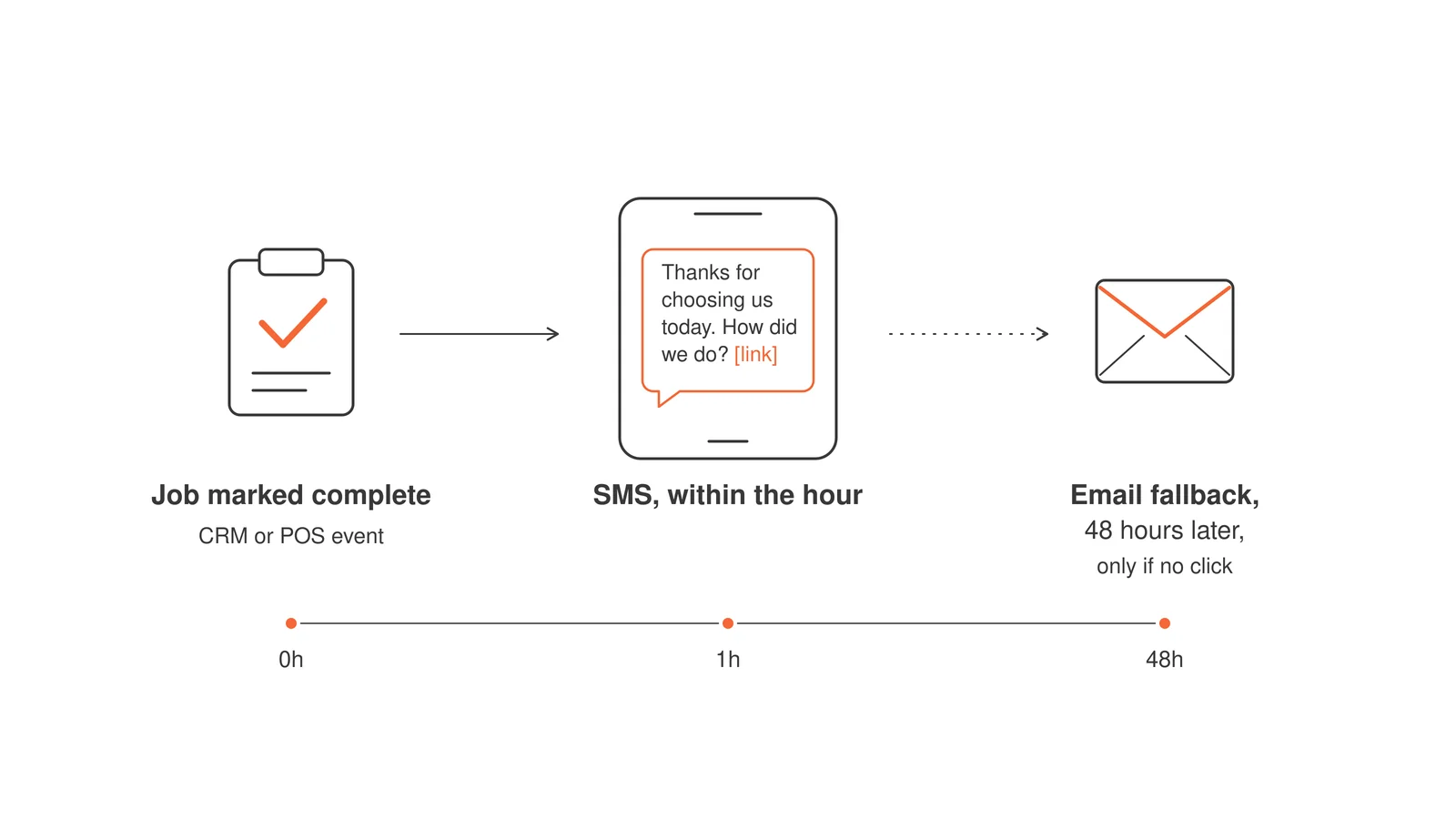
Pick the channel by speed. SMS gets opened within minutes, so it’s the workhorse for time-sensitive asks. Email works as a longer-form backup and for customers who prefer it. Trigger both off the CRM or POS so the request fires within hours of service, not days.
Ask for detail, and ask for photos. A prompt like “what did you come in for?” produces the keyword-rich, specific reviews that help with both search and AI corroboration. “Leave us a review” doesn’t. Photo and video reviews are rising fast, they build more trust than text alone, and they give you visual assets to reuse.
Build it into the workflow, not the to-do list. A request that depends on someone remembering won’t scale. Wire it to an event: job marked complete, invoice paid, appointment closed. Then it runs on its own.
Pro tip: Don’t send Yelp links in request campaigns. Yelp filters reviews it believes were solicited, and a filtered review is worse than no review. Let Yelp reviews arrive on their own and put the request budget on Google and the vertical sites.
Now the part that matters more than it used to: compliance.
The FTC’s Rule on the Use of Consumer Reviews and Testimonials took effect on October 21, 2024. It bans buying or selling fake reviews, including AI-generated ones, paying for reviews that express a particular sentiment, undisclosed insider reviews, and suppressing or selectively hiding negative reviews. Civil penalties run up to $53,088 per violation. On December 22, 2025 the FTC sent its first warning letters to 10 companies, based on consumer complaints and the companies’ own disclosures, so enforcement is no longer hypothetical. In the UK, fake and undisclosed incentivized reviews became a banned practice under the Digital Markets, Competition and Consumers Act on April 6, 2025, which matters for any agency with UK clients.
Two practices that used to be standard advice are now risky:
-
Review gating, asking happy customers for public reviews while routing unhappy ones to a private form, reads as suppression. Every customer has to be able to reach the public review link. You can still offer a private feedback channel alongside it. What you can’t do is show the public link only to people who passed a satisfaction screen.
-
Incentivizing for a rating, the “leave us five stars and get 10% off” move, is prohibited. You’ll still see guides and even vendor playbooks recommending discounts or loyalty points for reviews. That advice is out of date. You can ask for honest feedback. You can’t pay for the sentiment.
For agencies this is a selling point as much as a constraint. A client running gated or incentivized reviews is carrying legal risk they probably don’t know about. Cleaning that up is valuable, and it’s a reason to standardize review generation across every account you manage.
How to monitor reviews
Monitoring is the task everyone lists and few set up properly. Four things make it work.
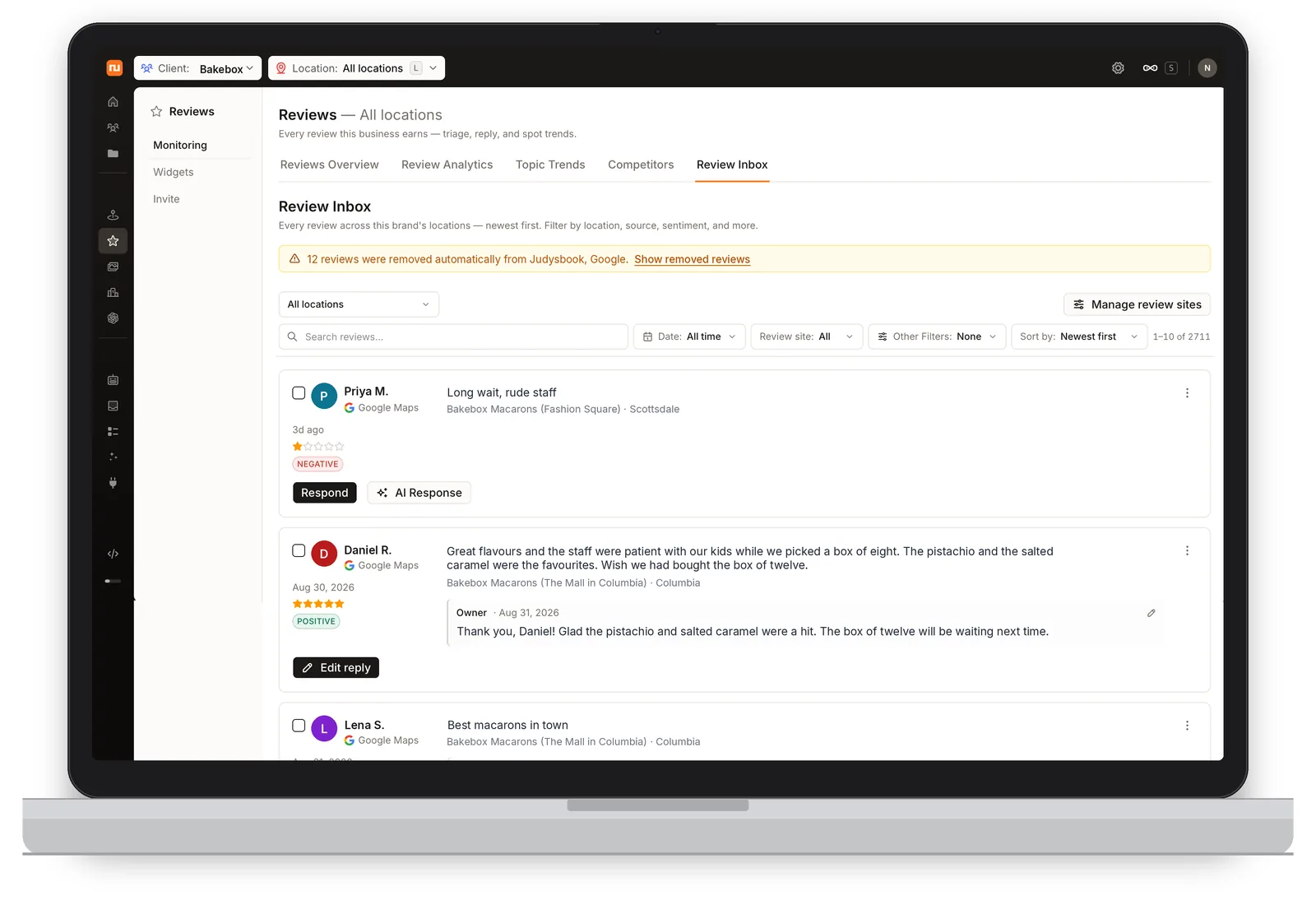
One queue. Every platform and every location in a single view. The failure mode is a manager checking Google weekly while a review on another important site sits unanswered for a month.
Alerts that match the risk. Instant alerts on anything under four stars and on keywords that signal trouble (refund, lawsuit, unsafe, sick, rotten, sue, legal). Positives can wait for the daily digest.
A named owner per location. Unowned inboxes are how “we monitor reviews” turns into “nobody replied.” One person is responsible for the first reply at each location, with a backup.
Escalation rules. Some categories never get an automated reply: safety complaints, legal threats, discrimination claims, bereavement, anything naming an employee. Write the list down, route those to a human, and review the list quarterly.
How to respond to reviews
A response is public theatre. You’re writing to the reviewer, but the audience is every prospective customer reading them later. Google’s own guidance says responding shows you value customers and their feedback.
Positive reviews. Thank them by name. Reference the specific thing they mentioned, which proves a human read it and quietly reinforces the service for search. Invite them back and keep it short.
Negative reviews. Reply fast, stay calm, and never get defensive in public. Acknowledge the issue, apologize where it’s warranted, and move the detail offline with a name and a direct contact. The goal isn’t to win the argument with an aggrieved customer, it’s to show the next reader how you handle a problem. A measured reply to a harsh review often does more good than the review did harm.
Then close the loop. Most businesses stop at the public reply. The full sequence has four steps:
-
Public reply within hours, short, moving the detail offline.
-
Private resolution within 48 hours. Fix the actual problem.
-
Public follow-up on the original review once resolved, so future readers see the outcome.
-
One week later, invite the customer to update the review. Asking someone to revise an honest review is not buying sentiment. Almost nobody sends this message, and it’s the highest-return message in the whole program.
Response time by rating. Set the SLA by tier and put it in the contract:
| Rating | Reply within | Who |
|---|---|---|
| 5 and 4 stars | 24 to 48 hours | AI draft, approved by a person, can publish in batches |
| 3 stars | 12 hours | Person, from an AI draft |
| 1 and 2 stars | 4 hours | Person. Move offline. |
Two things worth saying that most guides won’t.
When not to respond. Not every review needs a reply, and a canned response on every single one reads worse than selective, genuine ones. If the “responses” are obviously templated, the human signal is gone.
The automation. AI can draft good responses at scale, and for a portfolio you’ll need it. But templates are the wrong tool. Generic templates are exactly what readers and ranking systems spot. A reply drafted against the specific review, its rating, its content and what the customer actually mentioned, reads like a person wrote it. Where a brand has approved ways of handling recurring situations (a refund policy, HIPAA-safe wording, a franchise tone rule), save those as playbooks so consistency comes from the rules rather than from copy-paste text. Then keep a person in the loop: publish the clear four and five-star thank-yous after a quick approval, hold everything mixed or negative for a human to review.
Pro tip: Healthcare replies never confirm the reviewer was a patient. “Thank you for the feedback about scheduling” is fine. “Glad your crown went well” is a HIPAA problem, even when the reviewer mentioned the crown first.
Turning reviews into insight
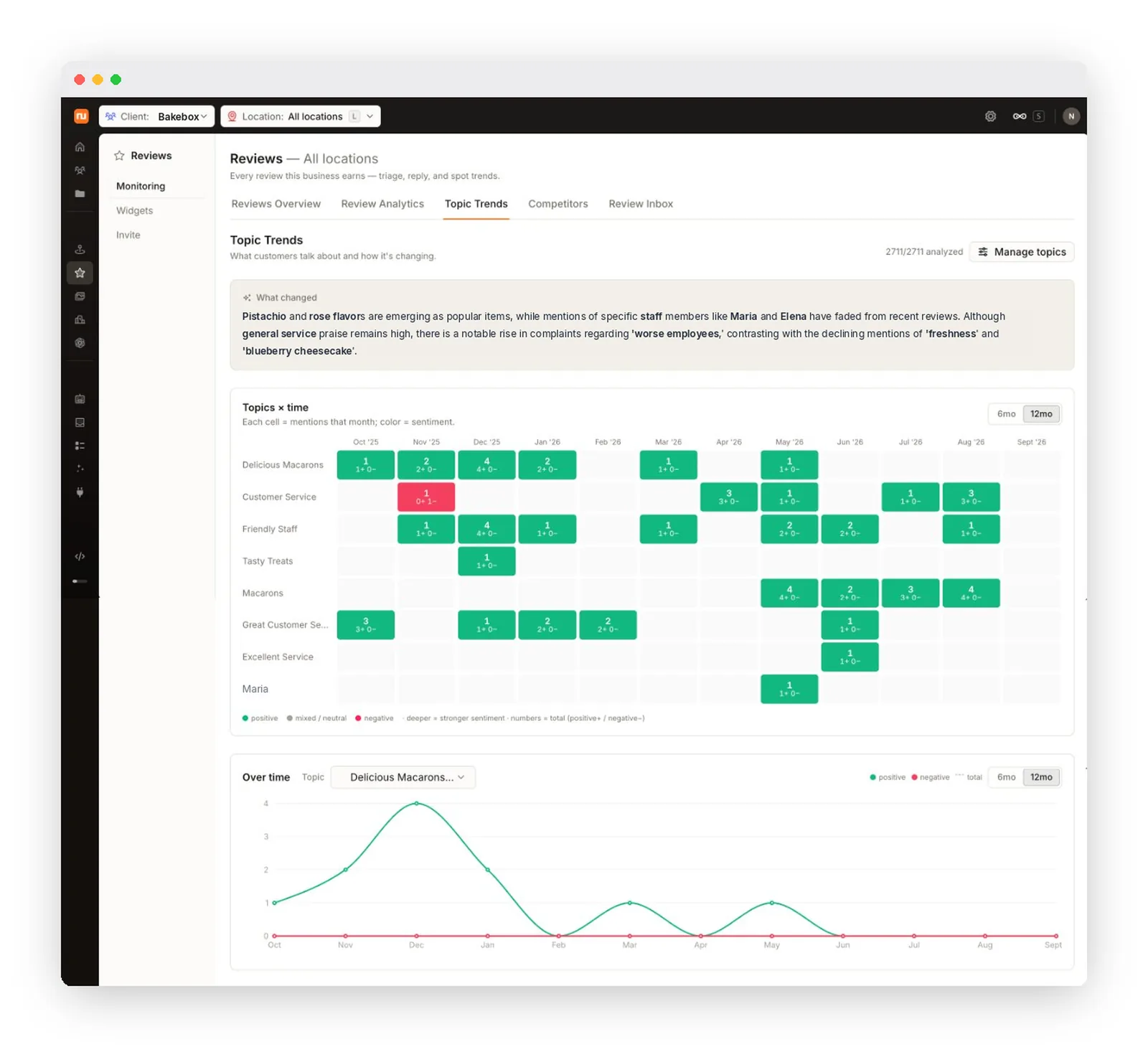
Reviews are the cheapest customer research a business will ever get, and most businesses waste it. The shift is from reading reviews one at a time to reading them in aggregate. Tag every review by theme, run sentiment on the text, then look at the pattern. Ten reviews mentioning slow service isn’t ten complaints, it’s one operational problem with a clear owner.
Aspect-based sentiment is what makes this actionable. A single review can praise the clinician, criticize the scheduling and still land at four stars. Flatten that into one number and you lose the part that is worth fixing. Score each theme on its own and the four-star review becomes two signals: keep doing the clinical work, fix the front desk. The better platforms also do this predictively, flagging a rising theme before it turns into a wave of bad reviews.
For agencies, the monthly insight report is one of the most underrated deliverables you can offer. It moves you from “we manage your reviews” to “we found three things hurting your business and here’s the fix.” That’s the difference between a commodity service and one clients don’t churn out of. Pull the recurring themes, tie each to an operational recommendation, and hand it over.
Putting reviews to work
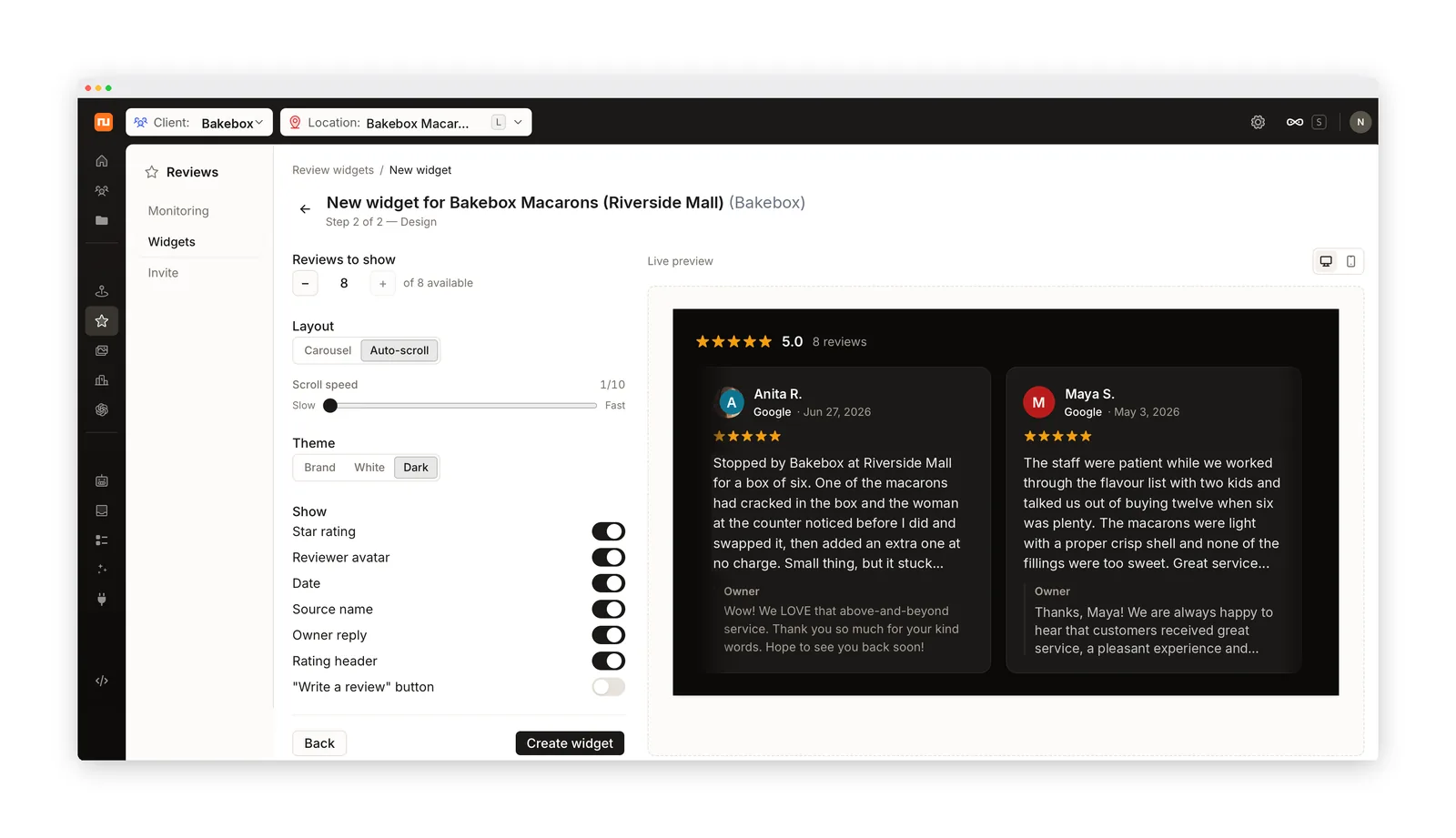
The fifth task is the one most programs never get to. Reviews can be the most persuasive marketing copy a business has, because the business didn’t write them. Use them on service, product and location pages, in proposals, in email, in posts and in ads. When you reuse one, include the reviewer’s first name and the platform it came from to make it look credible.
The usual tool is a review widget on the website, pulling reviews from the platforms and displaying them in the site’s own styling. One compliance point here that you should keep in mind. The FTC rule covers how you display reviews as well as how you collect them. A widget that shows only five-star reviews while the rest are hidden, or a “reviews” page presented as complete when it’s filtered, falls under the rule’s provisions on suppression and misrepresentation. So use the widget’s filters as moderation, not as a sentiment screen. Show the full rating range above a stated policy (spam, off-topic, profanity), or label the block clearly as a selection.
Measuring review management
In larger orgs if you can’t tie reviews to revenue, the budget is always going to be at risk. Here’s a model that holds up in a client report:
-
Inputs: review requests sent, request-to-review conversion rate, new reviews per location, average rating, review velocity, response rate and time.
-
Visibility: map-pack position for target terms, and presence in AI answers for a fixed set of seed queries.
-
Profile actions: the clicks, calls and direction requests from the business profile.
-
Outcomes: leads and revenue attributed to that channel.
The story you’re proving is that more and better reviews lift map-pack position and AI presence, which lifts profile actions, which lifts revenue. You won’t be able to prove that a specific review helped with a sale, but the directional link across locations is usually strong, and review-driven visitors tend to convert well because the trust is already built.
Sensible targets for the inputs: 100% response rate, median response time under 24 hours, request conversion improving quarter on quarter, and no location going 30 days without a new review.
A reputation score helps roll this into one number for clients. Blend average rating, review velocity, response rate, recency and listing accuracy into a single weekly figure per location. It turns a messy dashboard into a scoreboard clients understand, and it doubles as a priority map for your team: lowest scores get attention first.
Running review management as an agency service
Most of this guide applies to anyone. This part is for the agencies and resellers because it’s where the money is and where the generic advice runs out.
Productize it into tiers:
-
Monitor and respond. Centralised monitoring across platforms, response within SLA, basic monthly reporting. The entry tier.
-
Generate and grow. Add review generation campaigns, request automation off the client’s CRM or POS, and velocity targets.
-
Insight and protect. Add themed sentiment reporting, competitor benchmarking, and a crisis plan for review attacks or viral complaints.
A few operating principles that keep the service profitable:
-
Standardize the response playbook across accounts so quality doesn’t depend on who’s online. Playbooks per brand, AI drafts against each review, human approval before publishing.
-
Make review acquisition someone’s job at the client. The programs that work bake the ask into frontline roles, sometimes as a soft KPI, so it happens without anyone chasing it. Help your clients set that up as it is the difference between a campaign and a system.
-
White-label everything client-facing. Your brand on the dashboard and the reports, not the vendor’s.
-
Watch the unit economics. Response volume is the cost driver. AI-assisted drafting with human approval is what lets you take on more locations per head without quality slipping.
-
Benchmark against the client’s real competitors, not an abstract ideal. A 4.2 looks fine until the shop down the street sits at 4.8 with double the reviews. That gap is your case for the next tier.
This is the layer Synup is built for. The agency platform centralizes reviews across Google, Facebook and the directories that matter, runs request automation, drafts AI responses for human approval, and reports under your brand across every client location. If you’re running reviews as a service and stitching it together by hand, that’s the thing to fix first.
Choosing a review management software
The market is crowded and most tools cover the basics. Sort them on the things that actually differ:
| Capability | What to check |
|---|---|
| Platform coverage | Google and Facebook are table stakes. Check the vertical directories your clients’ industries care about, and Apple Business Connect. |
| Generation | Native request automation over SMS and email, CRM and POS triggers, QR and direct-link support. |
| Response | AI drafting tuned to brand playbooks, with a human approval step. Bulk workflows for volume. |
| Analysis | Aspect-based sentiment, themed tagging, competitor benchmarking, automated custom reports. |
| Multi-location and white-label | Per-location dashboards, role-based access, fully branded client-facing reporting. Non-negotiable for agencies. |
| AI search visibility | Can the tool show how the business appears in AI answers as well as traditional rankings? |
| Widget | Displays reviews on the client site with source and date filters, without hiding the rating range. |
| API | Programmatic access for building review data into your own stack or client portals. |
Match the tool to how you actually work. A single-location business and a 40-account agency need very different things, and the tool built for one is usually clumsy for the other.
Frequently asked questions
How do reviews affect local SEO? Google ranks local results on relevance, distance and prominence. Its own documentation says review count and review score factor into local ranking. Recency, velocity and spread across platforms add to prominence, and the words inside reviews add relevance by describing what the business is known for.
Do reviews influence AI search answers like ChatGPT and Google’s AI Mode? Yes. AI systems use review text as evidence to confirm facts about a business and check them across sources. Google has said its conversational Maps answers draw on review content. Consistent, specific, recent reviews across multiple platforms raise the odds of being included in AI-generated recommendations.
Can I ask customers for reviews? Yes. Asking is fine and encouraged on Google and most platforms. What’s not allowed under the FTC’s rule is paying for reviews of a particular sentiment, gating out unhappy customers, or posting undisclosed insider reviews.
Does Yelp allow asking for reviews? Yelp discourages it and filters reviews it believes were solicited. Leave Yelp out of request campaigns and let those reviews arrive on their own.
Can I delete a bad Google or Facebook review? Not directly. You can flag reviews that break platform policy (spam, fake, off-topic, conflicts of interest), and the platform decides. You can’t remove a legitimate negative review for disagreeing with it and the better play is to respond well and outweigh it with fresh, genuine reviews.
How many reviews does a business need? There’s no magic number. The target that holds up is to out-review the competitors you’re fighting in the local pack for your category, and to keep new ones arriving every month. Steady, recent reviews matter more than hitting a threshold once.
How fast should I respond to reviews? As fast as you can for negatives, ideally within a few hours, and within a day or two for positives.
Reading is step one. Sydekick does step two.
Sydekick runs the listings, review, and visibility work these guides describe, across every location you manage.