Marketing Agency Lead Generation: Successful Strategies for Acquiring New Clients
Want to learn how to generate leads for your agency and boost your client pipeline? Here are the 10 most effective lead generation strategies for agencies.
Let’s face it: without leads, your agency is like a car without gas, you’re not going anywhere fast. That’s why lead generation is the lifeblood of any agency. It keeps the wheels turning and the clients coming in.
Simply put, agency lead generation involves helping a business fill its sales pipeline with potential clients. The more you pour in, the more business flows out. But does that mean it's simple? Well, yes and no. The key is knowing which lead generation strategies to use and when.
We're about to break down 10 proven strategies to keep your agency's pipeline full. Let’s get into it!
What is Lead Generation?
Lead generation is the process of identifying, attracting, and converting people or businesses that show interest in your agency's services. Good lead generation gets you more qualified buyers who will convert.
For marketing agencies, lead generation includes inbound and outbound approaches. This can take many forms, like cold outreach, SEO, partnerships, webinars, referrals, tools, and more. These help fill the funnel with people who need what you offer.
Outbound vs Inbound Lead Generation Strategies: Which is the Best for Your Agency?
Lead generation falls into two major categories:
I. Inbound Lead Generation: Inbound leads come to you. This approach attracts clients through SEO, lead magnets, webinars, content marketing, organic social media, and similar channels.
II. Outbound Lead Generation: Outbound leads are the ones you pursue. You proactively reach out to prospects through cold emails, LinkedIn outreach, calls, events, and targeted ads.
Inbound works best when you want sustainable, long-term lead flow built on trust, brand authority, and education. Outbound is best when you want results fast or when you’re targeting very specific clients.
Of course, you’re probably always wondering which is better.
It depends on your goals. If you want quicker results, outbound may be a better option because it offers speed. However, if you're looking for long-term success, inbound marketing is the preferred choice, as it provides consistency.
In practice, agencies grow fastest with a hybrid approach, since using both strategies creates more consistent and predictable growth.
Best Strategies for Marketing Agency Lead Generation in 2025
Lead generation agencies that are winning today rely on multiple, well-aligned strategies. They combine outreach, content, tools, and partnerships, all built around precision and personalization. The goal isn’t to try random tactics but to create a system that compounds over time.
Below are the 10 strategies that consistently generate high-quality leads for marketing agencies today, along with simple steps to get started with each one.
#1. Cold Outreach (Email and LinkedIn)
First is the old, classic cold outreach. Yes, when done right, it can work really well. Cold outreach is all about playing the numbers game, but with strategy.
Take email, for example. Imagine you’re scrolling through your inbox. Would you open a cold email that reads, “We provide marketing services”? It’s unlikely to grab attention.
Now, what if the subject said, “We helped [Your Competitor] increase sales by 200%—Interested?” That just might do it. It’s all about grabbing attention with something worth reading.
LinkedIn is another great cold outreach lead generation platform for marketing agencies. The key here: be human. Nobody desires to communicate with a robot. Keep your messages short, personal, and to the point. Agencies that get this right see a huge return on LinkedIn lead generation strategies.
For example, Olga Kokhan of Tinko Group ran LinkedIn campaigns that targeted tech industry CEOs with personalized outreach. The top 25% of the campaigns received a 20% response rate.
Just remember: cold outreach isn’t about spamming. It's all about making a personal connection.
How to Get Started With Cold Outreach
- Build segmented prospect lists (e.g., based on industry, location, tech stack, hiring trends, job role, funding stage, recent changes). You can use tools like Apollo or LinkedIn Sales Navigator.
- Pick one industry plus one job role (e.g., SaaS founders, eCommerce CMOs). The narrower you go, the easier it is to write relevant messages. You can repeat the next steps for different combinations of audience segments.
- Send hyper-specific messages with context, such as references to wins, gaps, or triggers, especially in your opening lines. Also, use value-first subject lines.
- Use a simple 4-step sequence. Start with email. Then, a soft follow-up (e.g., ask a short question based on their pain point). Then nudge them on LinkedIn, and finally drop one actionable insight or value you bring.
- Offer a micro-value (a 2-line audit, quick product teardown, or insight).
- Track small variables, such as open rates, reply rates, and meeting rates, weekly. Test subject lines as per open rates, opening lines as per reply rates, and offers as per meeting rates. Small tweaks can bring massive gains.
- Keep everything short and personal. No one wants to read a novel from a stranger.
- Follow up thoughtfully without being pushy.
Also Read: 6 Email Marketing Campaign Examples to Grow Your Agency
#2. Webinars and Online Workshops
People love free stuff, especially when it teaches them something useful. This is where webinars and online workshops come in as primary tools to generate leads for an agency. They’re like holding a one-day workshop without all the stress of physical organization.
Agencies that run webinars position themselves as experts. You’re essentially saying, “Hey, we know our stuff, and we’re here to share the knowledge.” And people love learning from experts.
However, the key is to offer real value, not just a glorified sales pitch. No one will sign up for a workshop called “Why You Should Hire Us.”
An agency specializing in social media marketing could instead host a webinar called “How to Get 10K Instagram Followers in 60 Days.” That’s something people will want to attend.
While you’re disseminating valuable information, you’re also building trust. Before you know it, they’re reaching out to hire you because they know you’ve got the goods and industry know-how.
Additionally, webinars are interactive. You get to chat with potential clients in real-time, answer their burning questions, and showcase your expertise.
How to Get Started With Webinars & Online Workshops
- Identify your target audience and the problems you can help solve. Pick a problem your Ideal Customer Profile (ICP) loses sleep over.
- Choose topics that address specific pain points or interests. For example, a good one is “How to fix ROAS in 30 days,” not “Why marketing matters.” Basically, if the topic isn’t urgent, attendance drops.
- Select a reliable webinar platform that’s easy for attendees to use.
- Create a compelling title and description that highlights the value.
- Promote your webinar across all channels you can think of (email, social media, website). By all, we mean both the founders’ and the company’s LinkedIn, or even groups/communities your ICP hangs out in. Start promoting at least 10–14 days before.
- Prepare a structured presentation with actionable takeaways. Ensure the content is at least 80% educational and no more than 20% promotional, as no one appreciates a sales pitch masked as a webinar. Additionally, incorporate frameworks, examples, and mini audits.
- Include Q&A time to engage directly with attendees. This is where credibility goes up.
- Send follow-up resources to attendees afterward, and also a clear next step.
#3. Partnerships
Why do it alone when you can team up? Partnerships are the secret many agencies overlook. Collaborating with other businesses (that aren’t direct competitors, of course) opens doors to a whole new pool of potential clients, boosting agency lead generation.
Think of it this way: you’re a digital marketing agency partnering with a web development company. They build the websites; you bring the traffic. It’s a win-win! You gain access to their clients, and they gain access to yours. You’re essentially sharing lead generation strategies without stepping on each other’s toes.
Co-marketing is where the magic happens. Whether it’s joint webinars, blog swaps, or bundled services, combining forces makes both of you stronger. You get double the exposure for half the effort.
Here’s another clever tactic: reselling white-label services. Let’s say you’re an SEO agency, but your clients keep asking about reputation management. You don’t have to turn them away. You can partner with a company like Synup, resell their marketing solutions fully white-labeled, and suddenly you’re offering more solutions without all the heavy or technical work of starting from ground up.
The best part is that partnerships build credibility. When clients see you working with other reputable companies, they trust you more. It’s like being part of the cool league in the industry—everyone wants to sit with you.
So, don’t go solo. Partner up, cross-promote, and generate leads for your agency faster!
How to Get Started With Partnerships
- Identify complementary businesses that serve your target audience. Think of companies your clients already buy from (web dev, branding, IT, and other vendors).
- Reach out with a clear value proposition for both parties. Pitch a mutual value exchange, not a sales pitch. For example, start with something like “Your clients often need X. Ours often need Y. Want to explore a co-marketing partnership?”
- Pick one model to test the relationship, whether it’s referrals, revenue share, white-label, or co-marketing. You could start with co-marketing; it’s the easiest.
- Start with a small collaboration first. Things like a newsletter mention, a webinar, or a shared resource that you both promote usually work well.
- Create mutual referral agreements with clear terms. Define lead handoff rules, how to track referrals, what “qualified” means, etc. Review them together every month.
- Develop co-marketing initiatives, like joint webinars or content.
- Consider white-label partnerships to expand your service offerings.
- Maintain regular communication to keep the relationship alive.
- Track referrals and results to measure success. Then, double down on what works.
#4. Lead-gen Tools
Manual lead generation is quickly becoming a thing of the past. Why hustle for every lead when you’ve got tools that can do the job for you?
The appropriate tools can significantly assist you with agency lead generation. They can find and qualify potential clients without needing you to spend hours stalking LinkedIn profiles or scouring the web. The best part is that these tools provide you with data on exactly who you want to target.
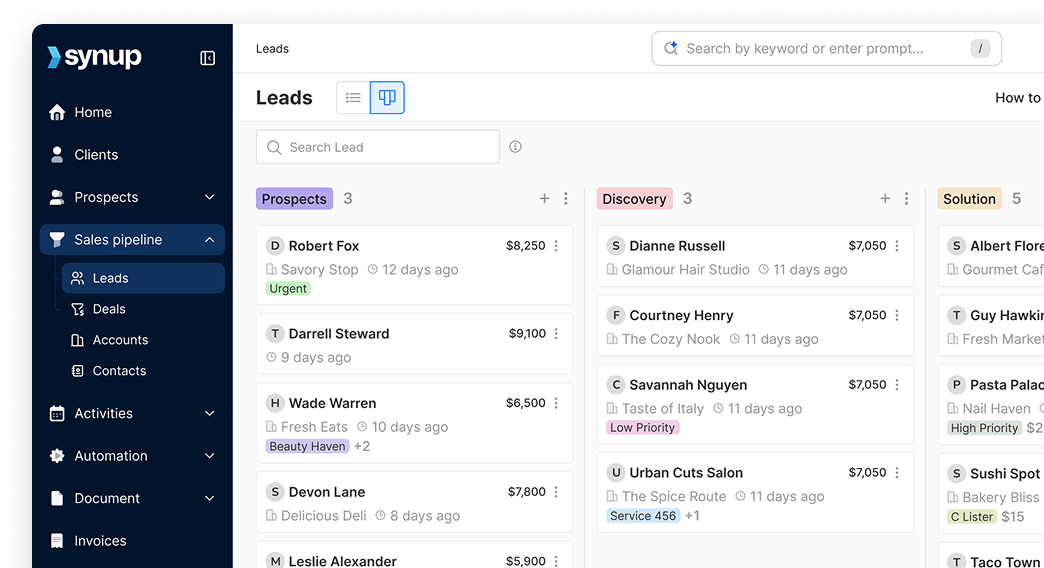
Take Synup's B2SMB lead platform, for example. It’s built specifically for agencies looking for SMB (small-to-medium business) prospects. You get access to detailed data, like company size, industry, and even key decision-makers.
Imagine getting a list of your dream clients handed to you on a silver platter. That’s basically what tools like Synup do. Instead of fishing blindly in a massive ocean, you’re now casting your net in a pond full of the exact fish you’re looking for.
And here’s the best thing: using a tool like this means you can focus on what you do best—closing deals, not chasing down prospects.
How to Get Started With Lead-Gen Tools
- Research and identify tools that match your target audience criteria. For SMBs, go for tools like Synup’s Prospecting Tool. For SaaS/eCom, use tools with deeper intent data, such as Clay or Clearbit.
- Start with a trial or demo to test the tool's effectiveness.
- Identify buying signals. You can look for triggers such as hiring for a marketing role, running ads, redesigning their website, securing funding, or expanding into new markets.
- Define your ICP parameters (industry, company size, location).
- Enrich leads before outreach. For example, add notes like “Spending on Google Ads but low CTR” or “No blog activity in 6 months.” This becomes your opener.
- Integrate the tool properly with your CRM.
- Set up automated workflows (intros, nudges, insights, etc.) to streamline lead capture and follow-up.
- Regularly review and refine your targeting criteria based on results. Intent data changes constantly, so keep it fresh.
- Train your team on how to use the tool effectively.
Also Read: How To Automate Sales Follow-Ups To Book More Clients
#5. Client Referrals
You know what’s better than getting a new client? Getting a new client because of an old one. That’s the magic of client referrals in agency lead generation.
When a happy client talks you up to their network, it’s like getting free advertising—except it’s much more credible because it comes from someone they trust.
Hard to believe?
92% of people trust recommendations from their peers (friends and family) more than any flashy marketing campaign, according to the Nielsen Global Trust Advertising Survey. If your client says, “Hey, these guys helped double our sales pipeline, check them out,” that’s gold. You don’t even have to sell yourself at that point; the trust is already established.
But you can’t just sit around waiting for referrals to happen. Sometimes, you need to give clients a little nudge. Ask for it! Offer an incentive, like a discount on future services or a free consultation for any new business they send your way. It’s a small price to pay for a steady stream of leads.
Think of it this way: client referrals are like the “friends and family plan” for your agency. If one person loves your work, chances are they know someone else who will too. So, deliver great results, build those relationships, and don’t be shy about asking for a referral.
How to Get Started With Client Referrals
- Define your referral program goals and what success looks like.
- Ask at the right time, such as immediately after a win. Right after delivering great results, say, “If you know anyone who could benefit from this, I’d love an intro.”
- Create attractive incentives that motivate clients to refer (10% discount, free services, one-month upgrade, or gift cards). Keep it simple and desirable.
- Explain the program clearly to existing clients through email and direct calls.
- Keep the referral process simple. Give clients a simple link or form. A small one-page form removes friction and tracks everything properly.
- Track referrals using a CRM or referral management software.
- Follow up in 24 hours. Speed matters because the referrer feels taken seriously, and the lead stays warm.
- Thank publicly (when appropriate) and reward referrers quickly to encourage more participation.
- Monitor the program's success and adjust incentives or processes as needed.
- Don't forget past clients. They know people, too. Reach out periodically to see if they know anyone who could benefit. If you keep clients happy, they’ll send you more clients.
#6. High-Quality Lead Magnets
Who doesn’t love a freebie? Lead magnets are like the bait you use to reel in potential clients. But your bait has to be worth biting for it to generate leads for an agency. No one’s downloading a boring PDF called “5 Marketing Tips.”
Instead, think high-quality and valuable. Offer something your target audience actually wants and needs. Maybe it’s an in-depth guide, a free audit, or a calculator that saves them time. It could even be a webinar replay packed with actionable insights. The key is to aim to solve a problem they’re struggling with. Make it so good they can’t resist signing up for future communication.
For example, let’s say you’re a PPC agency. You could create a free Google Ads budget planner. It helps potential clients plan their campaigns and—bonus!—positions you as the expert they’ll want to work with when they realize they need more help.
Lead magnets should feel like a win-win. Your prospective client gets something awesome for free, and you get their contact info. That’s the first step to building trust, and once they’re hooked, you’ve got the chance to convert them into paying clients.
How to Get Started With Lead Magnets
- Identify 1–2 of the biggest pain points or challenges your target audience faces.
- Create valuable resources that directly address these problems. Some great lead magnets are eBooks, checklists, guides, templates, and calculators. If it saves time, it converts.
- Ensure your lead magnet is closely related to your services.
- Design an attractive landing page with a clear value proposition. Your audience must think, “This is actually useful”.
- Also, add the lead magnet to your highest-traffic pages like blog posts, service pages, homepage, and LinkedIn posts.
- Keep forms simple. Only ask for essential information.
- Promote your lead magnets everywhere, including in email campaigns, on social media, through ads, in partnerships, at events, and on your website.
- Set up automated email sequences to nurture leads after they download.
- Add content upgrades inside blog posts.
- Track download rates and adjust your offers based on performance. Kill and replace underperforming magnets. Double down on the good ones.
#7. Search Engine Optimization (SEO)
Unfortunately, if you’re not showing up on Google, you’re basically invisible. This also means you’ve placed SEO on the back burner. Prioritizing SEO as a lead generation strategy is all about ensuring your agency pops up when someone searches for the services you offer.
It's simple internet engineering. Your ideal client is out there right now, typing “best marketing agency in [their location]” into Google. The question is, are you on the first page, or are you buried somewhere on page 10 with the random blogs from 2005?
SEO for agency lead generation is about getting your agency to rank higher. How? By using the right keywords, optimizing your website, and keeping your content fresh. It’s not magic, but when done right, it can feel like it.
Here’s a real-world scenario: you run a digital ad agency. You optimize your site with keywords like “PPC management” and “social media marketing for small businesses.” Over time, when people search those terms, your agency climbs the ranks. And you’re now in front of potential clients without paying a cent for ads.
SEO takes time, sure, but it pays off in the long run. Once you’ve built up that organic traffic, leads come in without any extra effort. It’s like setting up a fishing net that catches prospects while you’re doing other things.
So, if you haven’t been paying attention to SEO to generate leads for your agency, now’s the time to get serious. Because if Google doesn’t know you exist, how will your next client find you?
How to Get Started With SEO
- Research high-intent keywords related to your services. Include terms like “agency,” “services,” and “consultant.” Avoid jargon like “integrated omni-channel synergy.”
- Optimize your service and contact pages with relevant keywords. Add clear benefits, FAQs, and case studies too. This boosts conversions and rankings.
- Create high-quality blog content that addresses your audience's needs. Your content should answer questions that your audience asks before your competitors do. So, focus on business problems, not generic topics.
- Focus on on-page SEO basics (title tags, meta descriptions, headers, URL structure).
- Ensure your website is mobile-friendly with fast loading times.
- Build a strong internal linking structure to help search engines understand your site.
- Work on earning high-quality backlinks from reputable websites with value, partners, data, and insights. Do guest posts too to build authority.
- Use tools like Google Analytics and Search Console to track performance. Track metrics like rankings, traffic, engagement, and conversions.
- Regularly update and refine content to keep it relevant. Outdated advice is SEO poison and gets lower rankings on search engines.
#8. Attend Industry Events
Remember, networking isn’t dead. Attending industry events is still one of the best ways to generate leads for an agency.
Why?
Because face-to-face connections hit differently. When you’re in the room with potential clients, it’s much easier to build rapport. Plus, people tend to remember the person they shook hands with far more than the person who sent an email.
Conferences, trade shows, seminars—whatever floats your boat. These events are packed with people looking for solutions (aka what your agency offers). Don’t be shy. Chat people up, hand out your business cards, and make genuine connections.
Pro tip: Don’t just attend these events—participate. Host a booth, give a talk, or run a workshop. Put yourself in front of the crowd. Agencies that position themselves as experts at events get way more leads than those merely walking the floor with a coffee cup and a brochure.
And yes, even if you don’t walk away with 10 new clients the same day, you’ll leave with new relationships. Some of the best deals happen months after that first handshake.
How to Get Started With Industry Events
- Research relevant conferences, trade shows, and networking events in your industry.
- Register early and map out your attendance plan. Event organizers often fill speaker slots weeks or even months beforehand.
- Prepare your elevator pitch and conversation starters. Also, bring plenty of business cards and promotional materials.
- Try to speak, host, or sponsor if the budget allows. This significantly increases visibility.
- Host a booth or workshop to position yourself as an expert.
- Reach out within 24 to 48 hours after the event. Fast follow-up shows genuine interest and keeps those warm conversations from going cold.
- Post your event highlights on social media to extend your reach. Social proof works even when subtle.
#9. Paid Ads
Let’s cut to the chase—paid ads work. Sure, organic growth is great, but paid ads are invaluable if you want to speed things up. Whether it’s Google, Facebook, Instagram, or LinkedIn, you can get your agency in front of the right people fast.
However, the beauty of paid ads lies in targeting. You can zero in on exactly who you want to reach—business owners, marketing managers, or even specific industries. Why waste time hoping your message lands when you can pay to get it right in front of your ideal client’s face?
Take Facebook ads, for example. You could run a campaign offering a free consultation to small business owners struggling with SEO. Or you could use Google Ads to target people searching for the “best digital marketing agency in [your city].” Just like that, you are now appearing when potential clients need you most.
And yes, it costs money, but think of it as an investment. You spend $500 on a well-placed ad and land a $5,000 client. Worth it, right? Just make sure your ad copy is solid, your offer is enticing (no one clicks on dull ads), and you’re following up on leads.
How to Get Started With Paid Ads
- Pick one platform first. Google for high intent. LinkedIn for B2B targeting. Meta for high volume and cheap traffic.
- Identify high-intent keywords or audience segments most likely to convert.
- Design targeted landing pages optimized for your specific ad campaigns. Use clear and well-placed CTAs.
- Write ad copy that hits needs and pain points clearly.
- Set up retargeting campaigns for visitors who engaged but didn’t convert. This makes sure you don’t lose warm leads.
- Start with a modest budget and test different ad variations. Scale what works.
- Use platform-specific targeting options (job titles on LinkedIn, interests on Facebook, search terms on Google).
- Monitor key metrics like click-through rates (CTR), cost per click (CPC), cost per acquisition (CPA), return on ad spend (ROAS), call recordings, form submissions, and conversion rates closely.
- Adjust your strategy based on what's working best. Ensure you have a system for immediate follow-up on leads.
#10. Run Contests and Sweepstakes
Who doesn’t love the chance to win something cool? Running contests and sweepstakes is a fun and easy way to generate leads for your agency while getting your audience hyped up. People love freebies, and you’re giving them exactly that—plus, a little friendly competition never hurts.
The idea is simple: you offer something valuable (think free services, gift cards, or a year of your premium package), and in return, they give you their contact info. Boom—new leads right in your lap. It’s a win-win.
Let’s say you’re a branding agency. You could run a contest offering a free brand audit or logo redesign. People enter by filling out a quick form with their business info. You’ve now got a list of prospects who need what you offer.
And don’t stop there—spread the word. Post about it on social media, run a few paid ads, and get people excited. The more people who enter, the more leads you collect. Plus, it’s a great way to boost your online presence and generate buzz around your brand.
So, if you want a fun, fast way to fill your pipeline, contests are one of the best lead generation strategies. And even if they don’t win, they still get to know your agency. Now that’s also a win!
How to Get Started With Contests
- Determine what valuable prize you can offer and something your ideal client wants (free services, premium packages, etc.)
- Choose a contest platform or use social media tools to manage entries.
- Create simple entry requirements (e.g., form submission with business info). Simply asking for a name, email, company, and website can be enough in most cases.
- Design eye-catching promotional materials, creatives, and landing pages. Building hype works.
- Set clear contest rules, timeline, and winner selection criteria.
- Promote across multiple channels (social media, email, paid ads).
- Encourage social sharing to expand your reach.
- Follow up with all participants, not just the winner.
- Nurture contest leads through email sequences after the contest ends. Send participants a free resource, mini insights, and a soft CTA to book a call.
Also Read: Blueprint for a Successful Outreach Campaign for SMB Prospects
Common Mistakes to Watch Out for
Even the most sophisticated agencies face challenges with lead generation. Not due to poor strategy, but because lead gen leaves little room for error. To keep your efforts running at peak performance, here are the common mistakes you’ll want to avoid:
- Trying 10 strategies at once instead of mastering 2–3: Trying 10 strategies at once instead of mastering 2 to 3 is one of the fastest ways to stall your lead generation. Start by focusing on a small number of channels and get enough volume to see what is working. Once you have data, shift quickly toward quality. Bad-fit leads waste time, drain your team, and hurt close rates. Good-fit leads mean fewer calls, higher conversions, and predictable revenue.
- Relying on only one channel: Yes, this hurts you as well. No channel delivers forever. Agencies that depend solely on referrals or SEO always stall out at some point. There will be plateaus, and there will be climbs.
- Inconsistent follow-up: Most leads convert only after 2–5 touches, not on the first call. The fastest revenue leaks happen when leads go cold.
- No offer differentiation: When everyone sounds the same, no one is actually good enough. Saying “We are a full-service agency” kills a lot of your conversions immediately.
- Weak targeting: Messaging should always match audience pain points.
- Not tracking what’s working: No CRM, no attribution, or no clear pipeline often means no leads. If you cannot measure cost per lead (CPL), customer acquisition cost (CAC), sales qualified leads (SQL), or channel efficiency, then your growth is all about guessing.
- Talking like a salesperson rather than a specialist: This simply kills trust.
- Relying only on inbound or only on outbound: Instead, you should use both approaches for the best possible results.
- Long, slow, unclear CTAs: Many websites don’t clearly tell visitors what to do next. Every page needs a CTA (a clear one).
- Inconsistent publishing: Posting once every three months does nothing. Inbound grows through consistency, not perfection.
Also Read: 12 Marketing Agency Management Tips to Grow Your Business
Summing Up
You now have 10 lead generation strategies that can transform your agency. Each one, from cold outreach to contests, offers a unique way to reach new clients and fill your pipeline. The key is not to chase them all at once. Mix, match, and master the methods that fit your agency, then double down on what works.
Lead generation is more than tactics. It is about making real connections, delivering value, and earning trust. Track every effort, measure every result, and ruthlessly cut what does not move the needle. Every unqualified lead is wasted time, every missed follow-up is lost revenue.
With a disciplined system in place, your pipeline will never run dry. You will close more deals, grow faster, and build an agency that thrives no matter how competitive the market gets.
10 Types of Lead Generation Strategies for Agencies: FAQs
- What is the best strategy for lead generation?
A mix of methods works best. You may combine SEO, cold outreach, and paid ads to reach your ideal clients. It really depends on your audience. Experiment with client referrals and paid ads to see what resonates.
- What is the fastest way to generate leads for an agency?
Paid ads are your quickest bet to generate leads for an agency. You can target specific audiences and see results almost immediately. Client referrals also work wonders—they fast-track your leads since people trust recommendations. But if you want something fast, you have to make an investment.
- What are the 4 L's of a lead generation strategy?
The 4 L's are: List, Lead, Locate, and Leverage. You may also see it as: Location, Leads, Literature, and Luxury. Whichever version you use, the goal is the same: to connect with potential clients effectively.