How to create a high-converting local business website for your clients
Build local business websites that turn visitors into calls, bookings, and walk-ins. A complete guide covering design, local SEO, trust signals, and conversion optimization.
Most local business clients come to agencies with the same request: “We need a website that looks professional.”
What they actually need (and what they’re not saying, because they don’t know how to say it) is a website that turns visitors into phone calls, bookings, and walk-ins. Those two goals are related but not the same. And conflating them is exactly why so many polished local business websites produce disappointing results.
A high-converting local business website has to do three jobs simultaneously: perform well in local search to attract the right visitors, establish trust fast enough to keep them, and make it effortless for them to take action.
This guide covers how to build a site that does all three, specifically from the agency practitioner’s perspective.
- Local websites must drive calls, bookings, and walk-ins.
- Mobile-first speed and clear above-the-fold messaging determine if visitors stay or leave.
- Trust signals (reviews, real photos, credentials) are critical to conversion.
- Location pages and local SEO drive most high-intent traffic.
- Make action effortless with click-to-call, short forms, and low friction.
Why Local Business Websites Are Different
Before getting into specifics, it’s worth being clear about what makes local business website design distinct from building sites for e-commerce brands, SaaS products, or content businesses:
- Visitor intent is unusually high: someone searching for “emergency plumber near me” or “dentist in Austin accepting new patients” isn’t just browsing. They’re ready to take action. Research shows visitors make stay-or-leave decisions within 8 seconds, with 80% of that time focused on the headline. The site’s job isn’t to educate or persuade from scratch. It’s to quickly confirm that this is the right place, and then make it easy to act.
Research also shows that 88% of consumers who conduct a local search on their smartphone visit or call a business within 24 hours. That’s not a search audience you need to nurture. It’s an audience you need to convert immediately.
- Mobile is the primary channel: 57% of local searches are conducted on mobile devices. This changes the design hierarchy in a meaningful way. It means click-to-call is more important than a contact form. It means load time directly affects whether the visitor stays or leaves. And it means the experience on a 375px screen should drive design decisions, not a widescreen mockup in Figma.
- Trust is the primary conversion barrier: Local searchers have usually never heard of the business they found. They’re making a rapid judgment call based on signals that may seem superficial (photos, reviews, credentials, design quality) but are actually how humans have always evaluated unfamiliar service providers. Get trust wrong, and nothing else on the site matters.
- The website and Google Business Profile are a system: This is the piece most web designers don’t account for. Local businesses don’t live or die by the website alone. The GBP listing is often the first thing a searcher sees. The website needs to function as a trust-confirming destination for visitors who arrived from GBP, and the two need to be consistent enough that Google doesn’t treat them as conflicting signals.
Performance Foundations: Mobile-First and Page Speed
None of the design and content decisions below matter if the site is slow and difficult to use on mobile. These are the non-negotiable technical requirements that have to be resolved before any creative work begins.
- Mobile-first means designing for the smallest screen first: Navigation, CTAs, forms, and content hierarchy: all of it should be built for a 375px viewport and enhanced upward from there, not retrofitted downward from a desktop design after the fact.
- Page speed is both a ranking signal and a conversion driver: According to Google, 53% of mobile users abandon websites that take longer than 3 seconds to load. This eliminates a potential lead before they’ve seen a single line of the client’s pitch. For local businesses where every call matters, even small performance improvements have direct revenue implications.
The three Core Web Vitals Google officially evaluates are Largest Contentful Paint (LCP: how fast the main content loads, target under 2.5 seconds), Interaction to Next Paint (INP: responsiveness to user interactions, target under 200ms), and Cumulative Layout Shift (CLS: visual stability as the page loads, target under 0.1). Fix any “poor” scores before launch.
- Practical speed levers for local business sites: These include hero image compression (often the single biggest file on the page), deferred loading of non-critical JavaScript, efficient hosting on a modern stack (not budget shared hosting), and lazy loading for any below-the-fold images and media. Run the site through Google PageSpeed Insights and Search Console’s Core Web Vitals report before going live. Treat red scores as blockers, not suggestions.
Learn More: 10+ Marketing Agency Website Examples to Get You Inspired
The Homepage: First Impression, CTA, and Trust
The homepage is the highest-traffic page for most local business clients, and it’s where the conversion battle is won or lost above the fold. Every element in the hero section has a specific job.
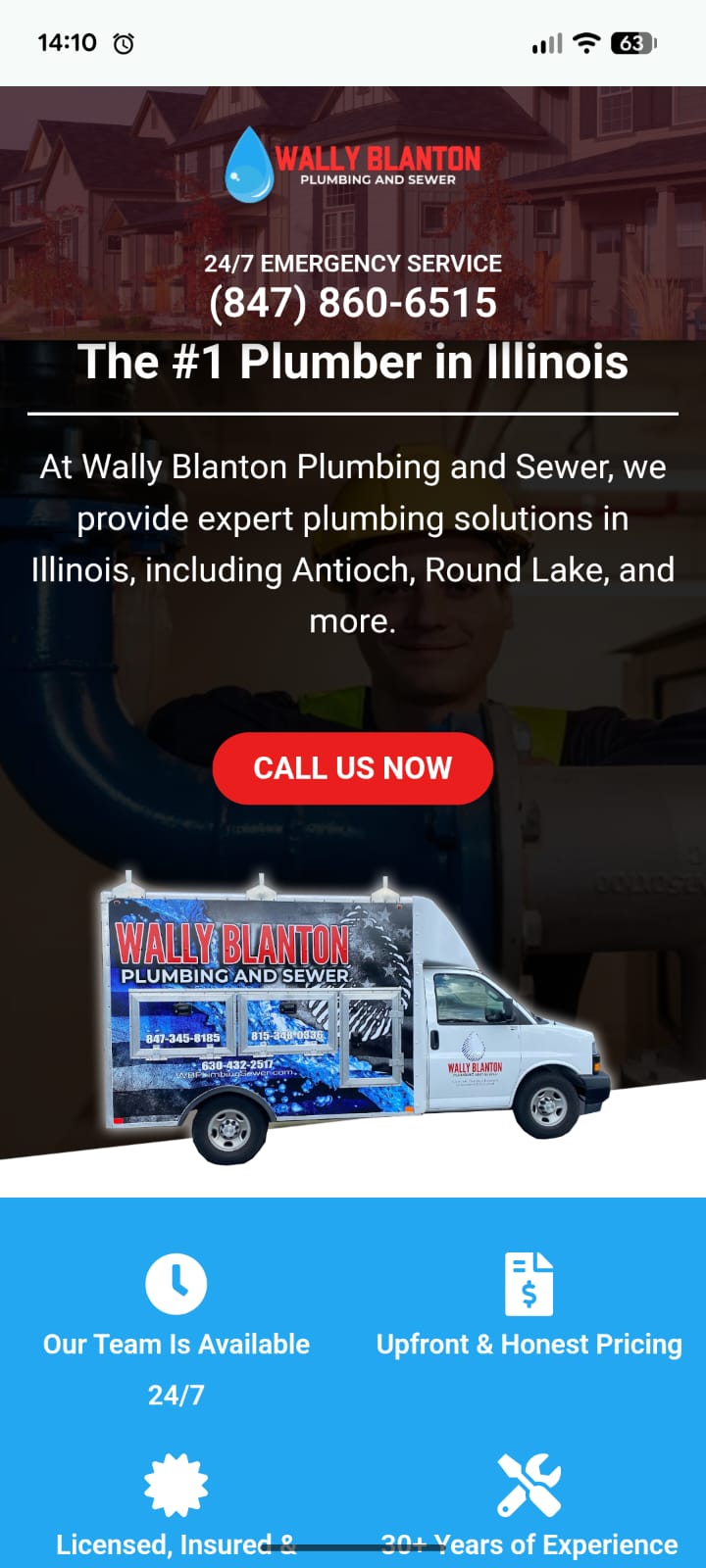
- The hero section needs to answer 3 questions in under 5 seconds: What does this business do? Where do they operate? And what should I do next? A reliable headline formula: [Service] + [Location] + [Key differentiator or benefit]. Example: “Licensed HVAC Services in Denver | Same-Day Repairs Available.” Not clever. Not branded. Immediately clear.
- Only one primary CTA above the fold: For most local service businesses, the highest-converting CTA is a “tap-to-call” button, not “Request a Quote,” not “Learn More.” If the client’s business model runs on phone calls, the phone number should be large, prominently placed, and clickable.
- Trust signals belong in the hero section: Star rating badge, number of Google reviews, years in business, relevant licenses or certifications: these answer the trust question immediately, before a visitor has to scroll. A first-time visitor who sees “4.9 stars from 312 Google reviews” in the hero section has a different conversion path than one who has to search the page for proof of credibility.
- Social proof below the fold should feel real: 3-5 featured Google reviews with reviewer names and, ideally, location references (e.g., “Sarah M., Austin”) convert better than anonymous testimonials on a branded card. The name and location make it feel verifiable, which it is.
- Real photography instead of stock images: This is worth fighting for in client conversations. Photos of actual staff, vehicles, work sites, or completed projects increase trust and conversion for local businesses more than any design element. Before the build begins, request a photo asset package from the client. Schedule a photographer if needed. The ROI on real imagery is among the highest in local web design.
- Service area clarity on the homepage: For businesses serving multiple neighborhoods or cities, the homepage should name the service area explicitly, either in the headline, a sub-headline, or an embedded map. Visitors who can’t quickly confirm you serve their location leave without converting.

Location and Service Area Pages
This is what most agency web builds underinvest in. Location pages are often the primary traffic drivers for local search and the highest-converting pages on the site.
- Why location pages matter for local search:
Google ranks individual pages in local results, not just domains. A service area page targeting “plumber in Round Rock” can rank independently for that specific query even if the business is headquartered 20 miles away. Businesses implementing comprehensive local page strategies report average revenue increases of 23% within the first year. That tells that they’re revenue pages too.
- What makes a location page rankable versus thin content:
This is where most agencies cut corners. A location page cannot be the same text as every other location page with a city name swapped in. Google is good at detecting templated thin content and discounting it. Each page needs genuinely unique content: references to local neighborhoods or landmarks, the business’s specific history in that area, location-specific reviews, services available at that location, and an embedded Google Map centered on the service area. A skilled copywriter can do this efficiently with the right client briefing.
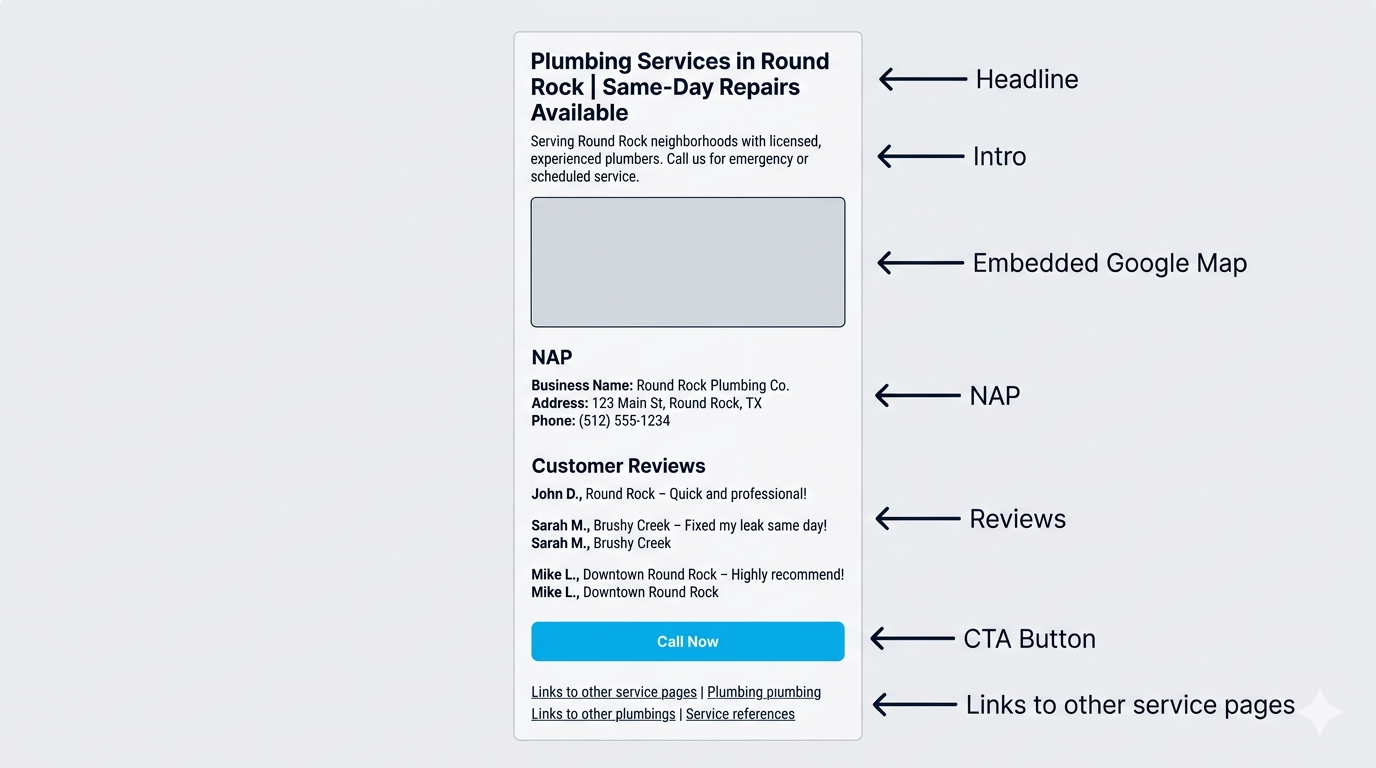
- The key elements of a high-performing location page:
Location-specific headline using the primary service keyword and city name, local keyword in the first paragraph, embedded Google Map, NAP (name, address, phone) specific to that location, 3-5 reviews mentioning that location, and a clear CTA (ideally click-to-call).
- For single-location businesses serving multiple neighborhoods:
A “cities we serve” section or a service area page that names specific neighborhoods helps the site match more specific local queries without requiring a full page per neighborhood. This is an intermediate solution though. It won’t rank as strongly as dedicated location pages, but it’s far better than nothing.
- The multi-location challenge agencies face:
For clients with 5, 10, or 50 locations, location pages need to be templatized for efficiency but uniquely populated for effectiveness. The biggest project risk is trying to launch without location-specific content in hand. Make location content collection part of your client onboarding checklist rather than an afterthought during content entry week.
Local SEO On-Page Optimization
A well-designed local business website that isn’t optimized for local search is essentially invisible. These are the on-page elements that determine whether the site ranks for the queries that actually matter:
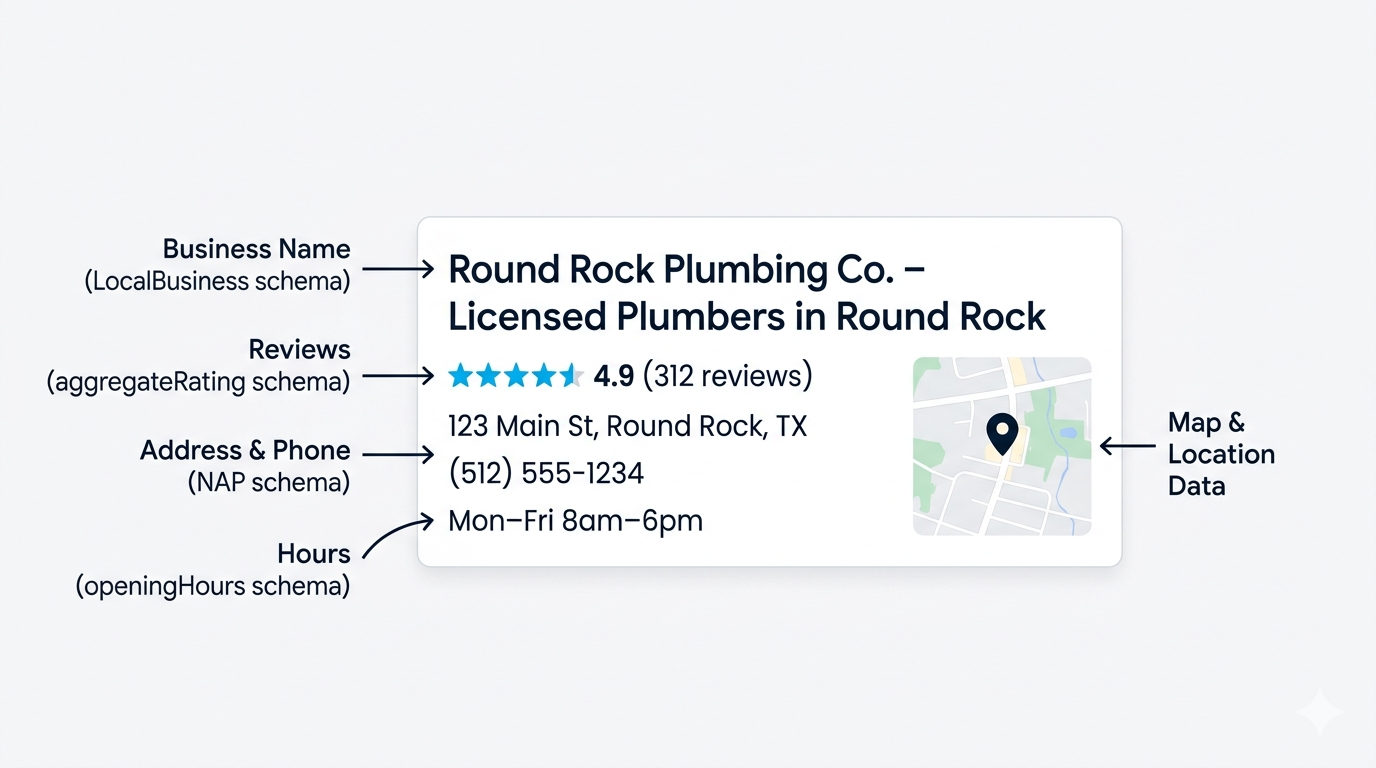
- NAP consistency is the foundation of local search trust: The business name, address, and phone number on the website must exactly match the GBP listing and major directory listings. “St” versus “Street,” a missing suite number, a different phone number format – these look like minor variations to a human but create conflicting data signals for search engines.
- Title tags and meta descriptions for local search: Every page needs a title tag that includes the primary service and location. Homepage format: [Business Name] | [Service] in [City]. Service pages: [Specific Service] in [City] | [Business Name]. Meta descriptions should include a local CTA like “Call us for same-day service in [City]” or “Serving [City] since [Year].” This is the most consistently missing element on local business sites built without SEO input, and it costs rankings.
- Local schema markup (LocalBusiness structured data): Schema tells search engines the business type, name, address, phone number, hours, and review data in machine-readable format. For local business websites, implementing LocalBusiness schema on the homepage and contact page is a ranking signal and enables rich results in Google Search. It’s not optional for competitive local markets. Implement it, validate it through Google’s Rich Results Test, and confirm it’s pulling the correct NAP before launch.
- Local keyword integration in body copy: Each service and location page should naturally incorporate the primary service keyword and location in the H1, the first paragraph, and 2-3 times throughout the body. However, write for the human first. Keyword stuffing creates a poor experience, and Google penalizes it. The goal is natural specificity, not density.
- Internal linking that communicates site structure: Service pages should link to relevant location pages. Location pages should link back to service pages. The homepage should link prominently to the highest-priority service and location pages. This internal linking structure distributes authority across the site and helps Google understand how pages relate to each other, which is particularly important for multi-location clients where location pages need to inherit authority from the main domain.
Also Read: 5 White Label Local SEO Services to Offer Your Clients Today
Integrating the GBP and Website
The website and GBP are two parts of the same local search system. Most web designers treat them as separate deliverables, which is a missed opportunity on both sides.
- The GBP must link to the correct website URL: This sounds obvious, but agencies taking over existing GBP listings frequently find the website field pointing to an old URL, a subdomain, or a homepage that redirects somewhere else. The GBP website URL should match the canonical homepage (or a specific landing page, if campaigns require it), and the redirect chain should be clean.
- Embed GBP reviews on the website: Use Google’s official embed or a reputation management tool. Pulling live Google reviews onto the site keeps review content fresh without manual updates and signals active reputation management to visitors.
- NAP consistency between GBP and the website is the highest-priority consistency check: Run both through a NAP checker before launch. Any discrepancy between the two creates a conflicting signal that dilutes local ranking authority. For agencies managing multiple client locations, keeping GBP and website NAP synchronized as information changes (new phone numbers, relocated addresses, updated hours) is an ongoing maintenance task.
- GBP categories and attributes should match website service offerings: If the GBP primary category is “HVAC contractor” but the website only mentions air conditioning and makes no reference to heating, there’s a content alignment gap. Google’s systems evaluate consistency across both properties. Align them during the build, and note any discrepancies for the client’s ongoing management.
For multi-location clients, keeping GBP data synchronized with website content at scale is where manual management breaks down. Synup for web design agencies provides the infrastructure to manage GBP consistency and listing accuracy across all client locations from a single platform, a meaningful add-on to a website delivery offering.
Also Read: Google Business Profile Optimization For Dummies in 2026
Conversion Optimization: Making It Easy to Take Action
Great design and strong SEO get visitors to the site. Conversion optimization determines whether they call, book, or leave. These are the specific elements that move the needle on local business website conversion:
- Click-to-call on every page (accessible without scrolling): A tappable phone number in a sticky header on mobile is the single highest-ROI conversion element for most local service businesses. The visitor should be able to tap on the phone number from any page, at any point in their session, without having to scroll back to the top or navigate to a contact page.
- Form length and friction are inversely related to conversion rate: For local business quote or inquiry forms, 3-5 fields outperform 10. Name, phone number, service requested, and preferred timing are enough to qualify and follow up on a lead. Every additional field costs completion rate. If the client pushes back on this (and they will), show them the data and remind them that unfinished long forms produce zero leads, while short forms produce qualified ones.
- Live chat or chatbot for after-hours lead capture: A significant portion of local searches happens outside business hours. A simple chatbot that captures a name, number, and service request converts visitors who arrive at 9 pm and won’t wait or leave without a trace. This is an upsell opportunity for agencies managing sites post-launch.
- Remove navigation friction on high-intent pages: Service and location pages with a stripped-down header (logo and click-to-call only, no full navigation menu) outperform pages where the visitor is being invited to browse. When the visitor has landed on a “Drain Cleaning in Austin” page from a local search, the goal is one action: call. Every additional navigation option is a potential exit.
- Urgency and availability signals where they’re authentic: “Available This Week,” “Same-Day Service,” “Accepting New Patients”. These phrases increase conversion on high-intent pages when they’re accurate. Don’t invent urgency that doesn’t exist, but don’t leave real differentiators unspoken in the copy either.
Measuring and Iterating on Conversion Performance
A local business website isn’t finished at launch. It’s a conversion asset that should improve over time. And the only way to improve it is to measure it correctly from day one.
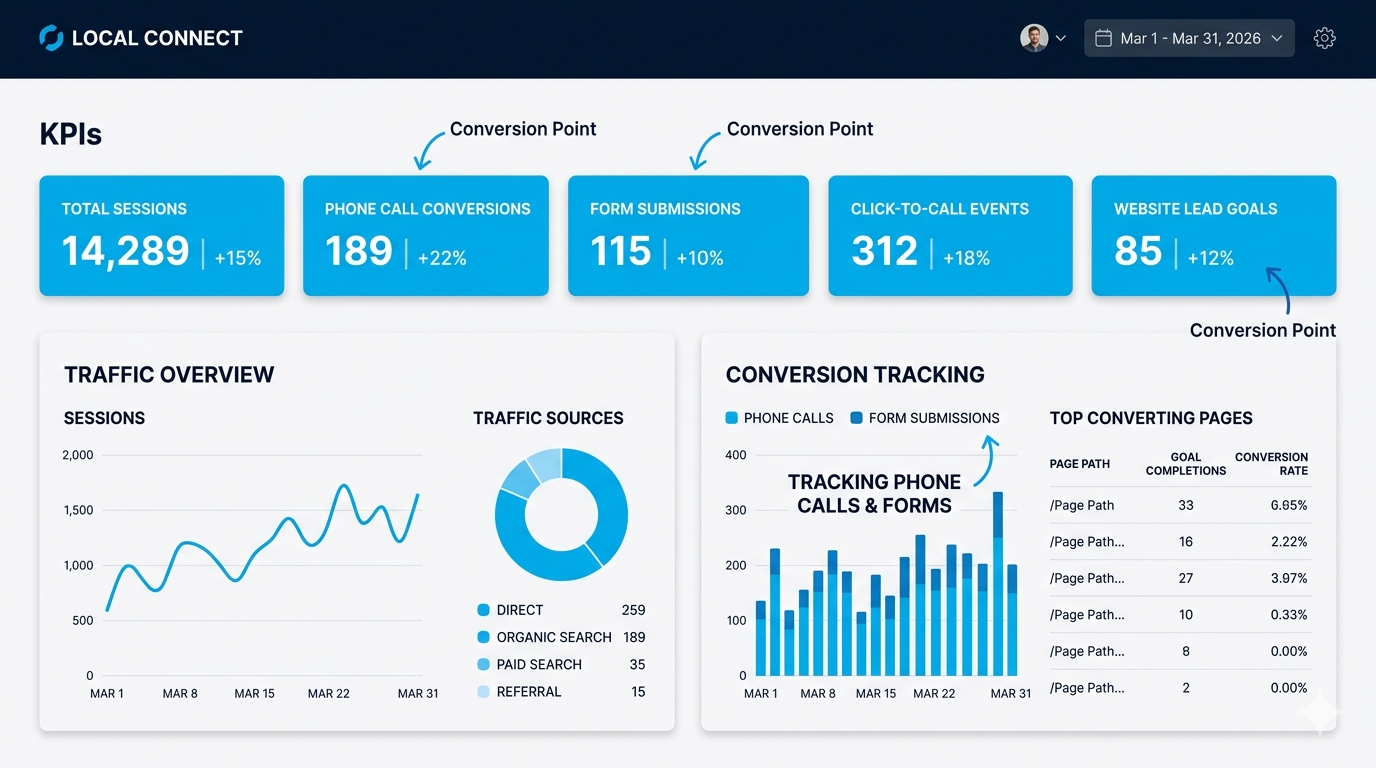
- Call tracking is the primary conversion metric: For most local businesses, phone calls are the main lead action. Without call tracking in place (a service that assigns unique phone numbers per traffic source), you cannot prove that the website generated a single call. Set up call tracking before launch. This data is also the foundation for any ongoing optimization recommendations you’ll make.
- Google Analytics 4 configuration for local sites: Configure event tracking for form submissions, click-to-call link clicks, map/directions clicks, and any booking tool interactions. These are the micro-conversion signals that predict call and visit intent. And they’re what let you diagnose conversion problems at the page level rather than the session level.
- Google Search Console for local keyword performance: Once the site is indexed, Search Console shows which local queries are driving impressions and clicks, broken down by page. This is the data source for identifying which service and location pages are getting traction and which need stronger content, better optimization, or stronger CTAs. Review it monthly as part of the client’s ongoing reporting.
- Establish a baseline before the new site launches: Capture current call volume, form submissions, and organic local traffic before the redesign goes live. Without a before/after comparison, it’s impossible to demonstrate the impact of the new site on the client.
Conclusion
A high-converting local business website is an outcome project rather than a design one. Everything in this guide is in service of one goal: connecting the right local searcher with the right business action.
The agencies that consistently deliver this don’t treat web builds as one-time deliverables. They treat them as the entry point to an ongoing service relationship: the site drives calls, the data shows what’s working, and that data creates a natural expansion into ongoing local SEO, listing management, and reputation services. That’s how a $3,000 web project becomes a $1,500/month retainer client.
For agencies looking to build that ongoing service offering alongside website delivery, Synup helps you turn one-time projects into recurring revenue by bundling listings, reviews, SEO, and social into a fully white-labeled growth platform.
FAQs
- What makes a local business website high-converting?
A high-converting site is built around action. It quickly builds trust and makes it easy for visitors to call, book, or visit without friction.
- Why are location pages important for SEO?
They help businesses rank for specific city-based searches and capture high-intent local traffic.
- Is SEO or design more important for local websites?
Neither works alone. SEO brings visitors, but design and UX convert them. You need both aligned.