Automated Local SEO: Tools, Workflows & What to Automate in 2026
Discover which local SEO tasks to automate in 2026, the best tools for each workflow, and where human oversight still wins.
Local SEO has always been operationally heavy. In 2026, that complexity has multiplied, and manual management no longer scales.
A business with just 10 locations can have 600+ listing touchpoints across directories, maps, and data aggregators. Keeping that information accurate manually is not realistic.
At that scale, manual updates don’t simply slow teams down; they break completely. Automation becomes the only reliable way to maintain accuracy.
Your business data no longer lives only on Google. It feeds into ChatGPT, Microsoft Copilot, Bing, Apple Maps, and voice assistants. If your information is inconsistent in one place, it's inconsistent everywhere, including AI-generated answers.
This is no longer a local pack problem. It's a data accuracy problem across the entire search ecosystem, and that's where local SEO automation becomes critical.
This guide breaks down exactly what to automate, what to keep human, and which tools are best for each job.
TL;DR
- Data from multiple directories now feed into ChatGPT, Copilot, Apple Maps, and voice assistants.
- Local SEO automation falls into three layers: fully automate, semi-automate (AI-assisted), and keep human.
- Listing sync, rank tracking, review monitoring, and scheduled reporting are safe to fully automate.
- Review response drafting and GBP Q&A work best as semi-automated; AI drafts, human approves before publishing.
- Strategy decisions, sensitive reviews, and GBP category selection must stay human.
Why Local SEO Automation Matters More in 2026
The urgency around local SEO automation is not new. What has changed is the scale and the cost of getting it wrong.
Local search is no longer confined to Google. Your business data now feeds multiple platforms simultaneously: Google Maps, ChatGPT, Bing Copilot, Apple Maps, Yelp, and voice assistants. Each platform pulls from different sources, often at different intervals.
This creates a distribution problem. A single update (new hours, a changed phone number, or a new location) needs to be reflected everywhere at once.
Manual workflows cannot keep up with that level of distribution.
The result is inconsistency at scale. One platform shows updated hours, another shows outdated information, and AI systems reproduce those inconsistencies in responses to users.
Automation solves this by creating a single source of truth and pushing updates across every connected platform in one action. Without that, maintaining accuracy becomes a constant, error-prone task, especially for multi-location businesses.
The Local SEO Automation Matrix: What to Automate, What to Semi-Automate, and What to Keep Human
Before picking tools, you need a decision framework. Not everything in local SEO benefits from automation. In fact, over-automation is one of the fastest ways to damage performance.
Here’s how you can decide:
- Fully Automate: Include structured, repetitive, and rule-based tasks. These processes don’t benefit from human creativity. They benefit from consistency and speed.
- Semi-Automate (AI-Assisted + Human Review): Include tasks that benefit from AI but still require oversight. The workflow here is simple: AI generates, then humans review and publish. This preserves efficiency while avoiding tone-deaf or generic outputs.
- Keep Human: Include tasks that require judgment, context, or strategic thinking. These decisions depend on nuances such as community context, brand voice, and business goals, which automation can’t reliably replicate.

Automating Listing Management and Citation Sync
Accurate business data is the foundation of local SEO. Name, Address, and Phone number (NAP) consistency isn’t just a ranking factor anymore. It’s now a data integrity requirement for AI visibility.
Yelp, Foursquare, and similar aggregators help shape the business data that can appear in AI-generated recommendations and assistant responses. If those sources are stale or inconsistent, the model may confidently repeat the wrong information.
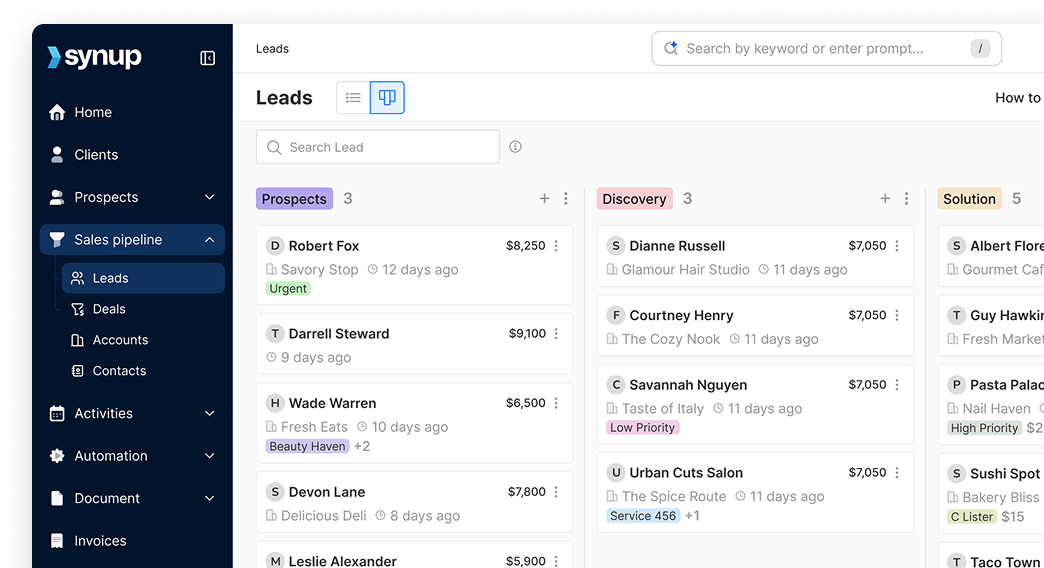
Listing management automation using tools like Synup and Yext ensures your business data stays consistent across every platform. Instead of manually updating each listing when hours change or a new service is added, a single update pushes changes across the network. Without this, even small updates (like a change in hours or location) quickly become inconsistent across directories and AI platforms.
What a Strong Listing Automation Tool Actually Handles
When you update business hours in a listing management platform, that change propagates to every connected directory in one push.
With tools like Synup Listing Management, you can simply update the central dashboard once and sync everywhere. That means there’s no longer a requirement for individual logins or manual checks of which platforms have pulled the update. For agencies managing multi-location clients, bulk edits apply across all locations simultaneously.
Citation auditing automation runs continuously in the background. Scheduled scans detect inconsistencies, duplicate listings, and missing citations before they compound into ranking problems. Most platforms flag these automatically and, in many cases, trigger one-click correction workflows.
What used to take days of manual updates now takes minutes to complete.
Mini-Workflow: Citation Sync Automation
The workflow typically runs whenever a business updates critical information, such as changing operating hours, opening a new location, or updating service offerings.
Here’s how a typical citation sync runs from trigger to output:
- Trigger: Business hours updated.
- Automated action: Platform pushes update to 70+ directories simultaneously.
- Human checkpoint: Monthly audit of key listings.
- Output: Accurate, consistent data across Google, Yelp, Apple Maps, and AI platforms.
Platforms Worth Knowing
Platforms in this category are broadly similar in purpose but differ in execution. Synup, Yext, Moz Local, and BrightLocal all help manage listings, but the key differences are network breadth and update mechanics.
- Synup’s listing management tool is API-based and auto-syncs listings across 70+ directories.
- Yext has 200+ direct API connections to publishers, and updates go live instantly, which helps rankings in both traditional search engines and AI answers.
- BrightLocal’s Citation Tracker is more audit-focused: it finds incorrect NAP data, duplicate listings, and gaps where competitors are listed but you are not.
- Moz Local’s auto-sync feature automatically sends location changes to partner directories.
Automating Review Management and Response
Reviews are both a ranking signal and a brand touchpoint. Managing them manually across platforms doesn’t scale, especially for multi-location businesses. Automation helps with scale, but this is also where over-automation can quickly become a risk.
What to Automate
- Review monitoring across Google, Yelp, Facebook, TripAdvisor, and industry-specific platforms.
- New review alerts with automated sentiment scoring. So you catch one-star reviews immediately, not after a week.
- Review request campaigns triggered by CRM events.
- Review performance reporting: volume trends, average rating by location, response rate, sentiment over time.
What to Semi-Automate
Review response drafting is the strongest use case for semi-automation in local SEO. The AI reads the review text, the rating, and the business context. Then it generates a personalized response, but a human must approve it.
What to Keep Human
Any review involving a specific complaint, potential legal exposure, or emotionally charged language must go to a real person.
A generic AI response to a serious complaint rarely resolves the issue. It often signals to the customer that no one is actually paying attention.
A Practical Workflow: Review Response
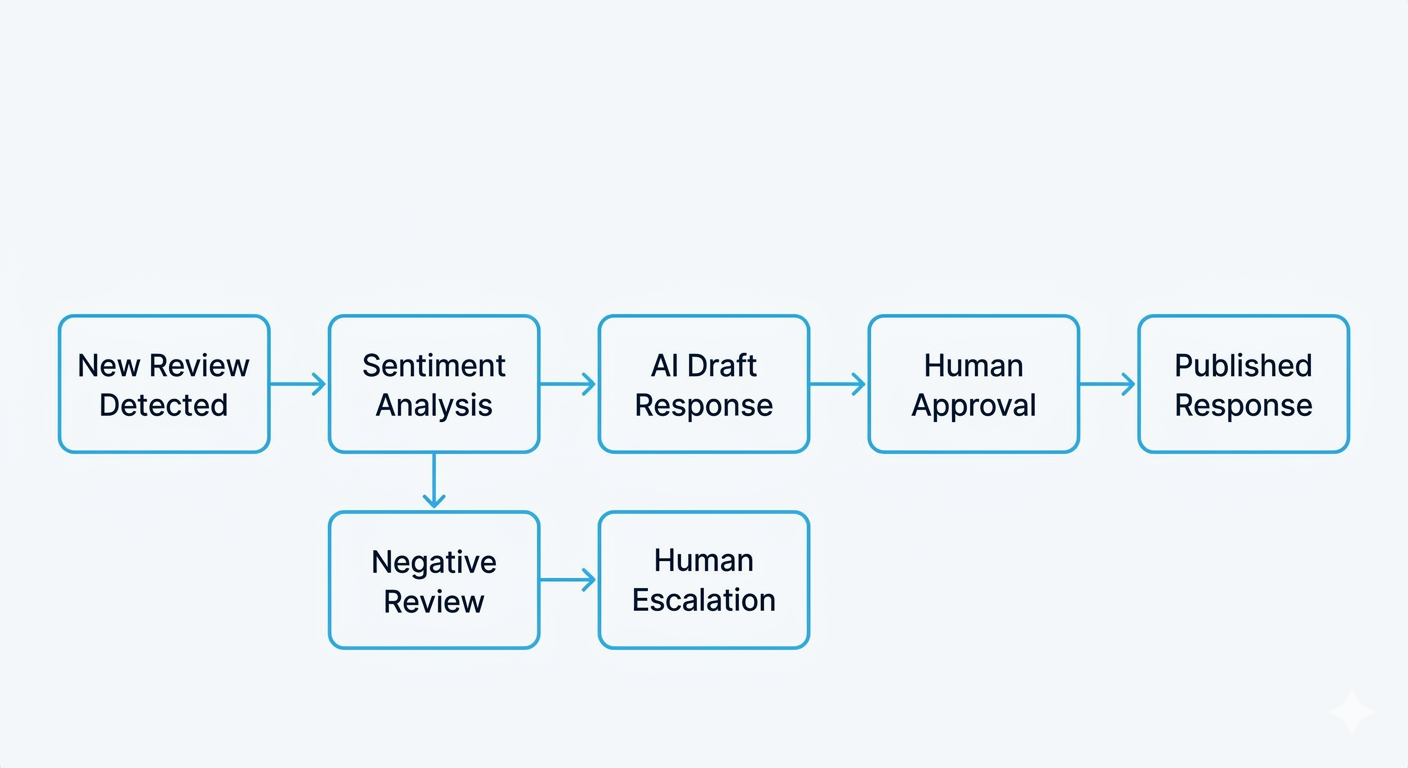
- Trigger: New review received (Google, Yelp, Facebook, etc.).
- Automated action: Sentiment detected (positive/neutral/negative) and draft response generated.
- Human checkpoint: Manager reviews draft, edits, or approves in one click.
- Output: Personalized response published within 24 hours of the original review
- If negative: Escalated to priority human queue with review summary; AI draft available, but publish requires explicit human approval.
Review velocity is an underrated ranking factor. It is not just the total review count that signals authority to Google’s local algorithm. It is the consistency of new reviews arriving over time.
Automating the review request process, tied to CRM triggers rather than manual outreach, is what keeps that flow steady without your team manually chasing every customer.
Synup’s reputation management software handles multi-platform monitoring, AI response drafting, sentiment analysis, and review request campaigns in one workflow.
Automating GBP Management and Local Content Scheduling
Google Business Profile sits at the center of your local search strategy and is one of the most time-consuming profiles to keep active.
For agencies managing a lot of client profiles, manual GBP management is not sustainable. GBP automation tools remove the repetition without removing the judgment.
What to Automate on GBP
GBP post-scheduling is the most immediate win. You can draft a quarterly content calendar in advance, scheduled through GBP post-scheduling tools to auto-publish on a cadence:
- Seasonal promotions
- Recurring service offers
- Event announcements
- Operational updates
One person can schedule a month of posts for dozens of GBP profiles in a single session, rather than logging in manually each week.
You can also automate photo and media uploads on a schedule. For multi-location businesses, this ensures location-specific imagery stays current without manual uploads at the individual location level. That’s an easy task to overlook, and one with real impact on profile completeness scores.
GBP Q&A monitoring works well as semi-automation. When a customer posts a question, an alert fires. For recurring questions about hours, parking, service area, or accessibility, an AI draft is generated, and a human reviews it before posting. You can cover most routine FAQs within hours rather than days.
What Still Needs Human Hands on GBP
GBP category selection is the highest-leverage, most consequential optimization decision on the profile. And it requires local market knowledge to get right.
Picking the wrong primary category can suppress rankings for your most important search terms. This is a strategic call, not a data-entry task.
Attribute updates for niche service offerings, local area descriptions, and any profile copy requiring genuine community context should stay human.
These elements carry too much local nuance to be predefined in an automation rule.
The Suspension Risk is Real
Automated bulk edits on GBP (particularly for newly verified profiles or profiles with a recent history of edits) can trigger Google’s spam detection.
Best practices include working from verified accounts with a clean history, spacing out bulk changes, avoiding automating category or ownership field updates, and using a platform with built-in safeguards.
The top local listing management platforms handle this carefully with built-in safeguards. This is worth confirming before you scale.
Automating Rank Tracking and Reporting
Rank tracking is one of the easiest workflows to automate and one of the most commonly ignored after setup. The goal is to run it correctly so the data is actually actionable.
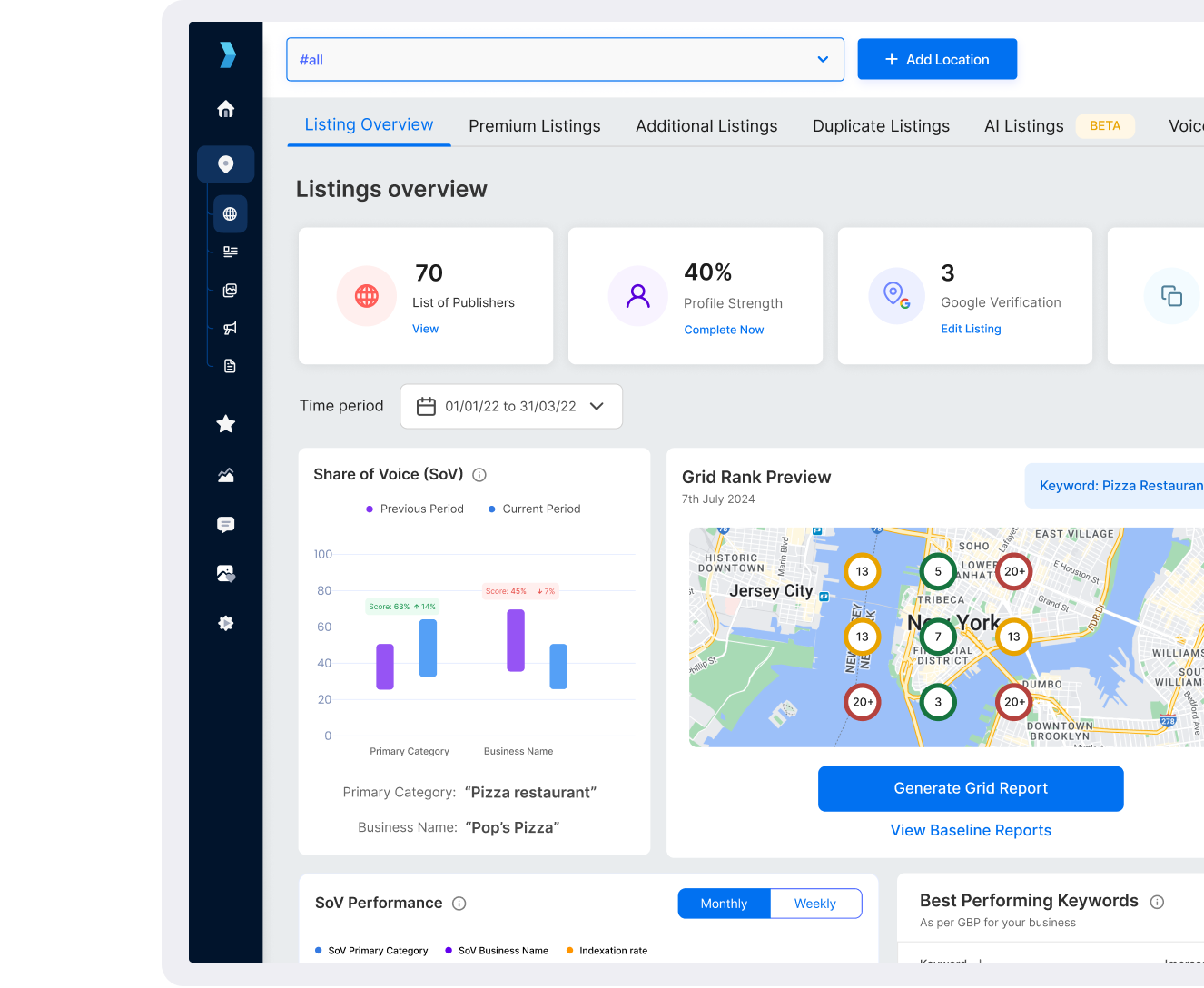
Rank tracking automation removes the need for manual querying. Geogrid scans give you something city-level rank data cannot: local pack visibility block by block.
A restaurant might rank first within two blocks of its front door and fall to sixth a mile away. For multi-location clients, automated geogrid scans run weekly or biweekly and surface exactly where each location’s footprint sits across its surrounding area, without a single manual search.
Automated performance dashboards also take the reporting assembly burden off your team entirely.
Connecting Google Search Console, Analytics, and rank tracking data into a Google Data Studio dashboard that refreshes on a schedule means clients and internal stakeholders can check performance at any time. That means:
- No monthly CSV exports.
- No reformatting data across various tools.
- No chasing numbers the morning of a client call.
White-label reporting is especially useful for agencies, reducing time spent on manual report creation. Scheduled reports (branded, formatted, covering the metrics clients actually care about) go out automatically. That is hours of production work per client per month, recovered and reinvested.
Rank tracking tools worth considering:
- Synup’s online local search rank tracking API with grid rank tracker, insights into top movers, ranking distribution, and bulk keyword tracking.
- BrightLocal for agency reporting with strong white-label features.
- Local Falcon for geogrid visualization designed to show clients why block-by-block matters.
- Semrush Local for integrating rank tracking with GBP management if you are already in the Semrush ecosystem.
One principle to keep front of mind: automation surfaces the data, but humans still need to interpret it. A sudden ranking drop requires a diagnosis. A month-over-month improvement does not explain itself or guarantee it continues. Build time into your workflow to actually read the reports, not just deliver them.
Building Your Local SEO Automation Stack: Tool Recommendations by Use Case
The right way to build a local SEO tools stack is not to pick the highest-rated tool from a comparison site and fit your workflow around it. It starts with identifying each job you need done and finding the best tool for that specific job.
For Listing and Citation Sync
Synup, Yext, Moz Local, and BrightLocal are the primary options. The distinction that matters most is how they push updates.
- Yext uses a direct publisher API network. That gives it fast sync, but per-location pricing compounds at scale.
- Synup connects to 70+ publishers with real-time API syncing, adds AI listing optimisation for voice and AI search, and includes bulk management features built for agency workflows.
- Moz Local routes through major aggregators. It gives you slower propagation but a more affordable entry point for SMBs managing a small number of locations.
- BrightLocal is strongest on citation auditing and monitoring.
You can compare the top local SEO platforms side by side on network breadth, automation depth, and pricing structure. This is worth doing before committing at scale.
For Review Management
For managing reviews at scale, options include Synup, Birdeye, and Podium.
The difference here is product philosophy. Birdeye and Podium are review-first platforms. They focus heavily on generating, managing, and responding to customer feedback, often tied closely to messaging and CRM workflows. Synup, by contrast, approaches reviews as part of a broader local SEO system, bundling them with listings and analytics.
If reviews are your primary growth lever, a review-first platform may be more suitable. If you want consolidation, an all-in-one tool can reduce fragmentation.
For Rank Tracking & Geogrid
Tracking local rankings accurately requires more than a single average position. Tools like Synup, BrightLocal, Local Falcon, and Semrush offer geogrid tracking.
A geogrid maps rankings across multiple points in a city (often visualized as a grid of search positions) rather than reporting one number for the entire area. This matters because local rankings vary significantly by proximity. A business might rank #1 in one neighborhood and #8 a few blocks away.
That granularity is essential for diagnosing real visibility.
For Reporting
Google Data Studio (free) is the most flexible option for custom dashboards.
BrightLocal’s white-label reports are purpose-built for agency client delivery.
However, integrated platforms like Synup bundle listing, review, and rank data into one reporting environment. This reduces the reconciliation work that multi-tool stacks create.
Understanding which SEO services agencies can automate most profitably starts with looking at where automation reduces human hours per deliverable. The stack that recovers the most billable time from production work is the one worth building.
For Agencies
For agencies specifically, the strongest argument for an integrated platform over a stack of point solutions is total cost, login consolidation, and cross-feature data visibility. Managing listing, review, and rank data in separate tools means reconciling them manually for every client report. That’s an invisible time sink that compounds across every client, every month.
Common Automation Mistakes (and How to Avoid Them)
The biggest risk in local SEO automation is not over-automation; it’s automation without accountability. Here are the common mistakes to avoid:
- Setting and forgetting it:
This is the most common mistake across all categories. Automated review responses tend to sound generic if no one audits them over time. Listing data gets out of sync when business details change, and no one checks whether the platform pushed updates correctly. Rank dashboards go unread because “the automation is handling it.” Every automated workflow needs a scheduled human checkpoint (even quarterly) to catch problems before they compound into months of bad data.
- Over-automating review responses:
Publishing AI-generated responses to complex or emotionally charged reviews without human approval is a brand liability. Customers detect templated responses. A canned reply to a specific complaint does not resolve the issue. It signals that no one read the review. For any review that involves a real complaint, charged language, or a factual dispute, a human needs to write or meaningfully edit the response before it goes live.
- GBP automation without verification:
Bulk automated edits on newly verified profiles or profiles with a history of recent edits are a fast path to a suspension. Google’s spam detection flags patterns that look like mass manipulation. The safeguards: work from verified accounts with a clean history, space out bulk changes, never automate category or ownership field updates, and use a platform with these guardrails already built in.
- Treating automation as a strategy:
This is the most costly misconception. Automation handles execution. It cannot decide which locations deserve more investment, which search terms to target, or whether your review response policy is actually working. Teams that automate without a clear underlying strategy do not get better results. They get the wrong results faster and at a greater scale.
- Missing the human checkpoint:
Every automated workflow should have a scheduled point where a human reviews a sample of outputs. Catching a pattern of robotic-sounding review responses in week two is a quick fix. Catching it after six months of automated publishing is a reputation cleanup.
Conclusion
Automation works best when it targets the right tasks, runs through the right tools, and has genuine human oversight built into the workflow.
The businesses and agencies winning in local SEO automation in 2026 are not grinding through listing updates manually. They are not handing everything to automation and stepping away, either. They map their workflows clearly: automate what is mechanical, apply AI assistance where judgment accelerates quality, and stay hands-on where context and strategy are non-negotiable.
If you want to see how an integrated platform handles listings, reviews, and rank tracking in a single automated local SEO workflow, Synup shows you that in a free demo. See how the different layers interact before you start building a stack from scratch.
Frequently Asked Questions
- What is the best local SEO automation tool for agencies?
It depends on priorities. Synup and Yext are the most comprehensive options for a fully integrated stack covering listings, reviews, and reporting. For geogrid rank tracking, Local Falcon and BrightLocal are the leading dedicated tools. For agencies, the most important criterion is usually whether the platform scales across client locations without per-location fees.
- Can you automate Google Business Profile management?
Certain GBP tasks can be automated safely and effectively. These include post scheduling, calendar-based photo uploads, Q&A monitoring with AI-drafted responses, and performance data pulls.
- Which local SEO tasks should never be automated?
Strategy decisions, responses to complex or emotionally charged reviews, content requiring genuine community knowledge, and GBP category optimization. These tasks depend on context that cannot be fully predefined in an automation rule.