Your Guide to Building an Agency Brand That Attracts Inbound Leads
Learn how to position your agency, build authority, and capture demand with SEO, content, and differentiation strategies that consistently drive inbound leads.
OK, so you just spent months refining your agency’s services, polishing your website, and crafting messaging that clearly explains what you do. Your portfolio looks strong, your case studies are live, and your sales deck is ready to go.
You sit back and wait for the discovery calls to roll in... but nothing happens. No inbound leads. No steady pipeline. Just the occasional referral and a lot of outbound effort.
Too many agencies fall into the trap of thinking that great services alone are enough to stand out in an increasingly crowded market.
They’re not.
You need a brand that actively attracts attention and turns that attention into demand.
On any given day, thousands of businesses are searching for agencies to help them grow. Unfortunately, it’s difficult to capture that demand unless your positioning is clear and your authority is visible before the first conversation even begins.
So how do you build a brand that actually attracts inbound leads?
That’s exactly what we’ll show you in this guide, covering positioning and differentiation, thought leadership, content ecosystems, and demand capture.
TL;DR
- Brand drives preference before price.
- Define a clear ICP and sharpen your positioning.
- Specialize so your agency is known for something specific.
- Build authority through content.
- Capture existing demand first before investing in awareness.
- Show proof everywhere and track the quality of inbound leads through an agency OS.
What Makes a Brand an Inbound Lead Magnet
Before you can start attracting inbound leads consistently, you need clarity on the core elements shaping how prospects evaluate your agency.
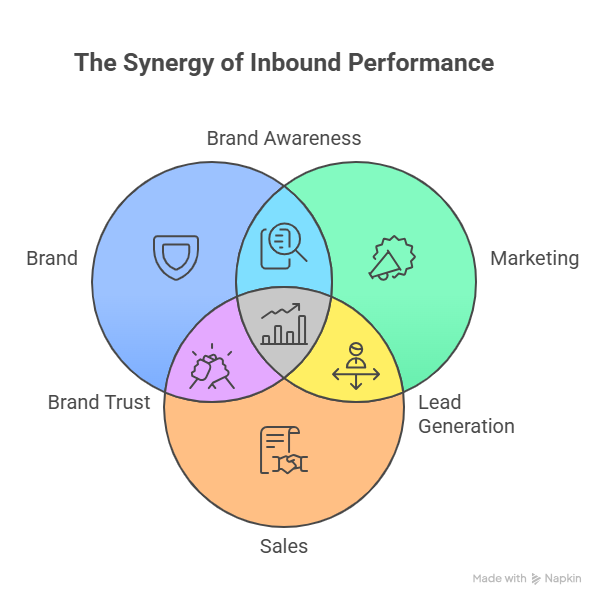
In practice, inbound performance sits at the intersection of three connected components: brand, marketing, and sales.
- Brand is the perception prospects hold about your agency: your positioning, credibility, specialization, and reputation.
- Marketing is the set of tactics used to shape that perception, including content, SEO, social media, advertising, and events.
- Sales is the process that converts that perception into revenue through discovery, proposals, and closing conversations.
When these three functions are aligned, your brand begins to pre-sell your value. When they’re disconnected, your team spends more time explaining and defending pricing.
The Signals That Influence Trust and Preference
Because buyers often research multiple agencies before ever reaching out, they look for patterns that reduce uncertainty and validate expertise.
One of the strongest signals is authority and credibility.
When prospects come across educational content, measurable case studies, or industry insights before a sales conversation, the relationship shifts from vendor evaluation to expert consideration. Long-form content, research-backed insights, industry recognition, speaking engagements, testimonials, and recognizable client logos all reinforce this authority.
Another major factor is differentiation.
In crowded markets, being “full-service” or “results-driven” is rarely enough. Agencies that attract inbound demand are typically known for something specific: an industry niche, a defined outcome, or a proprietary methodology. Clear specialization makes it easier for prospects to self-qualify and recognize fit.
Equally important is clarity of messaging.
Prospects should immediately understand:
- Who you serve
- What problem you solve
- What outcome you deliver
Positioning statements (visible on homepage within 3 seconds of landing), outcome-driven value propositions, and clearly defined ideal client profiles (ICP) help remove friction during early evaluation.
Finally, inbound brands rely on consistency across channels.
Every touchpoint (website content, social messaging, case studies, and sales materials) should reinforce the same positioning and expertise. Visual and verbal brand identity should also be applied uniformly.
Inconsistent messaging weakens trust, while aligned messaging accelerates it.
Research across B2B buying behavior, like that by Forrester, consistently shows that at least two-thirds of prospects would pay more for a brand they trust. Strong brand perception doesn’t just increase lead volume. It improves lead quality and shortens sales cycles.
Also Read: Store And Manage Your Agency’s Client Data Effectively with Synup OS
Defining Your Agency’s Brand Foundation
Before investing in content, SEO, or campaigns, you need a clear strategic foundation that defines what your agency stands for and who it serves. Without this structure, marketing efforts often become inconsistent, positioning becomes vague, and inbound leads remain unpredictable.
Mission, Vision & Values
You’ve probably seen this before. An agency launches a new website, publishes blog content, posts regularly on social, and still struggles to attract qualified prospects. In most cases, the issue isn’t execution; it’s positioning.
The first step is defining your mission, vision, and values.
- Mission: Your mission explains why your agency exists beyond revenue.
- Vision: Your vision defines where your agency is going over the next 5–10 years.
- Values: Your values guide how you make decisions, select clients, and build culture.
For example:
- Mission: Helping B2B SaaS companies scale from $1M to $10M ARR through predictable, data-driven growth systems
- Vision: Become the go-to growth partner for Series A SaaS companies
- Values: Transparency, data-driven decisions, long-term partnerships over quick wins
These aren’t just branding statements. They act as filters that help your agency attract aligned clients and avoid poor-fit engagements.
Also Read: Find the Ideal Marketing Agency Structure: 7-Step Guide & Best Practices
Target Audience and ICP Clarity
Once your foundation is defined, the next step is identifying exactly who your agency is built to serve.
Inbound marketing becomes significantly more effective when your messaging speaks directly to a specific audience instead of trying to appeal to everyone.
Start by defining your Ideal Client Profile (ICP) using five core dimensions stored with custom fields:
- Industry: Which verticals do you serve best (SaaS, healthcare, fintech, e-commerce)?
- Company size: Revenue range or growth stage (startup, mid-market, enterprise)?
- Buyer role: Who makes the decision (CMO, VP Marketing, Founder)?
- Pain points: What measurable problems are they trying to solve?
- Buying triggers: What events prompt agency evaluation (funding rounds, leadership changes, stalled growth)?
The tighter your ICP, the clearer your positioning becomes. “We help B2B companies grow” is generic. “We help Series A SaaS companies scale from $1M to $10M ARR in 18 months” is specific, and specificity attracts inbound demand.
Positioning Statement and Value Proposition
With ICP clarity in place, the next step is translating that focus into a clear positioning statement.
A simple and effective structure is:
We help [target audience] achieve [specific outcome] through [unique approach].
For example:
- We help healthcare SaaS companies generate an enterprise pipeline through account-based marketing programs that convert at 3× industry averages.
- We help DTC brands scale profitably on Meta and TikTok through data-driven creative testing systems that reduce CAC by 40%.
Strong positioning becomes even more effective when paired with proof.
Your value proposition should combine positioning with measurable results:
- Our clients see an average 3:1 ROI within 90 days
- We’ve generated $50M+ in pipeline for B2B technology companies
When your ICP, positioning, and proof are aligned, your brand becomes easier to understand and significantly easier to trust.
Also Read: Client Data Management Systems: A Practical Agency Guide
Differentiation: The Core of Inbound Attraction
Remember when we discussed how inbound brands rely on clear positioning and strong perception signals?
This is where differentiation becomes critical.
In crowded agency markets, simply offering multiple services isn’t enough to stand out. In fact, positioning your agency as “full-service” often makes it harder for prospects to understand what you’re actually known for.
Most buyers aren’t looking for agencies that do everything. They’re looking for agencies that solve their specific problem. Clear differentiation helps prospects recognize that fit faster.
Agencies that consistently attract inbound leads are typically associated with one identifiable strength: an industry focus, a specialized capability, a measurable outcome, or a proprietary methodology.
There are four common ways agencies build that differentiation.
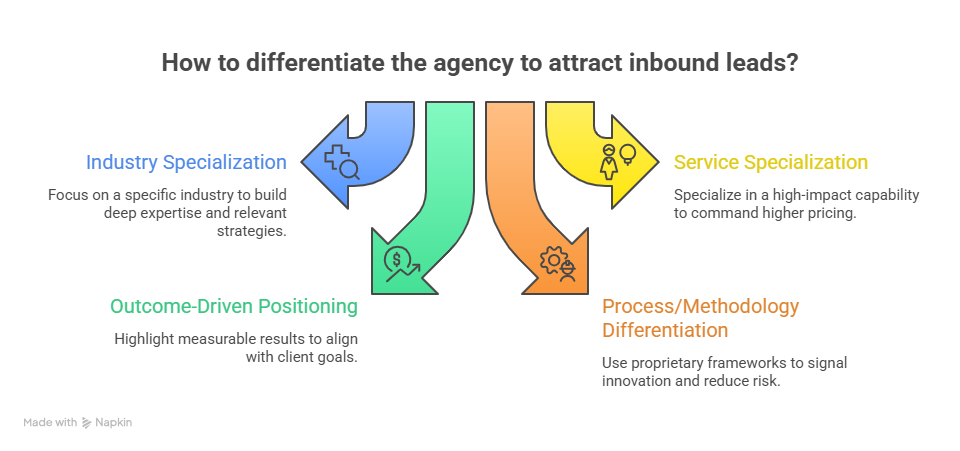
- Industry / Vertical Specialization
Many agencies choose to focus on a single industry and build deep expertise within that space.
Examples include:
- Healthcare SaaS growth agencies
- E-commerce retention marketing agencies
Specializing in a vertical allows agencies to develop stronger market insights, faster onboarding processes, and more relevant strategies based on repeated patterns across similar clients.
- Service Specialization
Another approach is specializing in a single high-impact capability.
Examples include:
- Account-based marketing (ABM) for enterprise sales
- Conversion rate optimization (CRO) for SaaS companies
Service specialists often command higher pricing because they position themselves around mastery rather than breadth.
- Outcome-Driven Positioning
Instead of positioning around services, some agencies differentiate based on measurable results.
For example:
“We help SaaS companies generate $1M+ in pipeline per quarter” instead of “We provide SEO and paid media services.”
Outcome-driven positioning aligns messaging with what clients ultimately care about: business results.
- Process / Methodology Differentiation
Some agencies build differentiation through proprietary frameworks or delivery systems.
For example:
- Growth Sprints: 90-day iterative campaigns designed to produce measurable ROI
Named methodologies help structure delivery, signal innovation, and reduce perceived risk for buyers.
Establishing Thought Leadership & Authority
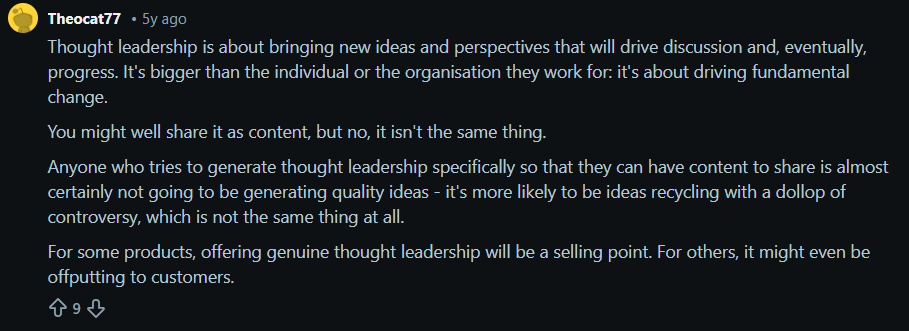
Some prospects don’t realize they need your agency until they encounter your insights. Thought leadership makes sure your expertise is consistently visible.
These insights usually appear as long-form blog posts, newsletters, webinars, or podcast conversations: formats your audience already consumes when researching solutions. The advantage of thought leadership content is that it communicates value early, clearly, and in a way that builds familiarity before any sales interaction happens.
Another bonus: educational content compounds over time.
When you publish high-value assets, such as in-depth articles, research-backed frameworks, or structured guides, search engines and distribution platforms expand your reach automatically. Long-form blog posts (1,500–3,000 words), recurring newsletters, and recorded webinars create reusable assets that can be repurposed across channels, from social posts to guest podcast topics, extending their lifecycle and visibility.
Pretty powerful, right?
Just think about it: A potential client is researching how to improve pipeline generation and comes across a detailed framework you published. They read the article, subscribe to your newsletter, and later hear you speaking on a webinar covering the same topic. By the time they visit your website, your expertise already feels familiar. And that recognition often becomes the first step toward an inbound lead.
Formats That Work for Agencies
Here’s how to set up this system:
- Blogs/Articles
Long-form content (1,500 to 3,000 words) targeting high-intent search queries and strategic topics.
Examples:
- “How to Build a $1M Pipeline with ABM (Step-by-Step Framework)”
- “Why Your Content Marketing Isn’t Generating Leads (And How to Fix It)”
Why it works: Blog content supports SEO visibility while demonstrating depth of expertise through structured education.
- Newsletters
Weekly or biweekly insights delivered to an owned audience.
Why it works: Email lists are owned distribution assets (unlike social followers), making newsletters one of the most reliable channels for both lead generation and retention.
- Speaking (Conferences, Webinars, Podcasts)
Live or recorded presentations position your agency as the expert in the room.
Speaking allows prospects to experience your expertise directly, accelerating trust and shortening evaluation cycles.
- Podcasts (Hosting or Guesting)
Long-form conversations that showcase perspective, frameworks, and experience.
Why it works: Podcast audiences are highly engaged, and repeated exposure strengthens familiarity and authority.
How to Convert Thought Content Into Leads
Here’s how you leverage this content:
- Cornerstone Content Strategy
Create 5–10 comprehensive “pillar” assets addressing your ICP’s biggest challenges.
Example: “The Complete Guide to B2B Lead Generation for SaaS Startups.”
These long-form resources improve search visibility while acting as central conversion assets.
- Syndication and Repurposing
One pillar article can be expanded into multiple distribution formats:
- 10 social posts
- 5 email newsletter segments
- 1 webinar topic
- 3 guest podcast talking points
Repurposing increases content lifespan while maintaining consistent messaging across channels.
- Author and Brand Authority Building
Publish consistently under both:
- Founder’s personal brand
- Agency brand channels
Platforms commonly include LinkedIn, Medium, and relevant industry publications.
Combining personal and company authority strengthens trust while improving long-term inbound visibility.
Content Ecosystem for Inbound Brand Growth
A content ecosystem helps you understand how prospects move through the buyer journey and gives them multiple reasons to return to your website.
Instead of relying on isolated blog posts or occasional campaigns, inbound-focused agencies build structured content across formats that guide prospects from education to evaluation. Each content type supports a different stage of decision-making while reinforcing your positioning and expertise.
Strategic Content Categories
To build a content strategy that drives both authority and revenue, your agency needs a balanced mix of content types.
- Educational Content
Educational content attracts early-stage prospects while positioning your agency as a subject-matter expert. “How-to” guides, frameworks, and strategic insights teach prospects how to solve specific problems.
Example: “How to Calculate Customer Acquisition Cost (CAC) for SaaS”
- Case Studies
Case studies combine social proof with performance validation, helping prospects see real-world results. They include detailed breakdowns of client strategies, metrics, and measurable outcomes.
Example: “How We Generated $2.3M in Pipeline for a Series A SaaS Company in 6 Months”
- Buying Guides
Content designed to help prospects evaluate agencies and compare options. It positions your evaluation criteria as the standard while supporting mid-funnel decision-making.
Examples:
- “What to Look for When Hiring a B2B Marketing Agency”
- “5 Questions to Ask Before Signing a Retainer”
- Product / Service Explainers
Clear breakdowns of your services, methodologies, and deliverables.
Why it works: Service-focused content removes ambiguity, sets expectations, and shortens sales cycles.
SEO’s Role in Inbound Attraction
Content ecosystems essentially help you exchange traffic for qualified leads.
But don’t overlook the importance of search structure and lead capture. According to Moz, SEO is the top inbound lead source.
You can organize content using topic clusters and pillar pages to build topical authority, map content to search intent (informational, commercial, transactional), and convert visitors using newsletter forms, gated resources, consultation bookings, and live chat engagement.
Topic Clusters and Pillar Pages:
Organize content around themes. Example:
- Pillar: “Complete Guide to B2B Lead Generation”
- Clusters: “Email lead gen,” “LinkedIn lead gen,” “Content lead gen,” “ABM lead gen”
Interlink cluster content to the pillar. This signals topical authority to Google.
Search Intent Mapping:
Match content to user intent:
- Informational: Blog post (e.g., “What is ABM?”)
- Navigational: Landing page (e.g., “[Your Agency Name] case studies”)
- Commercial: Comparison page (e.g., “Best ABM agencies”)
- Transactional: Service page with CTA (e.g., “Hire ABM agency”)
Lead Capture Mechanisms:
Driving inbound traffic is only half the system. Converting that traffic requires clear capture mechanisms.
Common high-performing conversion points include:
- Newsletter signup forms
- Gated resources (whitepapers, templates, calculators)
- Free consultation bookings
- Live chat for immediate engagement
Also Read: How to Grow Your Marketing Agency: 12 Actionable Tips
SEO and SERP Real Estate for Agencies
In the game of inbound marketing, showing up on Google isn’t optional; it’s the whole point.
Think about it: when a decision-maker needs an agency, the first thing they do is search. “B2B marketing agency,” “SEO agency for healthcare,” “Hire ABM consultant”. These aren’t casual searches; they’re buying signals. And if your agency isn’t showing up for them, someone else is getting that lead.
The good news? Owning SERP real estate is more achievable than most agency owners think.
Ranking for High-Intent Keywords
Start by targeting high-intent keywords, searches like “[service] agency,” “[industry] marketing,” or “hire [service] consultant.” These queries tell you exactly where a prospect is in their buying journey. They’re not browsing. They’re evaluating.
When researching these keywords, use tools like Ahrefs or SEMrush and filter for commercial and transactional intent. The sweet spot is typically 100–1,000 monthly searches – competitive enough to matter, achievable enough to win.
Local and Niche Search Opportunities
If you serve local markets, don’t sleep on geographic modifiers either. Searches like “marketing agency Chicago” or “SEO agency for healthcare New York City” often have lower competition and higher purchase intent than broad national terms. Tactics that work well here:
- Location-specific landing pages targeting “[service] agency [city]”
- Local citations with consistent NAP (name, address, phone) across directories
- Local backlinks through event sponsorships or chamber of commerce memberships
Optimizing Google Business Profile
And then there’s your Google Business Profile.
A complete, actively maintained GBP, with weekly posts, updated photos, answered Q&As, and a steady stream of reviews, can dramatically improve your local visibility. It’s one of the most underutilized tools in an agency’s inbound stack.
Worth noting: 46% of all Google searches have local intent, and your GBP determines whether you appear in the local 3-pack, arguably the most valuable SERP real estate for agencies serving regional markets.
Reviews & Reputation Signals
Speaking of reviews: Over 98% of consumers factor them into decisions before ever reaching out. That means your Google, Clutch, and G2 profiles are more than just credibility signals; they’re active parts of your lead generation system. Treat them that way.
Ask satisfied clients for a review right after delivering strong results, make it easy with a direct link, and follow up once if needed.
Schema Markup for Agencies
One more lever worth pulling: schema markup. Adding LocalBusiness, Review, and Service schema to your site helps Google display rich results (star ratings, FAQ listings, service callouts) directly in search. Rich results can increase click-through rates by 30–40% according to studies, which means more of the people already finding you actually visit your site.
Also Read: Top SEO Workflows You Can Automate with AI
Social Proof & Reputation as Lead Magnets
Social proof isn’t something you add to your website as an afterthought. It’s one of the most powerful conversion tools you have, and most agencies dramatically underuse it.
During lead capture, your proof should be impossible to miss:
- Client logos on your homepage (use a slider to show 12–20 clients at once)
- Testimonial widgets on landing pages and service pages
- Case study CTAs embedded inside blog content
- Video testimonials in sales decks and proposals
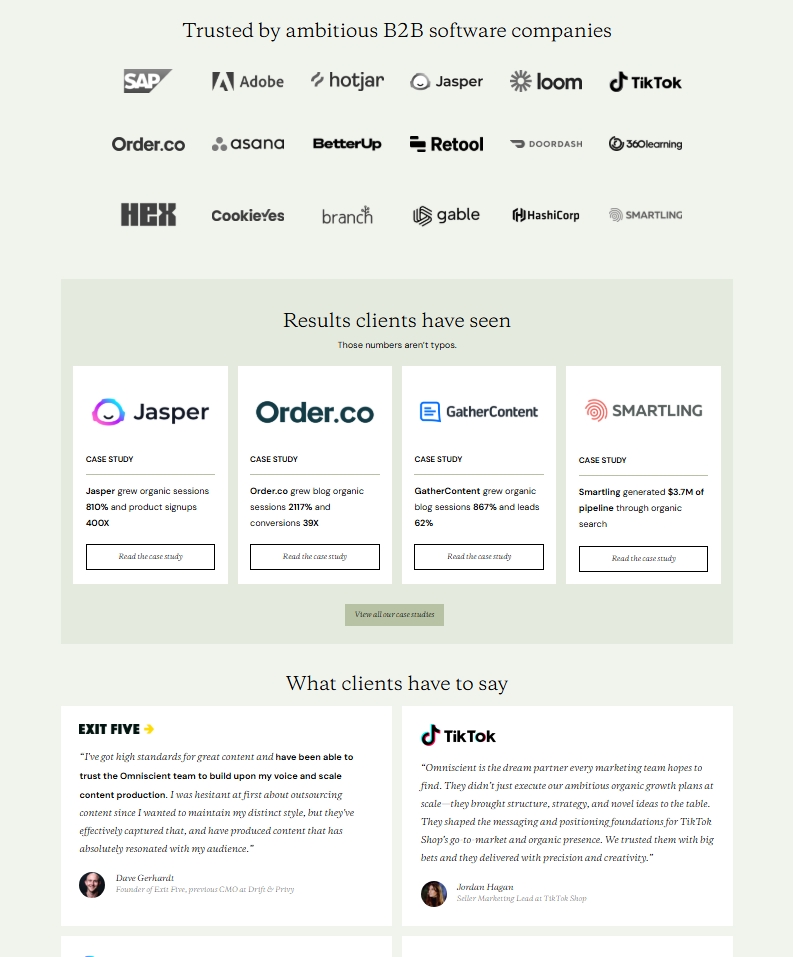
With testimonials, structure matters. The most effective ones follow a simple arc: the problem the client had before working with you, what you did about it, and the measurable result on the other side. Vague praise doesn’t convert. Specific outcomes do. “CAC reduced by 47%” will always outperform “they really understood our business.”
Don’t overlook awards and media mentions either. Third-party recognition from organizations like Inc. 5000, Clutch Top Agencies, or industry publications adds a layer of validation that no homepage copy can replicate.
Beyond your own website, third-party platforms do something your homepage can’t: they provide unbiased validation. Clutch, G2, Google, and Trustpilot all signal to prospects that your results are real, verified, and consistent. If you’re not actively building your presence on these platforms, you’re leaving trust on the table.
Also Read: How to Check Online Reputation for Your Clients
Demand Capture vs. Demand Generation
There’s a meaningful difference between demand capture and demand generation, and understanding it changes how you prioritize your content investment.
Demand Capture: Converting prospects already looking for what you offer:
- Bottom-of-funnel keywords (“hire ABM agency”), service pages, case studies
- Delivers faster ROI; prospects are ready to buy now
- Best for early-stage agencies that need revenue quickly
Demand Generation: Creating awareness where none existed:
- Thought leadership, educational content, podcasts, newsletters
- Longer timeline (6–12 months to see momentum)
- Builds the brand equity that makes capture easier over time
Which should you prioritize? Early-stage agencies are better served by focusing 70% on capture and 30% on generation. More established agencies can afford to shift that balance toward generation, building the brand moat that makes everything downstream more efficient.
The real power comes from aligning both to the buyer journey:
At the awareness stage, educational blogs and strategic guides attract prospects who are just starting to explore their problem. At the consideration stage, comparison content and case studies help them evaluate options, including you. At the decision stage, service pages, transparent pricing, and frictionless booking CTAs convert that consideration into a conversation.
Miss any stage, and you’ve got gaps. Cover all three, and your content ecosystem starts working like a system, not a series of disconnected posts.
Referral Systems & Community Influence
Want to know the highest-quality inbound lead you can get? One that arrives already trusting you.
Referrals are inbound accelerators for a reason. They’re pre-qualified, high-trust, and move through your sales cycle significantly faster than cold inbound leads. Research from the Wharton School backs this up: referred customers have a 37% higher retention rate and generate 16% more profit (measured as long-term customer value) than non-referred ones. Referral leads also close at three to five times the rate of cold outbound.
The problem is that most agencies treat referrals as something that just happens – a happy accident rather than a repeatable system. It doesn’t have to work that way.
Client Referral Program:
- Offer real incentives: credits toward future services, cash rewards, or a charitable donation in their name.
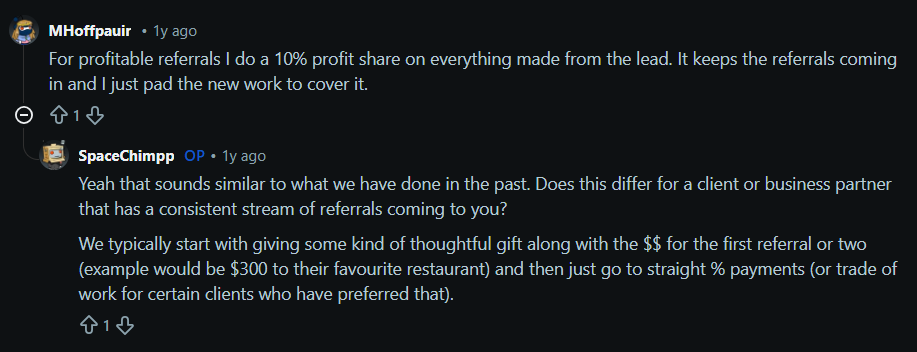
- Ask at the right moment: after delivering a strong result, during a quarterly review, or at contract renewal.
- Make it frictionless (a pre-written email they can forward goes a long way).
Partner Referral Ecosystem:
- Build alliances with complementary businesses (e.g., web design agencies, CRM consultants, fractional CMOs).
- Structure it with a referral fee (typically 10–20% of first-year contract value) and room for co-marketing, like joint webinars or shared case studies.
- Make it mutual. Send them leads too.
Community influence works the same way, just at scale. Showing up consistently in industry Slack groups, LinkedIn communities, and relevant forums (answering questions generously, sharing frameworks, connecting people) builds the kind of reputation that makes you top-of-mind when someone needs exactly what you offer.
And make sure you’re tracking it. Unique referral codes and CRM attribution tell you exactly where referred leads are coming from, which partnerships are performing, and where to double down.
Brand Measurement: What Metrics Matter for Inbound Leads
Now that you know how to build every layer of your inbound brand, you want to rush off and start executing, right?
Not so fast.
Without a way to measure what’s working, effort will remain just that: effort. By tracking the performance of your brand-building activities, you can double down on what’s driving qualified leads and cut what’s just keeping you busy.
There are two categories of metrics worth watching closely: brand visibility and lead performance.
- On the brand visibility side, watch organic traffic growth month-over-month, keyword rankings, share of voice against competitors, and direct traffic (visitors who type your URL directly), which signals genuine brand recall.
- On the lead performance side, track MQL-to-SQL conversion rates (40–60% is the benchmark for strong inbound brands), lead velocity, cost per acquisition by channel, and close rates by source via client dashboards. Inbound leads should close at two to three times the rate of cold outbound.
Attribution ties it all together, and it’s worth getting right.
Brand impact is rarely single-touch. A prospect might read your blog, download a guide, attend a webinar, and then get referred by a client, all before booking a single call. Last-touch attribution would credit only that final referral. First-touch credits only the first. Multi-touch attribution distributes credit across every interaction, giving you a much more accurate picture of what’s actually building your pipeline.
For attribution, use multi-touch models if your tools support it. If not, tracking first and last touch together gives you a solid enough picture of what’s acquiring and what’s converting.
Conclusion
OK, now we’ve gone over a whole lot. Here’s what you need to do first after reading this guide:
Block out 60 minutes in your calendar to audit where your agency currently stands, and pick one or two areas from this guide to start with based on where your biggest gaps are.
You don’t need to build everything at once. Foundation first, then authority, then visibility, and capture. Each layer compounds on the last.
Also Read: Proven Lead Generation Strategies to Grow Your Agency
FAQs
- How long does it take to build an inbound lead-generating brand?
Realistically, 6-12 months to see consistent traction. The first 90 days focus on the foundation (ICP, positioning, cornerstone content). Months 4-6 see early organic traffic growth. Months 7-12 deliver measurable inbound lead flow.
- Can small agencies compete with established brands for inbound leads?
Yes, through differentiation. Large agencies are generalists. You win by being hyper-specialized (vertical, service, outcome). A 5-person ABM agency for healthcare SaaS can out-position a 500-person “full-service” shop because specificity beats scale in inbound marketing.
- What’s the minimum content frequency to build thought leadership?
One comprehensive (1,500+ word) article, or two shorter (800-word) pieces. Consistency matters more than volume. Publishing sporadically trains your audience not to expect content. Weekly publishing builds anticipation and compounds SEO authority.