Mastering Marketing Agency Operations: Run Your Agency More Efficiently
Learn how to streamline your marketing agency’s operations for higher margins, happier clients, and scalable growth. A step‑by‑step operations blueprint.

Most marketing agencies are held together with Slack threads, Asana boards, Google Docs, and a bit of prayer.
Everyone’s sprinting, but no one knows who’s pacing. With one in five agencies failing within their first year, the cracks often start to show early: deadlines slipping, margins shrinking, and “quick revision” turning into five back-and-forth meetings. And in the middle of it all, the founder or CMO is struggling with delivery, strategy, people, and P&L.
Most niche agencies with streamlined operations see a profit margin of 45 to 75%. Great operations can be your agency’s growth engine. And yet, they’re equated to back-office admin.
At Synup, we’ve worked with hundreds of agencies across digital marketing, local SEO, and multi-location reputation management-dependent PR firms. The difference between high-growth and high-chaos is operational or systemic clarity.
In this six-part guide, we’ll walk you through how to:
- Rethink operations as your strategic multiplier
- Design systems that scale as you grow
- Avoid the most common mistakes agencies make with tools, processes, and people
Let’s get into the foundations.
TL;DR: Mastering Marketing Agency Operations
Why Agency Operations Matter
- Operations cover everything from client onboarding to billing.
- Poor ops cause missed deadlines, burnout, and churn.
- 82% of teams lack workflow structure; only 39% of work hours are productive.
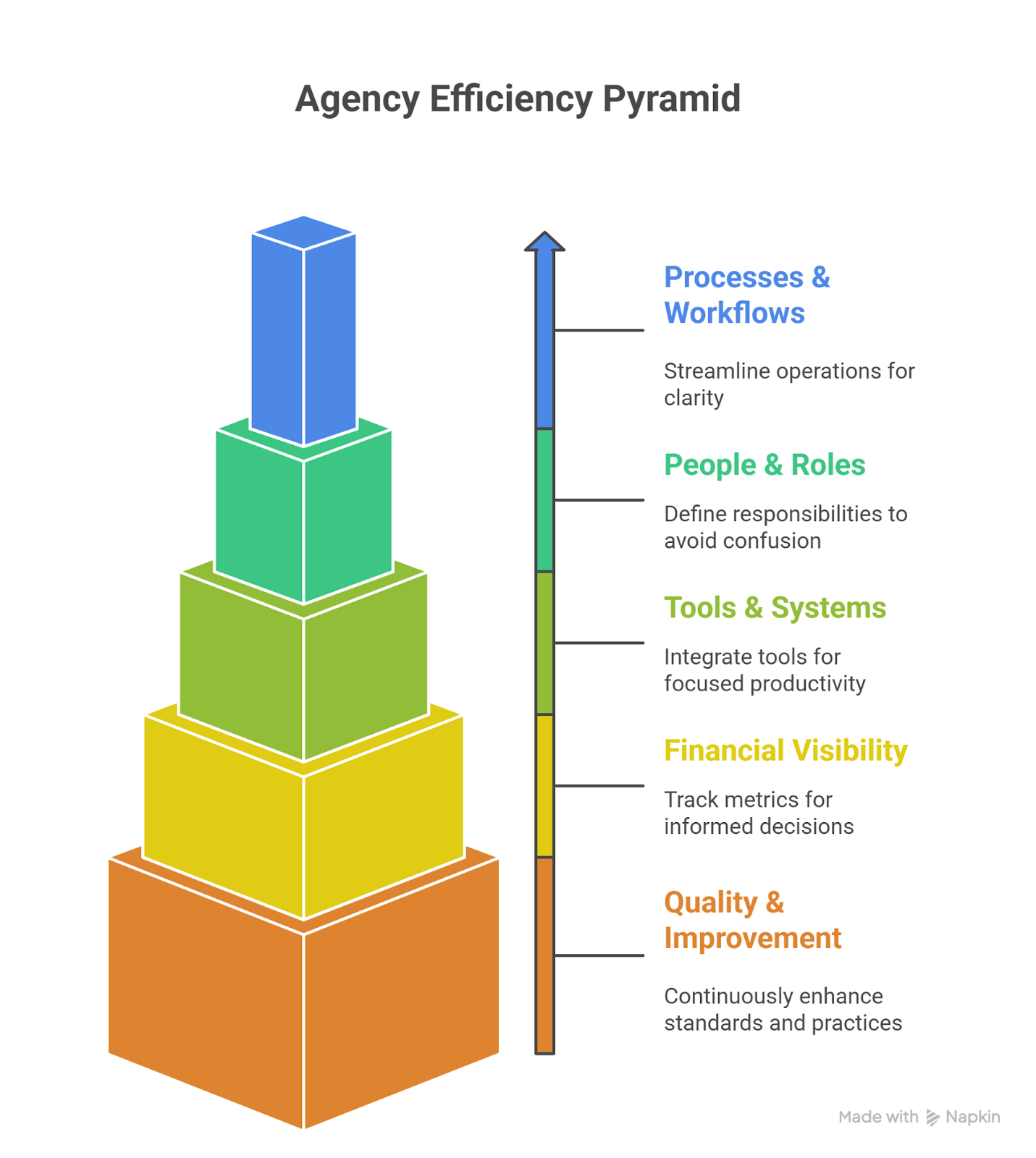
Core Pillars of Efficient Agency Operations
- Processes & Workflows: Document recurring steps; stop reinventing the wheel.
- People & Roles: Assign clear ownership; avoid confusion and overlap.
- Tools & Systems: Simplify; one core platform beats ten scattered apps.
- Financial Visibility: Track profit, utilization, and project margins monthly.
- Quality Control: Add QA checks and review after each project.
7-Step Agency Operations Framework
- Audit Your Current Ops: Map every step from lead to invoice.
- Standardize Processes: Create SOPs for onboarding, reporting, and QA.
- Implement Tools: Centralize everything under one hub, like Synup OS.
- Plan Resources: Balance workloads weekly to prevent burnout.
- Track Financials: Know client profitability and project margins.
- Add Quality Loops: Review what went right or wrong post-delivery.
- Optimize Quarterly: Automate, simplify, and fix one bottleneck at a time.
Common Mistakes
- Overspending or bloated teams.
- No emergency fund.
- Overreliance on one “whale” client.
- Margins under 20%.
- Offering too many services.
- Ignoring shifts in client demand.
- No one owning ops: the biggest silent killer.
Tools & Tech Stack
- Use: Synup OS, Asana, ClickUp, or Monday.com for project control.
- Track time via Harvest or Resource Guru; handle finances with Xero or QuickBooks.
- Communicate on Slack or Loom; document in Notion or Google Docs.
- Fewer tools mean faster workflows and fewer silos.
Scaling Operations
- Hire an Ops Lead: Once you hit 5+ staff or $70K MRR, delegate.
- Automate Tasks: Let tools handle reports, task creation, and updates.
- Track KPIs: CTR, CPC, CLV, CAC, and engagement metrics matter.
- Align Sales & Ops: Check capacity before signing new clients.
- Re-map Workflows: Update systems quarterly as your agency grows.
Why Agency Operations Matter
First, what do we mean by “operations”?
In simple terms…
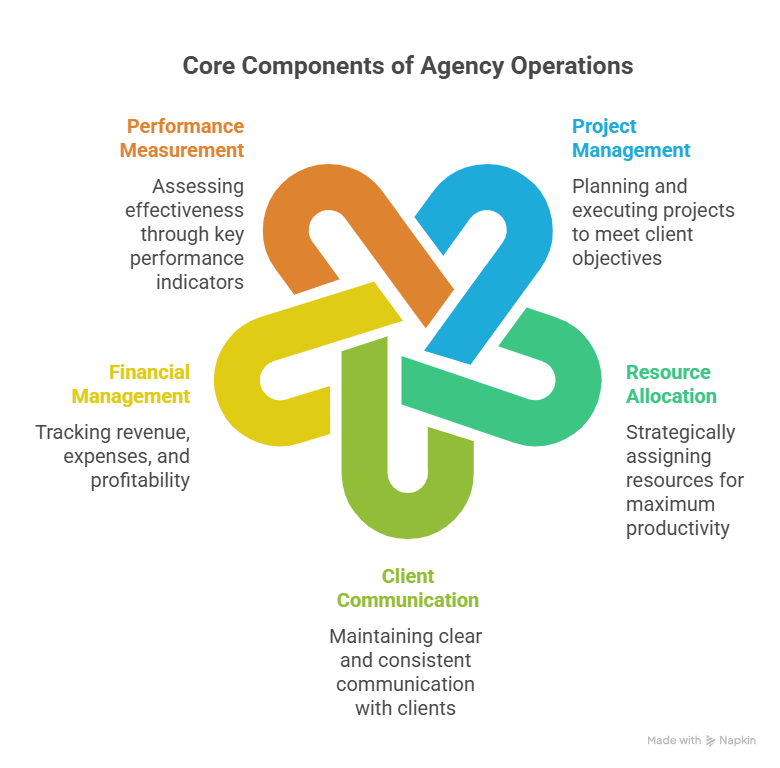
Agency operations mean everything that happens after a client signs and before the work is delivered profitably.
That includes:
- Team workflows
- Task and project management
- Communication systems
- Financial oversight (utilization, margins, billing)
- Process design, improvement, and documentation
- Resource planning
- Quality control and revisions
Put simply, it's the engine room of your agency.
Some agencies may not realize they have an operations problem until they land 3 big retainers at once and start struggling with delivery.
Some of the Costs of Bad Ops
When operations break down, the symptoms are everywhere:
- Missed or late deliverables
- Overworked and burned-out teams
- Clients ghosting (or worse, churning)
- Blame-games between departments
- Founders stuck in the weeds
82% of teams don't have a formal time or workflow management plan. Even worse, only 39% of knowledge workers' time goes to primary work. Most of it gets sucked into untracked admin or confusion.
The Core Pillars of Efficient Agency Operations
You don’t need an MBA to clean up operations. You just need to master these five core pillars.
- Processes & Workflows: Get Your House in Order
The fastest way to burn out a good team is to make them figure things out from scratch every time.
Without clear steps, your “process” is just people running around reacting to problems.
So, start documenting your recurring tasks, which can include:
- Onboarding new clients
- Briefing a campaign
- QA checks
- Content approvals
- Monthly reporting
You don’t need high-tech tools. A simple shared Notion page or Google Doc works fine. What matters is that everyone can find it and follow it.
When you’re still small, it’s easy to say, “We’ll systemize later.” But that “later” never comes, and suddenly you’re drowning in Slack threads explaining the same thing for the tenth time.
Someone once shared online that most agency owners end up trapped in endless team Q&As because everything lives in their head. They become the bottleneck, not because they want to, but because they never built proper documentation.

So, here’s the move: write down your steps as you do them. It’s not glamorous, but it’s important.
Try this:
- Pick one service you deliver most often; say, blog production or ad setup.
- Run through it from start to finish. Note who’s involved, what slows things down, and what questions come up most.
- Turn that into a repeatable checklist. Every time you repeat the task, update it till it runs like clockwork.
- People & Roles: Stop the “Who’s Doing What?” Game
Processes don’t mean much if ownership isn’t clear.
Break your projects into stages (onboarding, research, creative, review, and delivery) and give each stage a clear owner.
Shared checklists can do wonders. Everyone can see progress in real-time, and no one hides behind the assumption of someone else doing the task.
If you’re big enough, have someone act as your operations lead or PM. This would not just be a task chaser, but someone who keeps the system clean. Their job is to make sure work moves, blockers are cleared, and the team knows what’s next.
Then, empower the department leads to own their piece of the process. For example:
- Your content head should refine how briefs move from strategy to writers.
- Your designer lead should define the approval flow for creative assets.
When your team knows exactly who’s driving what, you don’t need to “check in” ten times a day. You just look at the dashboard and move on.
Learn More: Critical Roles In A Marketing Agency
- Tools & Systems: Fewer Apps for More Focus
Most agencies have too many tools. As we’ve already outlined in our agency process centralization guide, the average company now uses a whopping 100+ SaaS apps.
Slack, ClickUp, Asana, Notion, Trello, Sheets, Toggl… before you know it, half the day’s gone updating things instead of doing the actual work.
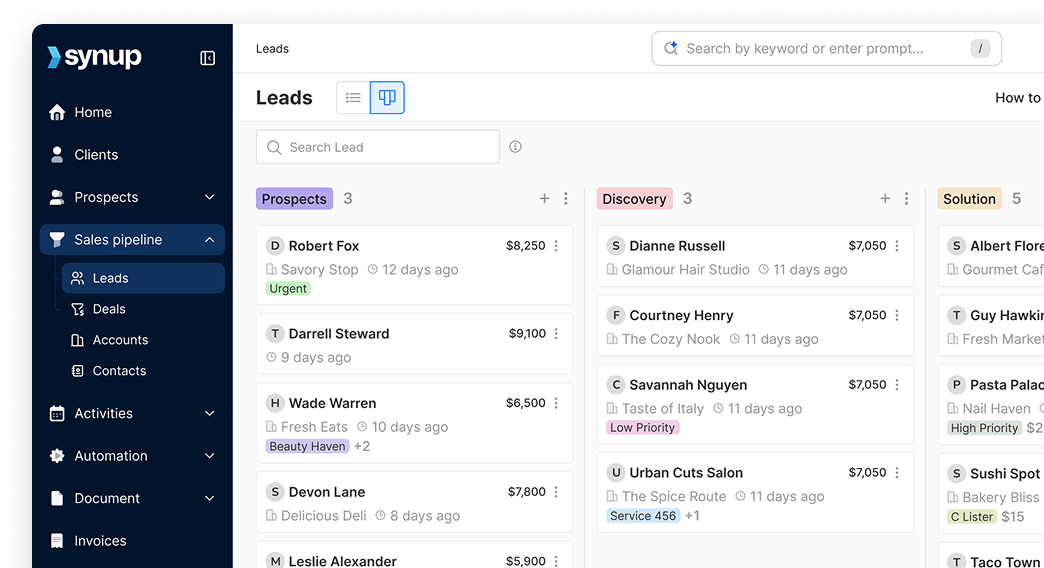
The best agencies strip all that down. They pick one main platform, their “source of truth,” and an all-in-one tool like Synup OS.
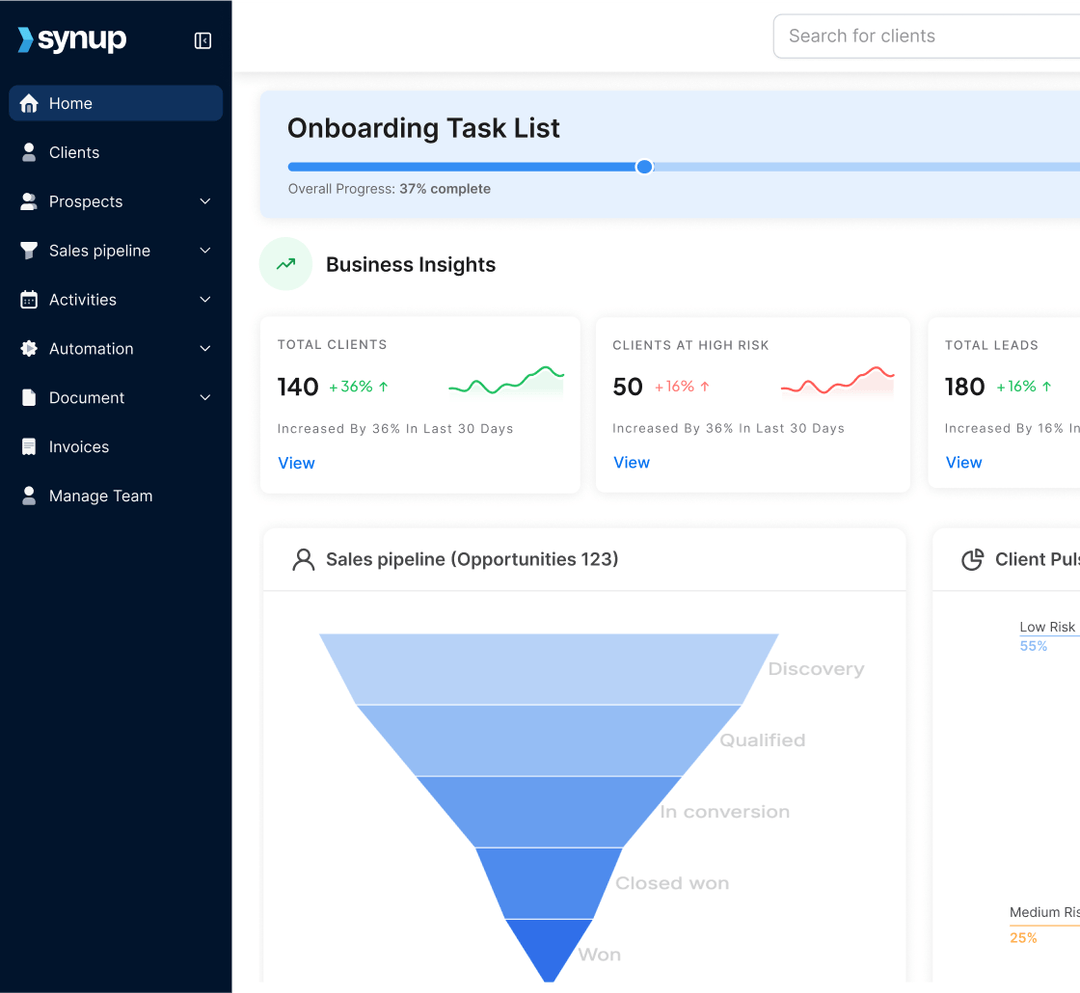
That’s where everything lives:
- Client chats and approvals
- Project timelines
- Deliverables and revisions
- Billables and team capacity
Platforms like Synup OS, ClickUp, or Monday.com work well because they keep things connected.
If your PM tool doesn’t talk to your time tracker or invoicing, you’re forced to do double work.
Every new hire you onboard should only need to learn one core system. If you can’t show them how your agency works in under an hour, you’ve got a bad case of tool sprawl.
- Financial Visibility: Don’t Guess; Measure
Running an agency without financial visibility is like driving around blindfolded. You might think you’re doing well, but one month of overruns can wipe out a few months of profits.
Here’s what you should track monthly:
- Project profitability: Income vs time spent
- Client margin: How much each client actually contributes after costs
- Team utilization: Are your people spending time on billable work or admin?
- Cost per deliverable: How much does it really cost you to ship one campaign or article?
Many agency owners only check their books quarterly. By then, it’s too late. For instance, an agency we knew in the industry once realized their “best” client (the one filling the schedule every week) was less than 10% after adding up the time spent on calls, follow-ups, and “quick revisions.”
That data helped them see a need to ensure proper time tracking, adjust pricing, reset expectations, and turn that same client into a 24% profit contributor within two months.
- Quality Control & Continuous Improvement
This is the point where your agency starts running like a business and not a reaction team.
Think of quality control as your safety buffer. It keeps clients happy and protects your reputation.
Add one final check before anything leaves the agency. Whether it’s a social ad, blog post, or report, have a simple checklist:
- Does it match the brief?
- Is it formatted correctly?
- Has someone fresh reviewed it?
Keep it short and specific. Then, after each project, do a quick retro:
- Did it go well?
- What went well?
- What caused delays?
- What can we tweak next time?
Bonus move: Keep a “lessons learned” doc or Slack channel where anyone can drop small insights. Over time, that becomes a live training manual for new hires.
The Agency Operations Framework: Step-by-Step
Every agency has two sides: the shiny front where clients see the good metrics, and the messy backroom where the work happens. This section provides a 7-step framework for cleaning up that backroom so your agency runs like a business and not a fire drill.
Step 1. Audit Your Current Operations
First things first, you can’t fix what you have not mapped.
Most agencies operate on tribal knowledge: people just “know how things are done.” That’s fine when you’re five people. But once you start scaling, those invisible systems become time bombs.
So, get practical. Open up a whiteboard, Miro board, or shared Google Doc and map every single stage of your workflow:
- When a lead comes in, what happens next?
- Who qualifies it? Who sends the proposal?
- How does it hand off to the creative or production team?
- Who signs off before it goes to the client?
- How is delivery tracked?
- When and how do you invoice?
If you’re confused, check out our Client Onboarding Process Checklist.
Write down every person, tool, and approval step in that journey.
You’ll quickly see gaps like the handoffs that always cause delays, the “waiting on approval” loops, or the forgotten steps that force last-minute scrambles.
The goal isn’t to make things pretty; it’s to get everything that’s living in people’s heads onto paper.
You’ll start spotting problems instantly. Maybe client briefs keep getting lost between sales and strategy. Or designers spend days waiting for sign-offs. That’s not a people problem. That’s a system problem.
Do this now: Sit with your team, draw out your process from inquiry to delivery, and highlight where delays happen. Once you can see the mess, you can start cleaning it.
Step 2. Standardize Processes
Every successful agency has one thing in common: repeatable processes.
So, start by building out SOPs (Standard Operating Procedures) for your most common work: client onboarding, creative reviews, revisions, and reporting. These should be your playbooks. The idea is that anyone new can walk in, follow the steps, and deliver consistent results.
The biggest mistake founders make is trying to build systems after scaling. They end up answering the same team questions a hundred times a week because “everything’s in their head.” Build your systems as you go so delegation actually works.
Quick tip: Start small. Pick one service (say, running ad campaigns). Document each step while you’re doing it this week. Next week, follow your own doc. You’ll find small tweaks that make it smoother. Rinse and repeat.
Step 3. Implement Tools & Systems
Again, most agencies lose the plot here with too many tools. You've got Slack, Asana, Notion, plus 10 more SaaS, and somehow no one knows where the latest update is.
Stop piling on software just because it looks slick or your competitor says they use it.
You need one central hub where all client comms, project timelines, and deliverables live.
Platforms like Synup OS can also bring order to the madness, combining client projects, performance tracking, and reporting under one roof. It gives you less tool hopping and fewer “multitasking” needs.
Pro tip: Create a list of every tool you pay for. If two do the same thing, kill one. If your PM software doesn’t sync with your invoicing tool, fix it. And if you have to copy-paste data between tools, that’s a red flag. Automate it.
Step 4. Resource & Capacity Planning
Every agency owner has made this mistake: saying yes to everything because they “can figure it out.” It's a call to team burnout.
Planning capacity means looking at what your team can handle and not what you wish they could. So, stop handing out projects based on gut feel. Use tools like Float or Productive.io to see real capacity and forecast workloads.
Many PMs probably see their team running at full speed until three people quit in a single quarter. But once they start visualizing workload, they can move deadlines before things break. Simple as that.
Every Monday, check who’s overloaded. If someone’s hitting 80% capacity, spread the work out. Good ops should keep people busy and not buried.
Take This Further: Your Guide to Agency Time Tracking: Where to Start and What Tools to Use
Step 5. Get Financial Oversight
If you don’t know your margins, you’re flying blind. We’ve seen agencies making $100K a month but were secretly losing money on every project.
Typical agency profit margins hover around 9 to 14% for small teams or early agencies, 15-20% for medium-sized agencies, and 20–30% for top, well-run ones.
If you’re below that, something’s wrong.
Here’s where to look:
- Are you billing for all your time, or giving hours away in “free tweaks”?
- Are project scopes clear, or do clients keep sneaking in extra work?
- Are you reviewing profitability per client monthly?
To fix this, you can run a monthly profit review. Check project margins, utilization rates, and client profitability. If a client costs more than they produce for the agency, reprice or part ways. You can’t grow a business quietly while bleeding money.
Check Out: 5 Best Ways to Invoice Clients & Simplify Billing for Your Agency
Step 6. Quality Control & Feedback Loops
Ops isn’t just about efficiency; it's also about consistency.
Without a quality control layer, mistakes can slip through, and clients start losing trust.
Set up QA checkpoints before deliverables go out. Have someone not involved in the project go through it with fresh eyes.
Then run quick retros after big jobs. Ask: What slowed us down? What caused rework? How do we avoid it next time?
Poor onboarding, lack of perceived value, and inconsistent communication are top reasons service clients churn. That’s what quality control prevents.
Step 7. Scale & Optimize
Scaling isn’t about growing bigger but growing smarter. The systems that worked for ten clients won’t survive thirty.
For that reason, start automating the repetitive stuff like task creation, client updates, and report pulls.
Then, review your tech every quarter. Tools that made sense last year might be slowing you down now.
Remember, no tool will ever be perfect for you. Your operations should evolve with you.
Here’s a quarterly ritual we recommend. Do a “systems check” by asking your team:
- What process feels old-fashioned or uninnovative?
- Which tool feels like extra work?
- Where are we wasting time?
Fix one bottleneck each quarter. In a year, your agency will feel twice as streamlined.
Also Read: 12 Marketing Agency Management Tips to Grow Your Business
Common Operational Mistakes Agencies Make
The best way to rejig your agency operations is to learn from those who have failed (or nearly did). Every agency screws up at some point. Here’s what those mistakes look like and how to dodge them.
- Overspending
A new owner once took over a 36-year-old agency that nearly collapsed under bloated costs: too many employees, a fancy office, and no backup plan. When a whale client bailed, the business simply tanked.

To fix that, he cut one-third of the team, modernized tech, and diversified clients. Within months, cash flow returned. The previous owner wasn’t clueless; he just stopped adapting.
Takeaway: Run lean. Invest in tools and people that drive revenue.
- No Rainy-Day Fund
If you don’t have 3–6 months of payroll sitting untouched, your agency business is all a gamble.
Too many owners pull profits fast, leaving nothing for dry spells. Remember, that same agency above had less than one month of payroll saved, and almost didn’t make it. Don’t repeat that. Keep your safety net full, even when things look good.
- Relying on Whale Clients
One or two big clients shouldn’t decide your future. If one leaves, you’re toast. Instead, build a mix. A few anchor accounts and a dozen smaller ones that keep the lights on. Predictable, steady retainers are the backbone of healthy agency operations.
- Running Thin Margins
Anything under 20% margins means you’re working for free.
Reprice your offers, trim low-value services, and raise retainers before you crash. The closer you get to 100% margin, the more breathing room you’ll have when things slow down.
- Cold Calling Forever
Cold calling helps when you’re starting out, sure. But you can’t scale a serious agency that way.
Build a referral system. Create partnerships with complementary businesses. Let satisfied clients bring you new ones. Relationships last longer than scripts.
- Offering Too Many Services
Remember what we said at the beginning of this article? Most niche agencies with streamlined operations see a profit margin of up to 75 percent.
Trying to be “full service” often means you’re half good at everything.
Narrow your focus. Be the agency that owns one or two core services. Clients pay more for specialists than generalists.
- Ignoring Market Shifts
Agencies fail when they stop watching the market. Keep tabs on where ad spend is moving, what platforms are dying, and what skills clients are starting to value. Staying curious keeps you relevant.
- No Ops Lead
Lastly, someone needs to own marketing agency operations.
Not the founder.
Not the intern.
A real operations lead whose job is to keep systems clean, teams balanced, and profits predictable.
When no one owns the operations, you end up with chaos. When someone does, everything flows.
Tools & Tech Stack for Agency Operations
Your tools can make or break your agency operations. Too many apps, and you’re wasting hours jumping between tabs and half of your profit margin on monthly subscription fees. Too few, and your team is stuck duct-taping workflows together.
If you’re serious about tightening your agency operations, start by trimming the fat. Pick one solid system for each core need.
You’ll want:
- Project management: something like Synup OS, Asana, ClickUp, or Monday.com to run all client work from one dashboard.
- Time tracking: Harvest or Resource Guru to know who’s at capacity and who’s free.
- Finance: Xero or QuickBooks to keep tabs on invoices, expenses, and project margins.
- Communication: Slack and Loom for updates, plus Google Workspace for shared files.
- Documentation: Notion or Google Docs for SOPs and onboarding.
- All-in-one hub: Synup OS if you want client, project, and finance data in one view.
That’s your base stack. Anything more than that, and you’re just complicating things.
Sales teams that unified or consolidated their tech stacks into fewer platforms are found to improve operational efficiency by 28%. The translation to that is you will get almost a third of your week back just by cutting down on tool sprawl.
If you’re not sure where to start, open a spreadsheet and list every app you pay for, who uses it, and what it actually does. You’ll be shocked at how many overlap. Cancel what you don’t need, connect what you keep, and teach your team how to use it properly.
Scaling Your Agency Operations
When your agency starts picking up speed, you quickly realize great creative work can’t survive without great systems behind it. Scaling isn’t about hiring more people but designing your marketing agency operations so they can grow with you.
Let’s break down what scaling an agency’s operations actually looks like.
When to Hire Dedicated Operations Leadership (Ops Lead or COO)
Most agency founders think they can do it all until the wheels start wobbling.
When you’ve got more than four or five full-time people, you’re officially out of “solo mode.” Past that point, the owner is usually handling clients, projects, finance, HR, and firefighting, all before lunchtime.
That’s when an operations leader becomes essential.
The right time to hire is when managing both the technical and business sides of the agency starts pulling you in opposite directions. You’ll feel it in missed deadlines, poor communication, and team fatigue.
One U.S.-based MSP ops manager shared how the owner waited too long. He brought in the operations manager when the business hit $70K in monthly recurring revenue, but by then, he was completely burned out. Once that manager took over day-to-day ops, the owner finally had room to focus on sales again, and in less than two years, the company grew to $150K MRR.

That’s what happens when you hand off the day-to-day. You get breathing room to grow again.
So, if you’re finding yourself buried in admin and approvals instead of sales calls, it’s time. Hire the person who loves checklists, hates chaos, and gets satisfaction from fixing what’s broken.
Automate Manual Work: Task Creation, Reports, Notifications
If you’re still assigning tasks by hand or building client reports manually, you’re wasting hours you’ll never get back.
Automation doesn’t mean replacing people but means freeing them from grunt work.
Start small:
- Set up automated project templates so every new client onboarding or campaign launch follows the same structure.
- Use scheduling rules that trigger Slack or email updates when tasks move stages.
- Auto-generate performance reports weekly using synced dashboards rather than pulling data by hand.
Example: One creative agency set up a simple Zapier workflow that connected Asana with Google Drive and Slack. Every time a designer uploaded a file, it automatically saved it to the client’s folder and tagged the PM for review. That small automation saved roughly 4 hours per week; that’s 200+ hours a year they now spend on billable work.
Action step: Identify five tasks your team repeats daily. Automate at least two. You’ll instantly feel the lift.
Here’s some inspiration: How to Automate SEO Workflows with AI Tools
Build KPIs for Every Department to Track Performance
Most agencies track a few surface metrics and call it a day. That’s not enough.
KPIs (key performance indicators) are your early-warning system. When they drop, something’s off.
For agencies, here’s what matters most:
Marketing KPIs
- CTR (Click-Through Rate): Measures ad relevance and creative impact. If CTR dips, your message isn’t landing.
- Conversions: The north star metric for ad spend. Track which channels bring the best ROI.
- CPC (Cost-Per-Click): Crucial for budget control. Stay updated on industry benchmarks through Google’s transparency reports.
Engagement KPIs
- Social media engagement and email open rates show how connected your audience really is. If you've got flat engagement, then it's time to refresh content formats or posting cadence.
- Bounce rate and time on page help web teams spot weak content or design friction.
Sales & Pipeline KPIs
- MQLs (Marketing Qualified Leads) and SQLs (Sales Qualified Leads) measure lead quality.
- Brand reach tracks visibility. A steady rise here usually correlates with lower acquisition costs.
Profitability KPIs
- Customer Acquisition Cost (CAC) and Customer Lifetime Value (CLV) tell you if your pricing and marketing mix actually make sense.
Also Read: 11 Most Important Marketing Agency KPIs to Track Every Month
Integrate Sales and Operations
Sales teams love closing deals, but if ops can’t deliver, everyone pays the price.
Before signing a new client, check delivery capacity.
If your team’s already slammed, be honest about start dates. It’s better to push a kickoff two weeks than to destroy your team’s morale.
Let's say you run a design shop that used to say yes to everything. What happens is projects pile up, burnout follows, and quality tanks. But changes can be seen when you switch and start weekly pipeline syncs between sales and ops with one simple meeting. Sales sees who was available, and ops could plan hiring ahead.
That’s the power of connecting both sides of your agency.
Treat your delivery schedule like inventory and don’t sell what you can’t deliver.
Here’s another idea: Automate your sales process.
Periodically Re-Map Processes to Support Growth
What worked at five people won’t work at fifteen. Processes age fast. Make it a quarterly ritual to audit and re-map your operations.
Ask your team:
- Where do we lose the most time?
- What’s repetitive that we can automate?
- Which client workflows are messy or outdated?
Growth always adds friction. Re-mapping removes it.
So, make it a habit. Every quarter, pick one workflow (client onboarding, billing, delivery) and rebuild it cleaner. That’s how mature agency operations evolve.
Conclusion & Next Steps
Strong marketing agency operations are the backbone of profitable growth. Efficient systems save time, protect margins, and keep clients happy. Start with an audit, standardize what works, and invest in tools and training that scale with you.
Once you’ve cleaned house, tools like Synup OS can pull it all together with clients, projects, and profits in one view. If you’re ready to see what an all-in-one system looks like, see how Synup OS unifies your clients, projects, and profitability in one place by requesting a free demo.
Frequently Asked Questions
- How can I improve my agency’s profitability?
Track your project margins monthly. Set pricing based on real delivery costs. Most importantly, keep utilization rates above 75% and trim non-billable hours. Well-run agencies average 25–35 percent margins, which should be your target.
- Which project-management tool is best for agencies?
It depends on your workflow. Tools like Synup OS, Asana, ClickUp, and Monday.com are reliable options. Asana and ClickUp are praised for visibility, but users often mention feature overload. Monday.com is visual but less robust for reporting. With Synup OS, client, project, and financial insights live in one platform, reducing both complexity and the higher costs of using several separate tools.