Mastering Agency Client Communication: Best Way to Communicate with Clients
Poor communication can lead to misunderstandings and lost clients. Learn strategies to improve agency-client communication and build strong relationships.

The relationships formed within agencies come in all shades of weird, wacky, and wonderful. You’ll cycle through clients across a spectrum, from those who respond instantly to those who barely engage.
Of course, unless you know how to handle each one with grace, that dreaded “We’ve decided to go in a different direction” email lands like a punch to the gut. More often than not, it’s not your work. It’s how you delivered it. Is your agency-client communication wrapped in enough layers of professionalism, respect, and firmness?
Most SMB clients don’t even glance at weekly reports. They judge progress by what you directly communicate and what they actually understand. When they don’t hear enough, they fill the silence with their own assumptions.
From Synup’s experience supporting more than 600,000 local SMBs, one thing is clear: for local operators, time is money….and often measured in one well-worded email. In this guide, we’ll break down what client communication really means in an agency setting. We’ll explore the best ways to engage clients and the critical role communication plays in retaining them.
TLDR: Mastering Agency Client Communication
- Communication is the #1 retention factor. Global agency surveys show that effective communication and strong working relationships (82.6%) are five times more influential in client retention than campaign performance (less than 15%).
- Clients often churn not because of bad work, but because of a perceived dip in communication. When they don't hear enough, they fill the silence with negative assumptions.
- SMB clients primarily want to know: what's happening, what's working, what's next, and what needs their attention. Raw performance data is meaningless unless it's explained simply.
- The Three Retention Pillars:
- Effective communication
- Strong working relationships
- Campaign performance
- Core Communication Benefits:
- Builds trust
- Prevents rework/protects margins
- Improves understanding
- Seven Key Pillars of Good Communication:
- Active Listening and Empathy
- Clarity and Transparency (especially on deliverables)
- Proactivity and Regular Updates
- Consistency and Reliability
- Flexibility and Personalization (using the right channel)
- Documentation and Showing Your Work
- Emotional Intelligence for handling tough moments.
- Common Challenges:
- Clients use multiple channels (text, email, Slack), requiring the agency to centralize all inputs to prevent errors.
- Scope creep, caused by poor communication at onboarding, is another challenge. Clearly defining what is Not Included is often more effective than listing what is.
- Delayed updates or failing to communicate dependencies (when the agency is waiting on the client) make the client assume the agency is idle.
What Is Client Communication?
Client communication covers every interaction your agency has with a client, from emails to Loom updates, Slack pings, Zoom calls, task comments, texts, and the occasional contract tweak. All of these form the running conversation that shapes the relationship day-to-day.
…And Why Is It Important?
Client communication is the single most critical factor determining an agency's long-term success, client retention rate, and reputation. It is the lifeblood of the agency-client relationship, as it ensures alignment, helps manage expectations, and creates a sense of shared purpose
In a global survey by AgencyAnalytics asking agencies what truly drives client retention, “campaign performance” didn’t even come close to the top. The results might surprise you.
Check out this report:

Add the first two together, and you get 82.6% of retention driven solely by communication and relationship quality. That’s five times more influential than raw campaign performance.
This reflects something agency veterans already know: an anxious client will churn, even if performance is good. A confident client stays, even when performance dips temporarily.
Let’s break down the top three retention drivers, as each reveals something critical about communication.
- Effective Communication
Clients stick with agencies that help them understand what’s happening and why. When agencies proactively flag problems (like delays, seasonal dips, or algorithm changes) clients respond calmly because they trust the honesty. Transparency weeds out that ambiguity that would have transformed into churn.
- Strong Working Relationships
Strong relationships improve resilience. If you make a mistake and communication is strong, most SMB clients will forgive it. If communication is not there and the client relationship is weak, the same mistake can be the last straw or fuel distrust.
- Campaign Performance
Experienced operators know this instinctively. Performance matters, but without clear communication, it can feel invisible.
For example, an agency might boost a client’s keyword rankings from 17 to 4 or increase review volume by 33%. Without charts, explanations, or context, the client may not see the impact and could assume nothing is happening. Many SMB clients also struggle to interpret data intuitively; a rise in impressions means little unless explained in simple terms, such as “More people in your area are finding you now.”
Other Notable Benefits of Great Client Communication (+ Examples)
Builds Long-Term Relationships
Trust doesn’t come from one good deliverable. It’s the tiny, repeatable micro-moments: a proactive heads-up, a clear next step, or even a short recap after a call. Here's a practical model:
- Daily micro-touch: automated status card (one line) in the client’s preferred channel: “Today: copy sent. Waiting on hero image. ETA Wed.”
- Weekly check-in: 10–15 minute sync for activity highlights and any decisions needed.
- Monthly recap: 1 page: wins, blockers, next 30 days.
Actionable steps:
- Commit to a 24-hour rule for any client-facing question (even if the answer is “I’m checking. Will update by X”).
- For each client, assign a single account lead responsible for those micro-moments (no passing the buck).
- Build a one-line “status card” template and automate it where possible.
Improves Understanding of Client Needs & Prevents Scope Drift
Effective communication addresses business changes to prevent campaign derailment. Small and medium-sized businesses often assume agencies "already know," but it's essential to ask the right questions regularly.
Here's a checklist to follow (ask the questions monthly):
- Any new products or seasonal promos?
- Staff or operational changes (hours, menu, headcount)?
- Any supplier or pricing shifts?
- Expansion or pause plans?
- New competitors or local events?
Let's say you make a request on the first Tuesday of the month and the client replies: “Yes, we have a pop-up market next month.” You can adjust ad budgets and assets two weeks earlier to avoid wasted impressions.
Communication also plays a big role in timing and expectation setting.
If a client expects leads in 2 weeks but the campaign typically needs 8 weeks to ramp, be honest and say 8 weeks. But explain ramp stages (setup, optimization, scaling).
Actionable steps:
- Use a 5-question monthly form (takes the client 90 seconds) and link it to the project board.
- Publish a simple “campaign ramp timeline” in onboarding:
- Week 0 = setup,
- Weeks 1–4 = data collection,
- Weeks 5–8 = optimisation,
- Week 9+ = scale.
Prevents Misunderstandings, Reduces Rework, and Protects Margins
Prompt communication prevents misunderstanding with clients, which can lead to rework.
Rework destroys your gross margins faster than price cuts. Here’s a practical way to see it.
Here's a concrete example:
- Your agency charges US$150 per location (or equivalent).
- Extra rework = 3 hours/week correcting misaligned tasks > 12 hours/month > 144 hours/year.
- Across 20 clients, that’s 2,880 hours/year of unpaid work (144 × 20 = 2,880). That’s the real cost.
How to stop it:
- Approval gates: every creative asset must pass a 3-point checklist before production (owner, headline, CTA). If any item is missing, the asset returns with a single tracked comment.
- Version control: enforce file naming standards like Client_Project_V1_YYYYMMDD + a one-line summary. No “final_final_v2.pdf”.
- SLA for clarifications: when a task is ambiguous, the agency has a 48-hour freeze. We’ll contact the client and won’t proceed until we have a resolution or sign an assumption with a price/time estimate.
Drives Retention, Satisfaction, and Referrals
During periods of slow performance (algorithm dips, seasonality), clients who receive regular, transparent explanations and a short corrective plan tend to stay. They understand the “why” and the “how we’ll fix it.”
We've seen data that proves communication helps with client retention.
However, retention is arithmetic. Retention multiplies revenue. Here's a quick sense-check you can relate to:
- If the average monthly bill is $2,000 and the client lifespan is 7 months, the LTV is $14,000.
- The same $2,000 average monthly bill, but a longer lifespan of 18 months, results in an LTV of $36,000.
- That's an LTV multiplier of 18 divided by 7, which is approximately 2.57 times. You don't need a case study to see why keeping a client longer pays off.
A happy local chain with 6 locations can introduce 2–3 new clients in the same local ecosystem. SMB referrals convert faster and cost almost zero in acquisition spend.
Actionable steps:
- Track three simple communication KPIs: average response time, number of open issues older than 48 hours, and monthly rework hours.
- Use a “retention dashboard”: if any KPI drift beyond the threshold, trigger a client health call.
- After a major hiccup, send a 1-page explainer showing what happened, what we’re doing, and how long it will take” memo within 48 hours.
Check Out: How to Handle Difficult Agency Clients: 10 Ways to Improve Communication
Key Pillars of Good Client Communication
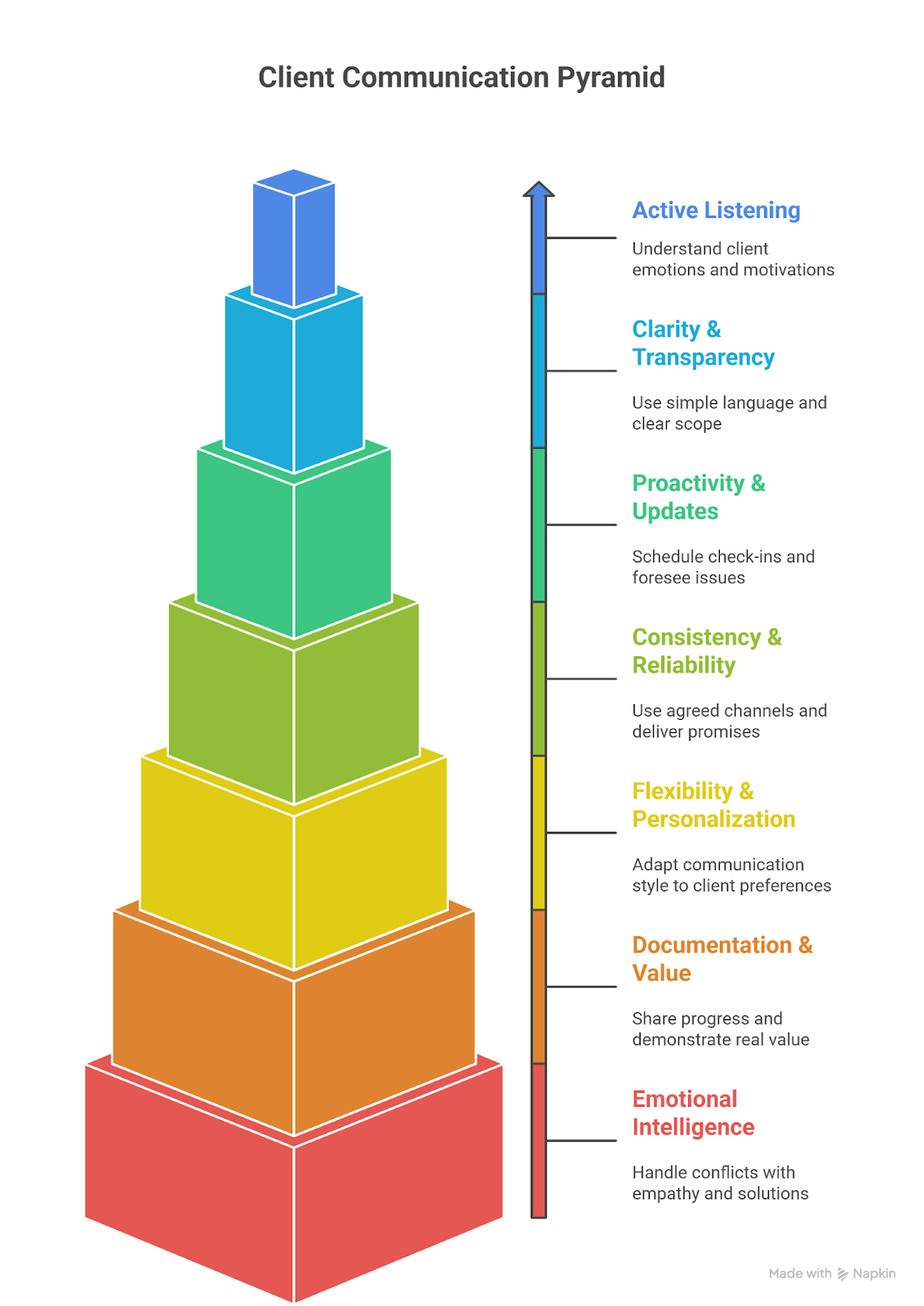
Good agency-client communication doesn't end at sending updates. It’s an operational strategy that directly affects project efficiency, client retention, and profitability. Agencies often overlook small habits that compound into big wins or major headaches. Here are the seven pillars of good client communication:
Active Listening and Empathy
Clients often present goals superficially. For example, a local bakery saying “I want more customers” may actually end up being “I need predictable foot traffic on weekends during peak hours.” Recognizing the underlying need avoids wasted effort and misaligned campaigns.
During client calls, repeat back what they say in your own words. It’s simple, yet it immediately confirms alignment. Don’t just wait for them to finish talking so you can get to speak. Actually hear them out.
Empathy is equally important when dealing with feedback. A frustrated client might complain about results, but they’re also anxious about their business.
Recognizing emotion first diffuses tension and makes collaboration smoother.
Clarity and Transparency
For example, if a package includes two social posts per week but the client expects five, a lack of clarity leads to frustration and extra work.
- Recommended strategy: Provide a deliverables table during onboarding. For a 10-location client paying $150 per location per month, showing which locations get updates, posts, or listings fixes creates accountability.
Besides, transparency isn’t only about deliverables. Showing how decisions are made (why certain listings are prioritized, why a post schedule is chosen) builds trust. It shifts the client from passive observer to informed partner.
Proactivity and Regular Updates
Clients would rather not chase you. Proactive communication keeps projects moving, reduces stress, and increases perceived value.
Send a one-page weekly summary with metrics. Show them using numbers that are easy to give a mental picture. For instance, “This week, we fixed 15 local listings, published 3 posts, and improved Google review response times by 12%.” It takes 20–30 minutes but saves multiple hours in back-and-forth emails.
For 15 clients at $150/location with 3 locations each, proactively sending updates means you invest roughly 7.5 hours weekly, but prevent potential miscommunication that could cost $6,750 in client churn if one client leaves.
Consistency and Reliability
Consistency across team members prevents confusion. Mixed messages from multiple contributors can erode agency-client relationships.
Use shared dashboards for project updates. If an account manager, strategist, and freelancer are all updating one client, a centralized log ensures alignment.
Flexibility and Personalization
Every client processes information differently, and their communication style usually mirrors how they run their business. A hands-on owner-operator juggling payroll and customer issues often prefers quick, skimmable updates, while a mid-sized clinic with a front-desk team might want structured emails they can share internally. Matching their pace builds trust quickly.
Tone also matters. Some clients want straight, punchy summaries. Others prefer softer, explanatory notes they can pass along to partners. Adapting your tone prevents simple updates from feeling rushed or unclear.
Choosing the right channel helps too:
- texts for urgent items
- email for deliverables
- Loom videos for explaining dashboards or strategy changes.
When communication fits the client’s style, misunderstandings drop, conversations stay calm, and renewals last longer because clients feel genuinely supported.
Documentation and Showing Your Work
Most agency work happens behind the scenes, from keyword cleanups to citation updates, listings fixes, review replies, and QA checks. If the client doesn’t see it, it might as well not exist. Documentation gives your work a physical presence and protects the relationship when the client forgets what was done or assumes something slipped through.
A simple shared dashboard removes 70% of those “update” messages. Let’s say you run pages for an 8-location café group. A good dashboard lets them see:
- Which 40+ listings were corrected last week
- Which 17 reviews you already responded to
- The exact 2–4 positions their local pack ranking moved
- Pending approvals, with timestamps, so nobody blames the wrong side for delays
Once they can see the moving parts, arguments drop off. In many mid-sized SMB agencies (serving 50–150 clients), clear documentation usually cuts client disputes considerably. That’s fewer refund requests, fewer escalations, and fewer emergency calls
On top of that, documentation also strengthens your retention pitch. It shows progress in black-and-white, which makes renewing a retainer easier because the value feels real.
Emotional Intelligence for Hard Moments
Tough moments will always come up, from delayed creative to slow approvals, and campaigns that don’t kick off as expected. Emotional intelligence is the difference between a client meltdown and a constructive reset.
Imagine this situation:
A restaurant client runs a Saturday promo expecting 50–60 extra covers, but only 18 customers redeem the offer. Then they fire off an annoyed message on Sunday morning. A defensive response (“the targeting was correct; it’s not our fault”) will kill trust immediately. Instead, acknowledge their frustration, show the actual reach and engagement numbers, and suggest two alternative hooks to test next weekend.
Clients stick with agencies that handle the ugly moments with steady hands, not agencies that panic or blame.
Also Read: How to Manage Client Expectations During Algorithm Changes
Common Challenges in Client Communication: Why Agencies Struggle
Every team faces some communication hurdles when managing multiple clients. Here are the top ones.
- Multiple Channels and Fragmented Information
Even with solid internal comms processes, clients don’t always follow the communication structure you set.
A founder once shared an example online that summed this up well. They mentioned how clients rarely stick to one communication channel, and they had various tools for projects and comms.

You might set up Slack, but someone still sends a request by text. You create a shared folder, yet a critical file shows up as an email attachment. Their point was simple: the agency needs a way to pull everything into one place because clients will always choose whatever method is fastest for them at the moment.
If you work with small businesses, you’ve seen this firsthand. A local restaurant owner might send a late-night text about their holiday special, follow up the next morning with an email containing a new photo for the same promo, then leave a comment in the Google Doc adjusting the copy. Three inputs, three different channels, all tied to the same task.
Without a central system, these scattered messages lead to avoidable errors like wrong versions sent out, duplicated work, or missed details that cost extra time. And once something slips, the client starts questioning how organised the agency really is.
Centralizing all communication and workflows in an all-in-one platform like Synup OS gives you one operating system for scaling, cutting miscommunication by more than half.
Read: Ultimate Guide to Agency Project Management: Save time & Scale Efficiently
- Lack of Clarity on Expectations / Scope Creep
Scope creep is the ultimate hidden cost. It rarely happens through malicious intent; it's a direct result of different mental models between the agency and the client regarding what is included. The client assumes a service (e.g., ad copywriting) is a fixed cost, while the agency sees it as an hourly task that wasn't priced in.
This is a communication failure at the onboarding stage. When the Statement of Work (SOW) is vague, every conversation after is a negotiation.
Imagine an agency manages five clients. One client asks for "some quick revisions" to a landing page wireframe, a task that takes 3 hours. Because the scope wasn't explicit, the agency does it unpaid. Across five clients, doing this once a week, the agency gives away 15 hours of unpaid time per week. At an average agency billable rate of $100/hour, that's $1,500 lost weekly, or $6,000 lost monthly, purely due to fuzzy communication about boundaries.
Tip: Clearly define deliverables (what you give) and activities (what you do) in writing. Use a "Not Included" list in your proposal. Communicating what the client won't get is often clearer than listing what they will get.
Take This Further: How to Create a Marketing Agency Rate Card
- Poor Timing or Delayed Updates
A lot of clients assume that if they haven’t heard from their agency, nothing is happening. Meanwhile, agencies often assume clients are prioritizing tasks and don’t realize their delay is slowing down an $8,000 launch.
Problem: The agency fails to proactively communicate its dependency. When agencies do not clearly state things like needing a logo file, approval on ad spend, or a short interview, clients often interpret the resulting silence as a lack of progress.
Consider a simple example. A creative agency waits seven days for approval on ten social ads. That delay backs up the production calendar and forces the team to juggle other projects. Every time they switch back, they lose 15 to 20 minutes of ramp-up time per person. With a three-person team, that is nearly an hour lost to context switching, which drains internal efficiency.
It happens more often than it should. We have seen agency owners get blamed for delays that were caused entirely by clients, simply because no one clarified where the bottleneck really was.

Actionable tip: Use automated reminders. A simple system that sends a "Still Pending: [Asset Name]. Project Deadline: 2 Days" email to the client, copied to the Agency Project Manager, forces a shared sense of urgency and transparency
- Over- or Under-Communication
This challenge is about the density and frequency of information.
- Over-communication (i.e. sending raw data dumps, endless email chains) causes the client to feel overwhelmed and assume the agency is disorganized.
- Under-communication (a generic, sparse monthly report), on the other hand, may cause anxiety and make the client question the value they are receiving.
A lot of agencies fail to communicate the narrative and strategic value. Clients don't care about clicks; they care about customers and profit.
Consider an agency handling an enterprise client with four different marketing channels (PPC, SEO, Social, Email). Then, four separate channel managers send four separate reports with 20 pages of data each. The client's CEO spends 3 hours trying to piece together a coherent picture. They may conclude the agency lacks a unified strategy.
The best strategy would have been sending:
- one weekly email featuring a 3-bullet summary per channel (e.g., "PPC: Costs stabilized, Conversion Rate up 12%"),
- a single Executive Summary paragraph,
- and a Next Step action item.
This saves the client the full 3 hours of confusion and gives them the confidence that the agency is on top of the entire strategy. The agency spends an extra 15 minutes synthesizing the data, but saves hours of follow-up calls and reduces the risk of churn.
It's more efficient to implement a "Narrative First" reporting structure. Every communication must start with:
- What happened?
- What does it mean?
- What are we doing next?
- Emotional Disconnect / Lack of Empathy
When a client expresses panic about a dip in sales, and the agency responds with a cold, data-heavy explanation, this is a failure to communicate understanding. The client doesn't need just a metric explanation but a reassurance that the agency is their partner in solving their core business worry.
If a business owner sees a sudden, unexplained 20% drop in organic traffic, this drop directly impacts their personal income and ability to pay overheads.
Bad client communication is sending an email explaining that: "Traffic is down due to Google Core Update. We are monitoring the situation and expect stabilization in 4-6 weeks." The client hears: "We lost your business 20% of its income, and we can't do anything about it for over a month."
An example of empathic client communication in this case would be something along the lines of:
"I understand how worrying this traffic drop is, and I want to assure you we've already isolated the issue to the Google update. We are immediately pivoting our content focus to address the new algorithm, starting with your highest-value pages. We have a daily task force on this. Let's schedule a 10-minute check-in call every day this week."
Empathetic agency client communication shifts the client's perception from "The agency is letting me down" to "The agency is fighting for me."
10 Tips for Better Agency-Client Communication
If you don't have a solid understanding of client communication, running a marketing agency for SMB clients can become easily messy. Here are ten practical tips that work in the trenches, drawn from real agency experience.
- Kick Things Off With a Discovery Meeting
Use this meeting to map out scope, deliverables, timing, and communication preferences. For instance, if you’re onboarding a small coffee shop with three locations, clarify that weekly progress emails land on Monday mornings, approvals are expected within 48 hours, and emergency calls are reserved for urgent issues.
Also, don’t shy away from gently setting boundaries. Let clients know you’re available during business hours and outline how off-hours communications will be handled.
- Pick a Primary Channel and Stick With It
When agencies use five different platforms for client updates, information gets scattered fast. Instead, agree on one primary communication channel per client, whether that’s email, a client portal, or a project management tool.
- Listen Fully So You Can Respond Wisely
Clients don’t just want updates; they want to feel understood. Listen closely to what they’re saying and how they’re saying it. No interrupting, even if it’s well-intentioned.
If a client says they're not seeing enough foot traffic this month, don’t jump straight into Google Ads numbers. Instead, listen actively, note down and acknowledge their concern, and proffer what the next steps would be.
- Keep Language Clear and Jargon-Free
Most small business owners aren’t fluent in marketing speak. Avoid metrics such as CTR, ROI, or CPC. Translate performance into real outcomes. Also, visuals help. Quick charts or screenshots of dashboards convey more than paragraphs of numbers. Another thing: highlight key takeaways at the top so clients don’t have to dig to understand the impact.
- Be Proactive With Updates
Clients appreciate transparency, even when there isn’t dramatic news. Send a short note, “Here’s what we’ve done this week,” rather than waiting for them to ask.
- Document Decisions, Approvals, and Changes
Keep written records of every scope adjustment, client approval, and milestone. Besides making life easier for you, it removes subjective arguments and keeps agency-client relationships smooth.
- Show the Value You’re Delivering
Clients often don’t see the behind-the-scenes work. Make the invisible visible. For instance, instead of just reporting that you posted three social media campaigns, explain what it means: “These posts reached 1,200 local users, and three people signed up for your newsletter.”
- Set Boundaries and Manage Expectations
Scope creep is a revenue killer and time waster. Make rules clear on reporting frequency, feedback windows, and expected timelines. On top of that, define how last-minute requests will be handled. This prevents unrealistic expectations from causing stress.
- Use Collaborative Tools or Portals
When agencies have multiple clients, a central hub is essential. For instance, the Synup Client Portal keeps tasks, approvals, and metrics in one place. Besides keeping things organized, portals also show clients that your process is professional and transparent.
- Make Communication Two-Way
Communication isn’t just you talking; it’s listening and adapting. Ask clients for feedback regularly. For instance, three months into the work relationship, ask your clients if weekly reports felt too frequent. It shows you care about their experience and fosters collaboration and long-term loyalty.
Conclusion & Key Takeaways
Strong agency-client communication goes beyond occasional emails. It’s consistent, structured, empathetic, and clear. Agencies that get this right retain clients longer, reduce misunderstandings, smooth workflows, and build trust that leads to referrals.
Equally important, communication is part of your service. Setting expectations, documenting everything, showing real results, and making feedback a two-way street turns you from a vendor into a partner.
You can put these principles into action efficiently by centralizing communication and client projects with tools like Synup’s Agency OS. Tool features like the Client Portal and the Tasks & Activities dashboard can help make project+communication easy to plan and execute.
Frequently Asked Questions
- How do you talk to clients on the phone?
Start with a recap of your last conversation and/or current campaign activities. Keep updates short and focused. Ask clarifying questions and confirm next steps before ending the call. End the call with a hard close, summarizing clear, separate next steps for both the agency and the client to ensure immediate alignment and prevent chasing loose ends.
- How do you start a conversation with a client on chat?
Before you type, quickly review your client's history. Check their last interaction: Did they have an open support ticket? Was a project recently completed? This helps you personalize the opening and anticipate their needs. Know their name (and use it!). This is the foundation of personalization. Also, are you checking in, following up on a specific issue, or proactively sharing a relevant update? Be friendly but professional. Introduce yourself (if necessary), and state the reason for the chat, especially if they didn't initiate it.
- How do you handle client pushback on delays or results?
Immediately acknowledge and validate their frustration. Assure them. Then, calmly state the undeniable fact of the issue, often involving a specific dependency, like "The launch was set back by 10 days due to required API verification." Finally, pivot instantly to the action plan, detailing immediate steps you're taking to mitigate the impact.