Dealing With Local Ranking Fluctuations: What To Do?
Local rankings will move no matter what. The key is knowing how to steady the swings by keeping profiles fresh, reviews steady, experience better, and watching competitors.
If you’ve been tracking local SEO for any amount of time, you’ve seen it. Your business climbs into the local pack. A week later, you drop two spots. The next day, you’re back. Sometimes you vanish altogether, only to reappear a few days later.
This isn’t just your imagination. Local ranking fluctuations are real, and they frustrate business owners and agencies alike. But here’s the mistake most people make: treating every fluctuation as a sign of failure.
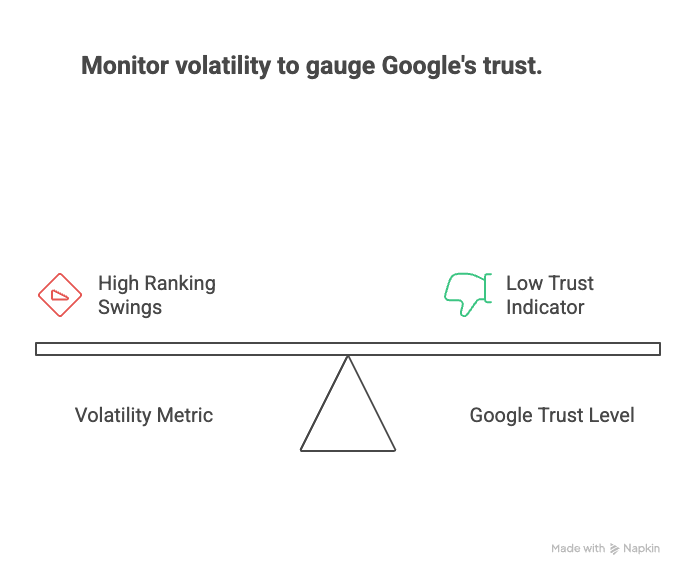
I’d argue the opposite. Volatility itself is the metric you should be watching. The swings in your local rankings are not noise to ignore; they’re diagnostics. The level of volatility tells you how much Google trusts you as the “default” answer.
Before I explain this view, let’s map the landscape of how other experts explain fluctuations.
What Most People Believe About Fluctuations
Ask in SEO forums and you’ll see three common takes:
- It’s just Google shuffling results.
Many think fluctuations are pure algorithm noise and can’t be controlled. - It’s proximity bias.
Others argue it’s all about where the searcher is standing. Move a few blocks and you’ll see different results, so volatility doesn’t matter. - It’s a penalty or an algo update.
Some panic every time rankings drop, assuming they’ve been hit by an update.
There’s some truth in all three, but they ignore the bigger picture. Volatility isn’t random. It’s how Google “stress tests” your business. If you vanish and reappear, it’s not punishment or pure chance. It’s Google deciding whether you’re a reliable answer across different users, devices, and locations.
And that’s exactly what we’re going to look into. But first, let’s understand a few things.
Volatility As A Trust Signal
Fluctuations aren’t just random. They’re testing how much they can trust your business.
Think of it like this:
- If your profile shoots up and then vanishes, that’s Google saying, “Not ready yet.”
- If you keep bouncing between the middle spots, it means Google is still figuring you out.
- If you stay locked in the top results with only small shifts, that’s a sign of strong trust.
This matters even more now with AI Overviews.
👉 Google is showing fewer local websites and only pulling in businesses it’s confident about. If your rankings keep jumping up and down, you’re less likely to get featured. A steady presence signals reliability, and that’s what earns you a spot in AI-driven results.
So, What Can You Actually Do About Ranking Volatility?
You cannot eliminate volatility. Rankings will always move; that is the nature of local SEO. But you can shrink the swings and build the kind of stability that earns long-term trust from Google. Here’s how:
1. Keep your profile fresh and active
Most businesses set up their Google Business Profile once and forget about it. That is a mistake. Google wants to surface businesses that look alive, not abandoned. Regularly update your hours, categories, services, photos, and posts. Even small changes signal that you are active and engaged.
2. Focus on steady review growth, not bursts
One of the strongest trust signals is how reviews come in. Ten reviews in a week, followed by silence, looks unnatural. Google notices. Instead, aim for slow and steady growth:
- A few high-quality reviews each month
- Staff trained to ask consistently
- Subtle reminders in emails or after service
Consistency beats intensity when it comes to reviews.
3. Improve the experience after the click
Google does not just look at your profile. It also tracks what happens after someone interacts with your business.
Negative signals include:
- Users clicking on your site and leaving quickly
- Calls that end right away
- Reviews mentioning slow service or unclear pricing
You can fix this by improving the experience:
- Fast-loading pages
- Clear service info
- Helpful FAQs
The smoother the journey, the stronger your trust signals become.
4. Strengthen your website with local content and schema
Thin websites are volatility magnets. If all you have is a homepage and a couple of generic service pages, Google does not have much to work with. A stronger approach is to create:
- Location-specific service pages
- Neighborhood landing pages
- Local resource guides that tie your business to the community
On top of that, add schema markup so Google clearly understands your services, locations, and details. The more context you provide, the more confidence Google has in where to rank you.
5. Track what your competitors are doing
Sometimes, a dip in rankings is not about you slipping; it is about your competitors leveling up. If you notice volatility, check whether they:
- Added a wave of new reviews
- Published fresh local content
- Built new citations
In many cases, they are stacking new trust signals while you have stayed flat. Watching competitors is not about copying them; it is about spotting what Google is rewarding right now and making sure you keep pace.
Conclusion
Ranking volatility is not something you can eliminate. It is something you learn from. Every spike or dip is Google testing how much it can trust your business, and your job is to keep sending signals that build confidence over time. Stability is what earns you visibility in the results that matter most, including AI Overviews, where only the most reliable businesses make the cut.
The way to get there is through consistency. Keep your profile active, grow reviews at a steady pace, improve the customer experience, publish local content, and track what competitors are doing. These actions turn volatility from a stress point into a signal you can use to guide your strategy.
For agencies and businesses, the challenge is scale. Managing all of this across multiple locations and clients can get messy very quickly.
That is where an operating system approach like Synup OS helps. Agencies often juggle a half-dozen tools to manage clients, one for listings, one for reviews, another for reporting, a CRM, and spreadsheets to tie it all together. Synup OS replaces that patchwork with a single system.