Marketing Agency Business Plan: Ready-to-use Template
Learn how to write a marketing agency business plan that actually drives growth and structure. Read our expert guide and follow the ready-to-use template.

Most founders start the same way, chasing after projects, winning clients, and staying up late to make it all work. Then it hits you: in a business that’s constantly risking saturation, creativity alone can’t sustain growth, keep clients happy, or scale a team that lasts.
You need an actual, honest-to-god business plan. Sure, it’ll also work as a slide deck for investors, but it’s also about you and mapping out the business success you wanna see.
Whether you’re running a five-person creative studio or a full-service digital agency, this guide breaks down how to create a marketing firm business plan that’s practical, actionable, and built for real growth.
TL;DR: Marketing Agency Business Plan (Ready-to-Use Template)
- Running an agency without structure can quickly turn chaotic. A marketing agency business plan fixes that.
Part 1: Executive Summary
- This is your agency trailer. Short, sharp, and clear about who you help and how.
- Include your mission, vision, UVP, core services, and 12-month goals.
Part 2: Business & Market Analysis
- Explain your origin story, legal setup, and team structure as investors value authenticity.
- Add a competitor table with strengths, weaknesses, and opportunities; it makes your positioning clear.
Part 3: Marketing & Sales Strategy
- Outline exactly how you’ll attract and retain clients, from SEO and thought leadership to paid ads and referrals.
Part 4: Management & Financial Plan
- Map out your team structure, who handles what, and KPIs for each role.
- Show startup costs, revenue projections, and break-even points.
- Healthy agencies maintain a 40–55% gross margin and a three-month cash flow buffer.
Part 5: Additional Sections
- Add a SWOT analysis to spot blind spots before they become problems.
- Use your appendix for bios, legal docs, portfolios, and market data.
Part 1: The Executive Summary
The executive summary section makes or breaks your plan. It's like your agency’s trailer. It’s gotta really quickly convince a reader that the full story is worth looking at.
A great creative agency business plan starts with a simple statement of intent. Don’t overcomplicate it. For example:
“We help small-to-midsize marketing agencies that serve local businesses generate high-retention recurring revenue through specialized local SEO, reputation management, and targeted listing management services.”
That’s clear and tells investors or clients exactly what problem you solve.
Next, outline your vision for growth. You may include specific milestones like:
- Increase annual recurring revenue (ARR) to $2 million in 18 months.
- Expand to three new verticals (Healthcare, SaaS, and Real Estate).
- Maintain client retention above 85% by introducing quarterly audits and training.
Now add your mission; that is, what you stand for. For example: “To make data-driven marketing accessible to every small business owner who wants measurable growth without the jargon.”
Finally, highlight your unique value proposition (UVP). Most agencies say they’re “creative” or “strategic.” That’s not a UVP. It’s a nothing burger that’ll get you nowhere. A real one sounds like this:
“We merge behavioral marketing psychology with technical SEO uto help clients double conversions without increasing ad spend.”
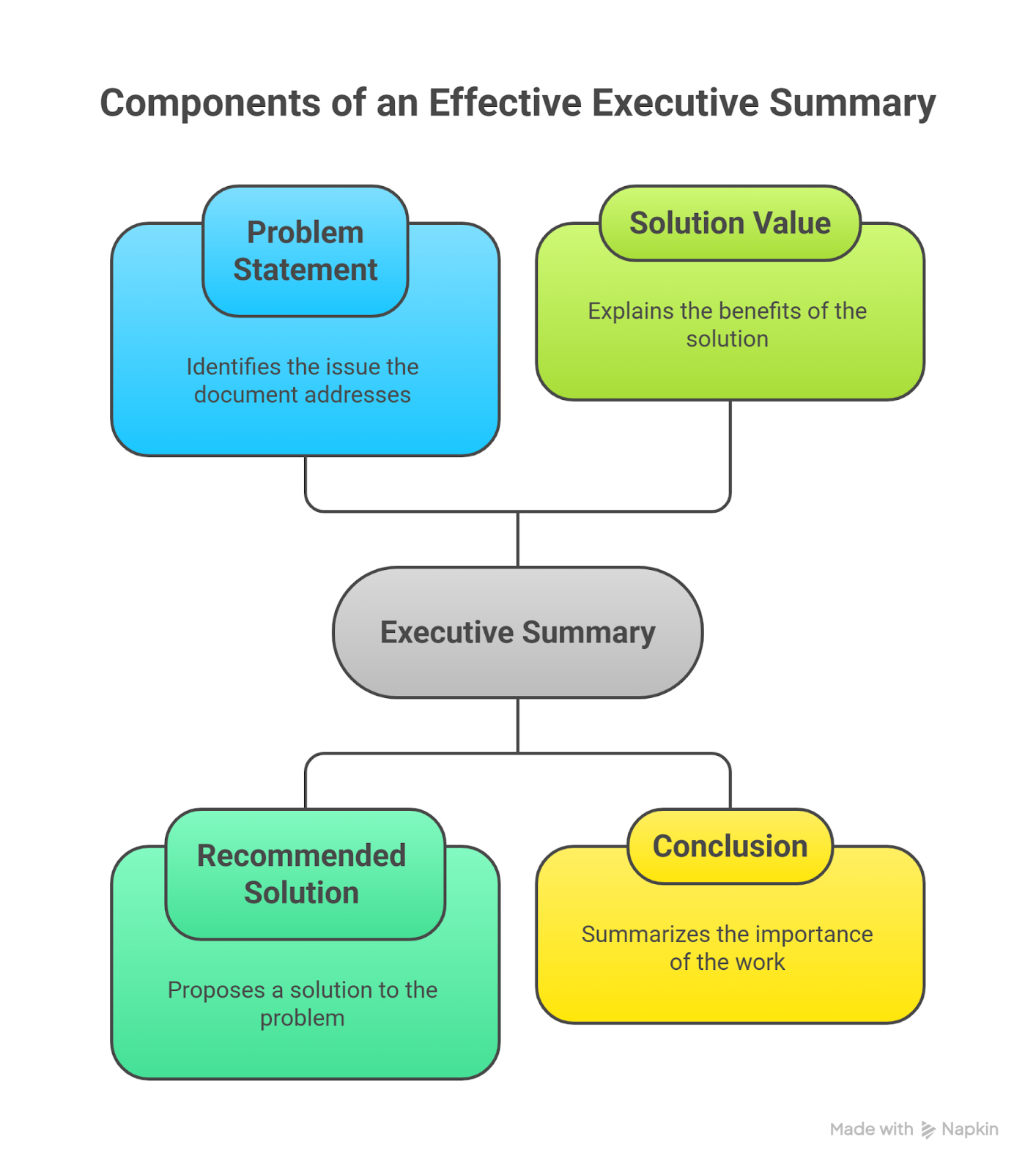
Pro tip: Set out to write this summary last. Once your full plan is ready, summarizing will be easier and more accurate.
Part 2: The Business & Market Analysis
This is where your business plan becomes grounded in market context. Numbers, trends, and structure matter here.
Company Description & Unique Value Proposition (UVP)
Always start with your origin story: how and why your agency began. Investors and clients want to see authenticity.
For example, if you have an existing operation:
“Founded in 2019 by a team of ex-brand strategists and SEO consultants, SparkMotion Agency started as a two-person shop in Austin. Today, we manage over 40 clients across the U.S., specializing in B2B lead generation campaigns.”
Once that’s done, detail your legal structure (LLC, S-Corp, etc.) and team makeup. Mention the founders’ experience, including years in the industry, major projects delivered, and notable client wins.
Your UVP has a place here too. Expand on what makes your agency irreplaceable. Maybe it’s that you integrate first-party data analytics with creative production, or that your reporting turnaround is under 48 hours.
Services Offered & Business Model
Be specific. Vague service lists don’t attract good clients. Outline your top offerings (which can look like this for a digital marketing agency):
- Local SEO & Listings Management: Google Business Profile optimization, local citation building, and review monitoring.
- Reputation Management: Review generation strategies, management of all review platforms, and response templates.
- Performance Marketing: Google Ads, Meta Ads, remarketing funnels.
- Content Marketing: Long-form blogs, case studies, landing pages.
- Social Media Management: Strategy, design, community growth, analytics.
- Other Project-based Services: Website design or specific one-off marketing audits.
Then explain your business model.
- Recurring Service Fees: 80% of revenue, based on per-location monthly pricing. Typical contract length is month-to-month, averaging $100–$200 per location (for single-location businesses).
- One-off Projects: 15% of revenue, primarily for services like website design or major marketing strategy audits.
- Consultation/Setup Fees: 5% for one-time client onboarding or in-depth service setup.
Include margins. Investors love and need to see them. Most mid-tier agencies operate at 40–55% gross margin; anything above 60% means you’re managing operations efficiently.
Finally, address your pricing philosophy. Example: “Our retainer model aligns incentives. We grow only when clients grow. This ensures sustainable client partnerships averaging 14 months.”
Market Analysis & Competitive Analysis
Here’s where you need to validate your positioning.
Define your target audience clearly:
- Location: US and Canada
- Company size: 10–250 employees
- Decision-makers: CMOs, founders, or marketing managers
- Pain points: lack of in-house expertise, inconsistent lead flow, and limited ROI tracking
Then build a competitor table. Include direct competitors and indirect ones (freelancers, AI tools).
For example:
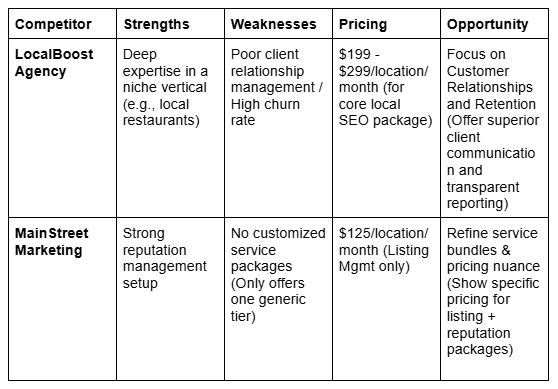
This shows readers that you understand where you fit in the market.
Part 3: The Marketing & Sales Strategy
A marketing agency business plan without a clear client acquisition and retention strategy is a non-starter. Here's what to include and how to go about it:.
Marketing Plan
Detail how you’ll attract, nurture, and retain clients.
- Outbound & Cold Outreach: This is an essential initial channel for the agency. Dedicate resources to cold calling and targeted cold email campaigns to acquire the first clients
- Social Media Ads: Allocate initial budget to channels like Facebook and Instagram Ads, where SMB businesses are more likely to be found, offering a better initial ROI.
- Email Marketing: Use lead magnets (like a free audit) to build lists of prospective local business owners or other agencies.
- SEO & Content: A longer-term play. Publish educational content, but focus resources elsewhere initially.
For client retention, create systems:
- Monthly strategy calls instead of report-only check-ins.
- Quarterly review decks showcasing real ROI metrics.
- Annual client workshops to refresh goals.
These small touches help maintain long-term relationships and reduce churn.
Sales Strategy
Now that your marketing generates interest, explain how your sales team converts it.
Start with your lead generation funnel:
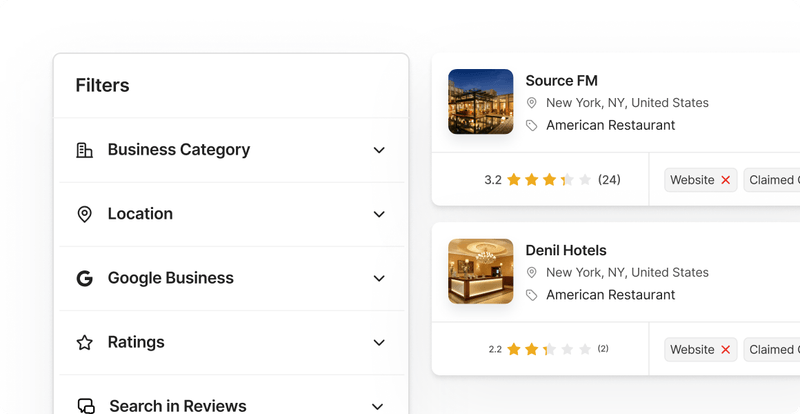
- Use the Synup SMB Leads Tool for it all (lead discovery and strategies for nurturing)
- Initial Cold Outreach/Calling (The first touchpoint).
- Discovery calls via Calendly or CRM forms (This follows initial contact/conversion).
- Free Mini-Audit (15 minutes) using an external scanning tool like the Synup Scan Tool to check for missing listings, review sentiment, and other local SEO issues
- Proposal within 48 hours. Onboarding within 5 days post-contract.
This timeline shows you’re organized and client-ready. Also, be transparent about your conversion rates and goals. You can, for instance, plan:
- 200 leads/month.
- 40 qualified.
- 10 new clients closed (25% conversion).
- Average Annual Project Value (AAV): $1,200 – $2,400 (Based on per-location recurring fees).
Then discuss tooling costs and estimate:
- Provide an estimated monthly cost breakdown for necessary tools across Sales (CRM, Cold Outreach), Payments (Invoicing, Billing), Project Management (Collaboration), and Service Delivery (Listing Management, Review Management, etc.).
- You could also consider an all-in-one solution like Synup OS as an alternative that improves margins by consolidating these platform costs.
Add retention metrics:
- Current Retention Rate: 60% – 70% (Due to higher churn with SMB clients).
- Goal: 90% within 12 months through loyalty credits and proactive upsells.
Part 4: The Management & Financial Plan
This part of your marketing agency business plan answers the big questions every investor, partner, or client wants to know: who’s running the business, and can the numbers back the vision?
Organizational Structure & Team
Your structure tells people how work flows, who’s accountable, and how decisions get made. Even small teams need this. Companies with defined organizational hierarchies are more likely to scale efficiently because there’s less confusion and duplicated effort.
An organizational structure helps employees work more efficiently, laying the groundwork for internal operations.
So, start by listing your legal structure.
Most U.S. marketing firms register as LLCs for tax flexibility and limited liability. If you’re expecting to raise funds or bring in partners, an S-Corp structure makes ownership shares clearer.
Then map your management chart. Use real names, titles, and experience. Here's an example layout:
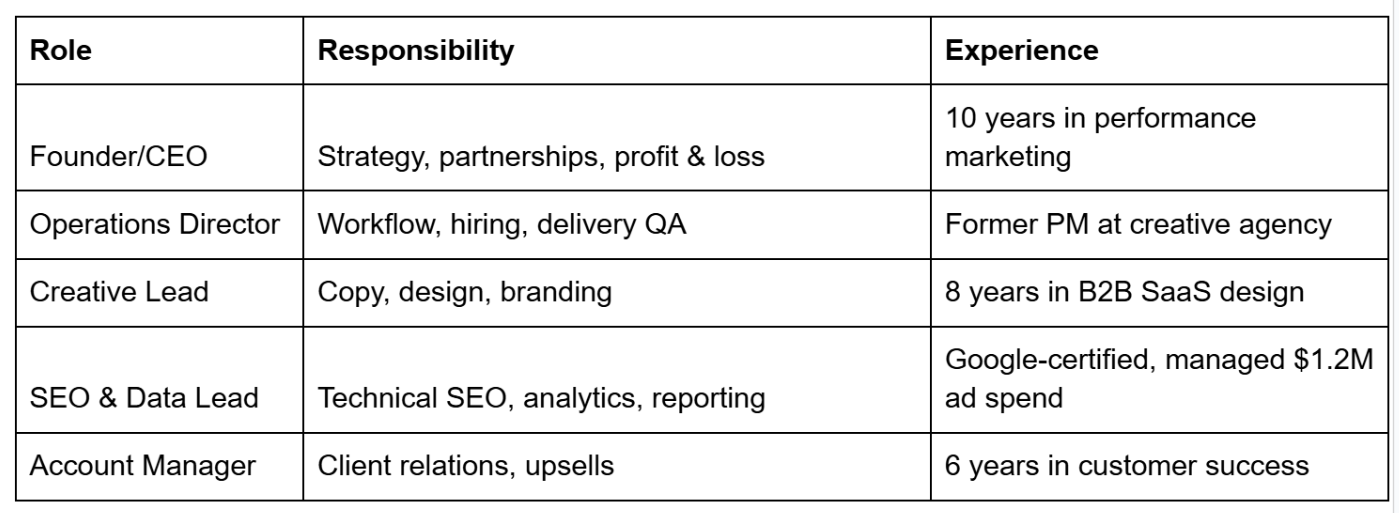
Each position should include KPIs. For instance, your operations lead may target 95% on-time delivery, while your SEO lead owns a 20% month-over-month organic traffic goal. That’s how you build accountability.
Also note your work model: remote, hybrid, or office-based. If you’re remote, mention collaboration tools (Slack, Notion, ClickUp). Investors like knowing you’ve thought about productivity systems.
Take This Further: Find the Ideal Marketing Agency Structure: 7-Step Guide & Best Practices
Financial Plan & Projections
Your financial plan is where vision meets math. A strong marketing firm's business plan includes three essentials:
- Income Statement (Revenue – Expenses = Profit)
- Balance Sheet (Assets, Liabilities, Equity)
- Cash Flow Statement (Money in vs. money out each month)
Here’s a snapshot for a 10-person digital agency:
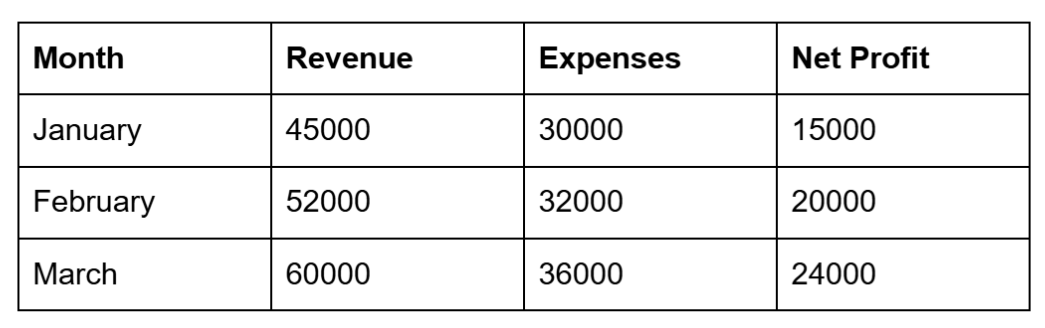
That’s a healthy 40% gross margin.
Don't forget to include your startup costs. An example could be:
- Website + branding: $1,500
- Legal + accounting: $700
- Marketing software: $600/month
- Initial ad spend: $1,000
- Laptop and tools per staff: $1,200 each
So, if you’re launching with five team members, expect $12K–$15K initial capital.
Then, calculate your break-even point. If your monthly fixed cost is $18,000 and your average client retainer is $3,000, you need six retainers to break even. Every client above that means a profit.
Also, forecast your cash flow buffer. Agencies with at least three months of operating expenses in savings survive downturns better.
Lastly, show growth assumptions:
- 10 new inbound leads/month
- 20% close rate > 2 clients/month
- Average client lifetime: 12 months
That’s predictable recurring revenue investors can trust.
Part 5: Additional Sections (As Needed)
Before wrapping up, it’s worth adding a few extra sections that make your marketing agency business plan more complete and grounded in reality.
SWOT Analysis
A business plan for a marketing and advertising company without a SWOT analysis is half-finished. It’s not a school exercise.
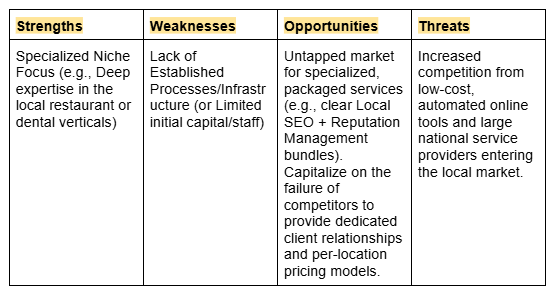
SWOTs help you pre-empt issues. For example, a marketing agency can use theirs to see a risk in PPC dependency. Then, invest in content strategy, and see organic leads replace one-third of paid traffic.
Appendix
Your appendix is where you should nestle in your credibility. Make sure you add:
- Team bios with LinkedIn links
- Legal docs (LLC registration, insurance, service contracts)
- Portfolio samples and testimonials
- Market data from IBISWorld or Statista showing sector growth
If you need help organizing a marketing business plan for your new agency, we’ve built a marketing company business plan sample tailored for digital and creative agencies. Find it here:
Complete Marketing Agency Business Plan Template
It includes sections for goals, team structure, KPIs, and financial modeling, all ready to plug your data into.
Conclusion & Next Steps
A business plan is your playbook. It keeps your team aligned, impresses clients, and shows investors you understand numbers, not just creatives.
Use this guide and business plan template to structure and clarify who runs what, where your revenue’s headed, and how you’ll adapt to market shifts. Then power your operations with Synup’s OS for SMBs. Curious about how it works? Find out in this quick demo.
Frequently Asked Questions
- How detailed should a marketing agency business plan be?
Around 1,500 to 3,000 words is usually enough if you’re being honest and specific. Include how much you plan to make, who’s doing what, what clients you’re targeting, and what success looks like in numbers.
- Do I need separate plans for creative and digital services?
Not unless they’re run like two different companies. Most small and mid-sized agencies keep one creative agency business plan that covers both. You can simply split service lines inside it. For instance, have one section for brand and design retainers and another for paid media or SEO. It keeps your numbers in one place and helps you see how both teams drive profit together instead of working in silos.
- How often should I update my plan?
You should update your business plan every three months without fail. Marketing moves fast. New tools drop, clients shift budgets, and what worked last quarter might flop this one. A quarterly review helps you stay ahead and spot patterns early. Even a one-hour update meeting with your leadership team can reset priorities and stop you from drifting off track.