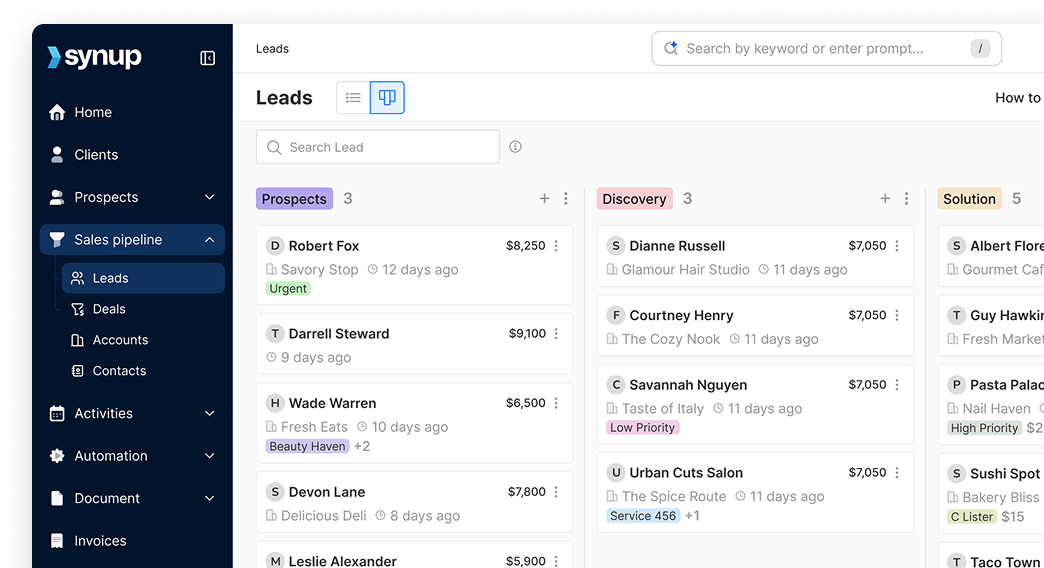
Your Complete Guide to Marketing Agency Sales Process
Learn how to master your digital agency’s sales process from lead to onboarding. Build repeatable growth, boost forecasting & client retention.

The biggest irony in our industry is that most marketing agencies can’t market their services effectively.
The creativity is there.
The client results are often great.
But when it comes to running a consistent marketing agency sales process, things start getting difficult. Many agencies rely on referrals, luck, last-minute pitches or random requests for proposals to keep business flowing.
And it’s costing a lot of agencies big time. 34% of agencies say client acquisition is their toughest challenge. Without a defined sales process, you simply can’t forecast revenue, scale your team, or build stability.
In this guide, you’ll learn:
- Why your digital marketing agency's sales process is the backbone of predictable growth.
- Step-by-step actions to build a reliable agency sales pipeline.
- Real-world examples that show what works.
If you’re tired of praying for leads, burning thousands on paid ads and chasing ghost prospects, read on.
TL;DR: Marketing Agency Sales Process Guide
- Without a defined digital marketing agency sales process, revenue forecasting and scaling become nearly impossible.
- This guide walks through the full journey: foundations > prospecting > qualification > proposal > negotiation > closing > onboarding
- A predictable sales process turns unpredictable “feast-and-famine” months into predictable revenue.
- How to do this:
- Lay the groundwork: Define ICP, craft value proposition
- Prospecting and lead generation
- Qualification and discovery: Use frameworks, determine discovery call essentials
- Presenting your solution
- Proposal, negotiation, and closing
- Onboarding and follow-up
Why a Defined Sales Process is the Foundation of Agency Growth
A digital agency sales process is a documented, repeatable set of actions that takes someone from stranger > lead > client, and, if the process is well-oiled > promoter.
Without one, every deal depends on the founder’s charm, timing, or luck.
An agency owner shared online how his 5-year-old software firm grew to a 20-person team purely through referrals and word of mouth. After trying everything from cold outreach to Meta campaigns, he admitted that nothing brought consistent results. “Clearly, we’re missing something,” he wrote.
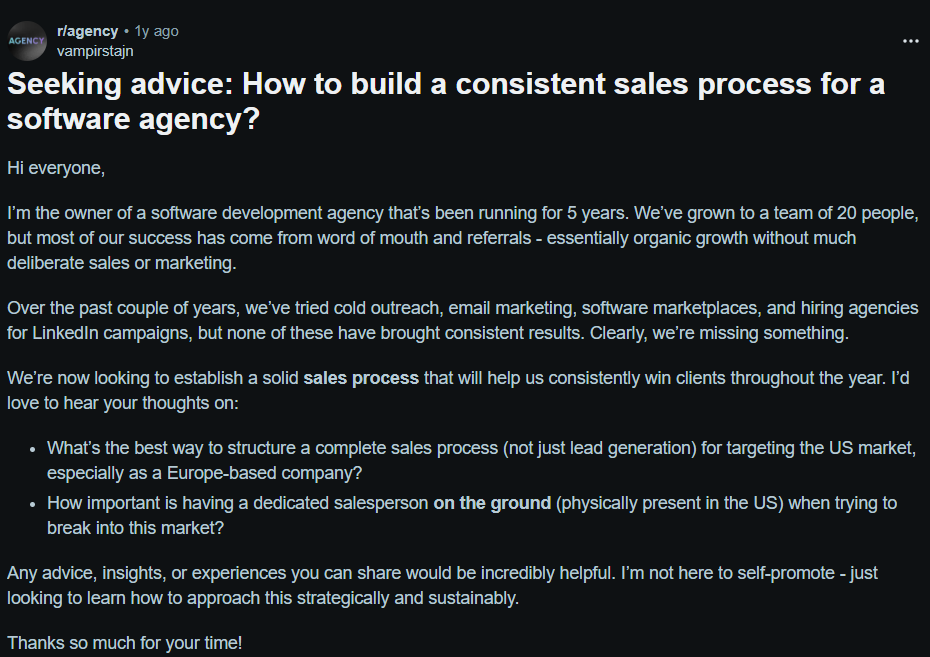
WITH a dedicated sales process, you can scale your agency easily.
Here’s why it’s non-negotiable:
- It makes your revenue predictable.
You can’t grow what you can’t forecast. Agencies with documented processes are 33% more likely to outperform competitors in deal closures. With structure, you can plan cash flow, make hiring decisions, and stop living in “project-to-project” survival mode.
- It speeds up onboarding for sales hires.
When your process is written down, new reps don’t need months to “figure it out.” They know how to qualify leads, what discovery questions to ask, and how to follow up. That saves time and eliminates founder bottlenecks.
- It improves client experience.
A clear agency client onboarding process doesn’t just make you look professional; it builds trust from day one. Clients hate confusion. If your steps are smooth (from proposal to kickoff), they’ll feel they’re working with a well-oiled partner, not a freelancer winging it.
- It filters out bad clients before they drain you.
The right process naturally attracts good-fit clients and screens out red-flag ones. Many agencies waste months with clients who don’t really understand their offerings. After defining qualification steps, they can invest in high-value leads instead.
Let’s paint a picture.
Imagine Agency A and Agency B.
- Agency A: Every deal is a new adventure. Leads come from random DMs, friends of friends, and inbound website forms. The founder still handles all sales calls.
- Agency B: Has a clear agency sales pipeline mapped in a CRM, from prospecting to qualification, proposal, negotiation, to deal close. They tag, track, and move every new lead through a defined journey. Within six months, Agency B improves close rates by 38% and increases deal volume by 2×.
Many agency experts agree there’s no one-size-fits-all process. A paid ads agency will structure it differently than a PR shop. But the core principles remain. Let’s get into the actual steps.
Step 1: Lay the Groundwork (Before You Prospect)
Before chasing leads or flooding LinkedIn with DMs, you’ve got to sort your foundation. A proper marketing agency sales process doesn’t start with selling.
You need to start by being painfully specific about who you’re trying to reach, what you’re really offering, and how you’re different from every other “full-service” shop out there.
Let’s break down how to actually build that foundation.
Define Your Target Audience (ICP) & Client Personas
You can’t build a sales process if you don’t know who you’re selling to. Too many agencies still use broad terms like “small business” or “startups.” That isn’t a niche at all. That is the whole economy.
Your Ideal Client Profile (ICP) should clearly outline:
- Industry/vertical: e.g., legal, hospitality, healthcare.
- Location: US-based, EU-based, global.
- Revenue size or ad spend: e.g., $1k+ monthly marketing budget.
- Decision-maker role: Owner or Marketing Manager.
- Pain points: Lack of qualified leads, poor brand visibility, and inconsistent ROI.
Example: “We work with SMB clients in the US spending $500-1000 a month on marketing.”
That specificity filters out mismatched leads before they waste your time.
One founder recently shared on Reddit that after eight years of running a video marketing business, he’d never defined a clear ICP because he was used to saying yes to every project that came his way.
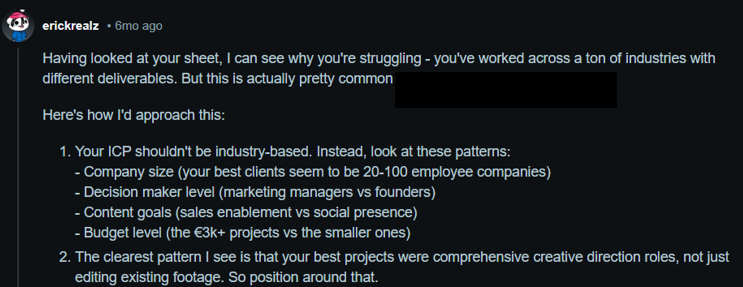
Pro tip: Build two or three client personas based on your ICP. Give them names and real-world context. For example:
- Renee, the Marketing Manager (retail): Juggles multiple channels, values reliability, and hates overpromises.
- Tom, the Founder (Local Business): Wants more footfall to store, hates long strategy talk, and makes decisions fast.
Mapping these personas lets you personalize outreach and content.
Craft Your Value Proposition
Once you know who your dream clients are, the next step is nailing why they should choose you.
Your value proposition should answer three simple questions:
- What do you solve?
- Who do you solve it for?
- Why are you different?
Weak: “We help businesses grow online.”
Strong: “We help SMB clients drive 40% more footfall from their Google Business Profile & online channels”
Specificity sells. Agencies that lead with measurable impact outperform “full-service” generalists.
Seven out of ten agencies still sound the same. Everyone says, “We help businesses grow online.” But no client has ever woken up saying, “I need to grow online.” They wake up saying, “Why is my cost per lead so high?” or “Why is no one seeing my website?”
As your next step, tie your value proposition directly into your pitch decks and proposals.
Also, your value proposition has to connect emotionally, too. The more your copy reflects understanding of a prospect’s pain, the faster they’ll trust you.
When crafting it, use their language. If your ICP calls it “customer acquisition,” don’t call it “lead generation.” Mirror their tone and phrases. It shows you understand them.
And here’s another thing: your value proposition should flow right into your proposal and sales pitch. If you say you’re an “ROI-first paid ads agency,” your proposal better start with how you’ll measure ROI and what metrics define success.
Step 2: Prospecting & Lead Generation
Now that your foundation is set, let’s talk about filling your agency's sales pipeline with qualified leads. A lot of agencies get inconsistent here. They have a great one month and get silent the next.
The truth is, prospecting is about connecting, not convincing. It’s how you reach out to potential clients in a way that feels relevant, helpful, and personal. To do that well, you’ll need a balance of both inbound and outbound methods, a human touch, and the patience to nurture relationships before they turn into sales.
Your agency sales pipeline is your oxygen. Without consistent prospecting, your digital agency sales process stalls.
Set Clear Prospecting Goals
Your pipeline is your heartbeat. When it weakens, your agency weakens. When it stops, your agency flatlines. You need a clear idea of what top-of-funnel activity should look like every month.
Let’s say your average retainer is $4,000, and your close rate is 20%. That means you close 2 deals for every 10 proposals. To add $20,000 in monthly recurring revenue, you’d need at least 50 qualified leads each month.
Without that math, you’re working blindly.
A digital agency sales process typically runs through seven stages:
- Prospecting
- Discovery
- Qualification
- Proposal
- Negotiation
- Closing
- Onboarding
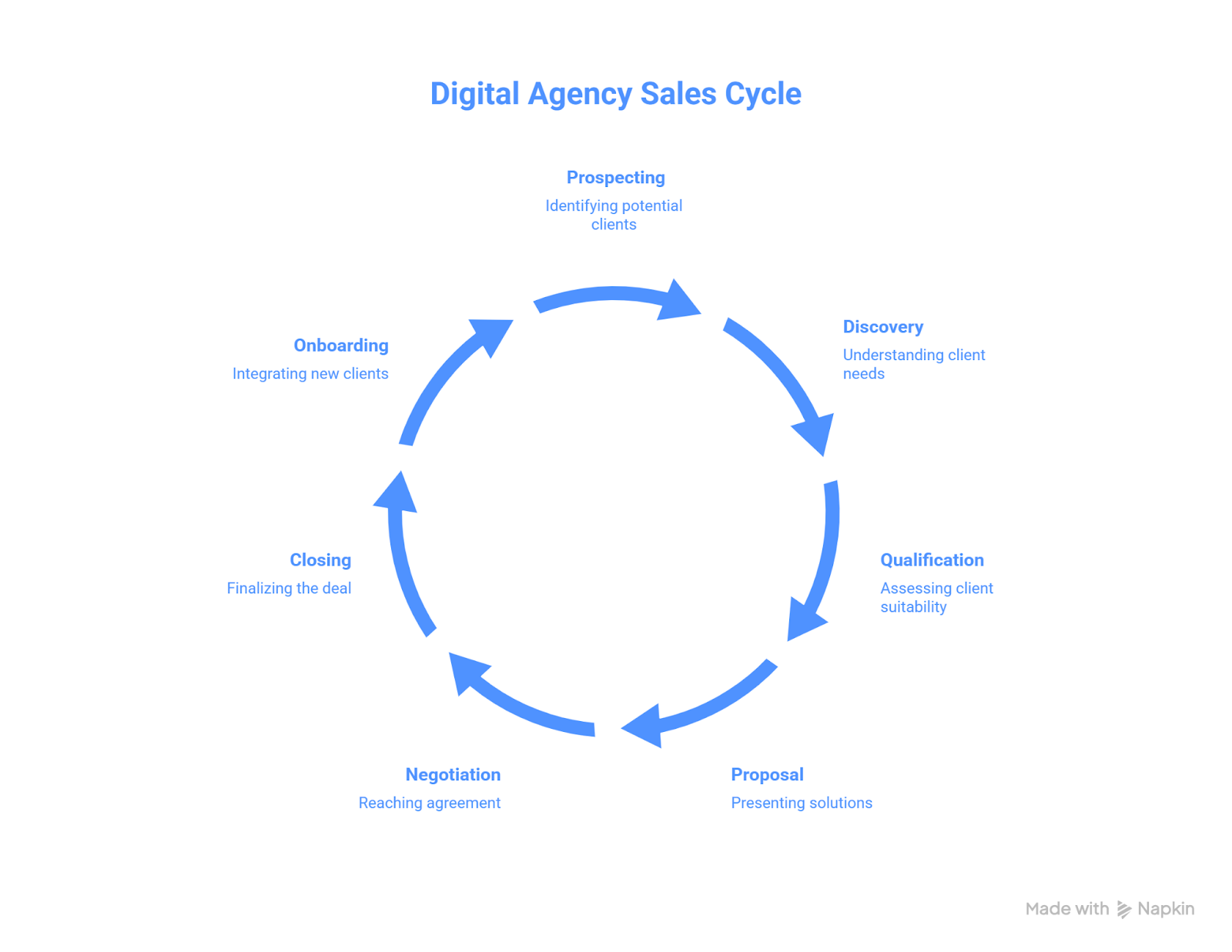
Source: Napkin
Each stage deserves data tracking: how many leads, what sources, and how many convert.
Inbound vs. Outbound
Inbound brings people to you, and outbound helps you reach the ones who should already be talking to you. Both are key.
Inbound Is The “Come-to-Us” Engine
Inbound prospecting attracts leads through valuable content that builds trust and shows what your agency does best. Think blogs, case studies, videos, or even social posts that address common client challenges. When done right, your content does the talking long before your first call.
Start with content that helps your audience. Talk about real problems your ICP faces every day. For example:
- If you’re a PPC agency, publish something like “5 Mistakes SMB Businesses Make on their Local Listings”
- If you run a branding studio, try “How Local Businesses Waste Ad Spend Without Realizing It.”
Also, add a short, no-BS checklist at the end, maybe an “Ad Spend Audit” download or “Local SEO Brand Visibility Scorecard.”
Also, don’t sleep on webinars. Host a 30-minute live session like “Scaling Local Services Ads Without Raising Budget.” Keep it casual with less PowerPoint and more talk. Record it, cut the clips into short Instagram posts, and repurpose it into a YouTube video. One good webinar can feed your entire funnel for weeks.
Publish bite-sized case studies that highlight results. And finally, referrals. Happy clients are your best lead source. Create a simple referral incentive, even if it’s a discount, gift card, or feature spotlight. According to Nielsen, over 90% of people trust recommendations from people they know. That’s free marketing you can’t buy.
Here's an example of a working inbound flow:
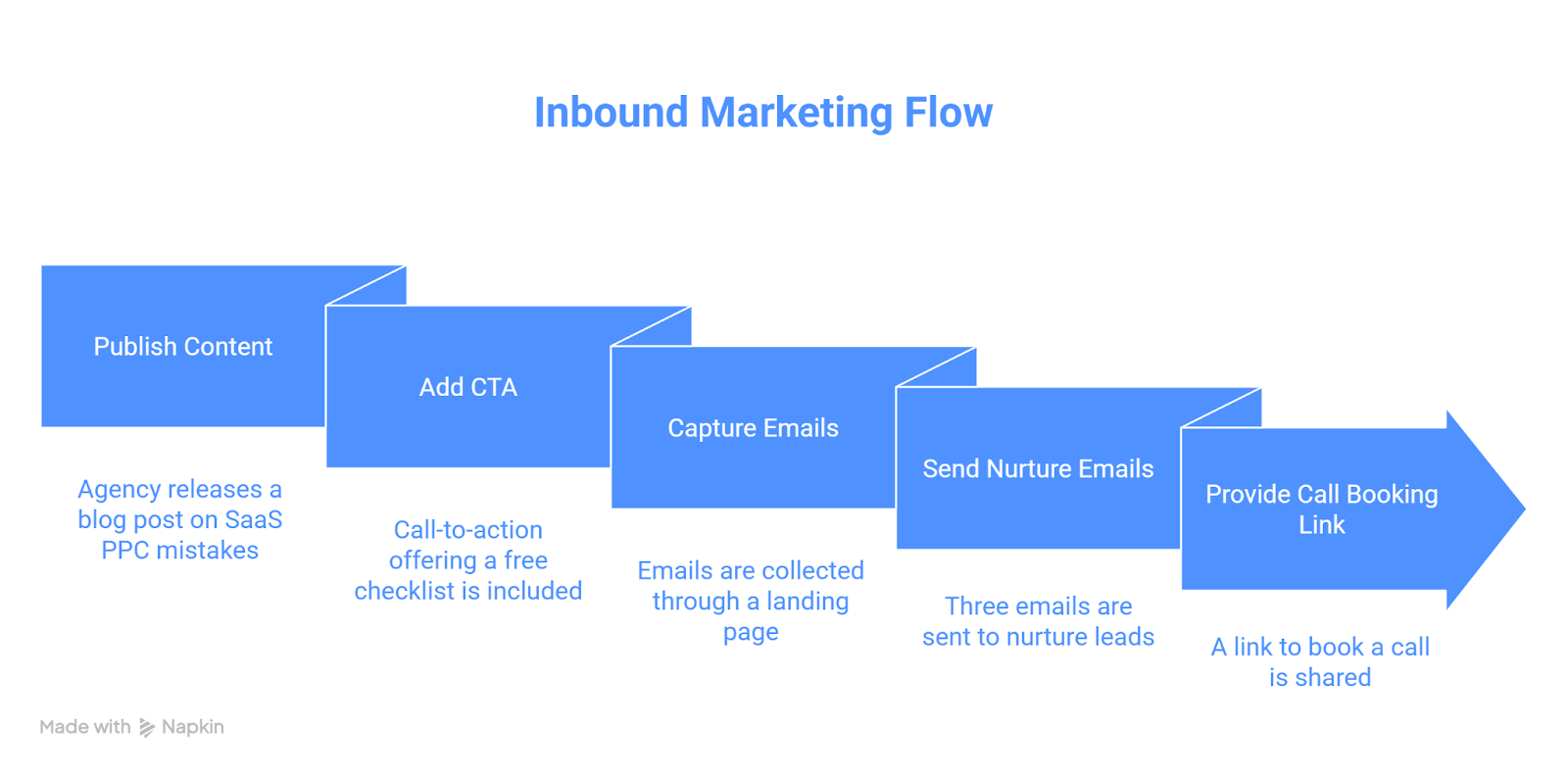
The best part is that once your inbound setup is live, it keeps running even when you’re busy with client work.
Outbound: The “Let’s-Talk” Play
Now let’s flip to outbound, the active side of your digital marketing agency sales process. Outbound prospecting is about taking initiative and starting conversations with people who fit your ideal client profile. Cold emails, DMs, or networking at industry events all count. The key is to make every interaction feel thoughtful and personal rather than salesy or automated.
Start by building quality prospect lists.
Look for companies already spending on ads or posting about campaigns. If you see a business running Facebook Ads but missing call extensions, that’s a golden conversation starter.
For example:
“Hey, noticed your ad on Google for [product/service], looks great. But you’re missing site link extensions that could boost your click-through rate by 15–20%. Would you like me to show how that works?”
Also, outbound isn’t just about email. Combine channels: connect on LinkedIn, leave meaningful comments, send a short video message, or even drop a voice note. The more real you sound, the more likely you’ll get a response.
Plus, mix in partnerships and events. Attend local marketing meetups, webinars, or niche conferences. Don’t pitch right away, but chat, share insights, and connect later. Relationships made in person (or virtually) often convert faster than cold contacts.
Where to Find Leads That Convert
- Job Boards
A lot of agencies ignore this, but job boards are one of the easiest places to find warm leads. When a company posts roles like “Marketing Manager,” “SEO Lead,” or “PPC Specialist,” they’re already telling you three things:
- they have a marketing problem,
- they have a budget set aside,
- and they’re actively looking for help almost immediately.
You’re not convincing them to care. You’re simply showing up when they already do.
Good places to monitor:
- Indeed
- AngelList for startup-heavy roles
Also, don’t overthink it. Spend 10 minutes daily scanning new marketing-related postings. You’ll start to see patterns and companies that clearly need external support.
Then reach out with something like this:
“Hey [Name], noticed you’re hiring for a Marketing Manager. Would you consider an agency partner who can handle your campaigns while you find the right hire?”
This works because you’re stepping into a moment of urgency. Hiring takes weeks or even months, and performance usually drops during that gap. You’re offering the perfect bridge.
Besides, most prospects will instantly understand the value. You save them time, reduce pressure, and keep their pipeline moving.
- Paid ads watchlist
Another idea is to track companies already advertising. These companies are usually easier to talk to because they already believe in advertising and have a budget on the table. Plus, they know the pain of not getting the results they expected.
Also, these prospects tend to make faster decisions because they can instantly compare your offer to their current spend. If they’re wasting money, they know that immediately.
You can spot these companies on platforms like Yelp, Google Ads, and Twitter Ads. Each network tells you something different about the business.
- Yelp often signals local brick-and-mortar shops trying to boost visibility.
- Google Ads usually indicates a business already chasing bottom-funnel intent.
- Twitter Ads can hint at brands pushing awareness or trying to reach niche communities.
Besides that, the ad platform itself gives you clues about the business’s goals and where they’re struggling. A local business dumping money into Yelp, for example, almost always has complaints about visibility, unfair reviews, or rising ad costs. This gives you an easy way to tailor your outreach.
Here’s the thinking behind it: if they’re spending money but still frustrated, they’re already primed to hear alternatives. You’re not pitching them out of the blue but offering relief.
Also Read: How To Automate Sales Follow-Ups To Book More Clients
Step 3: Qualification and Discovery
Before you even think about pitching, you need to figure out whether this prospect is someone your agency should be spending time on. A good qualification screening is how you stop chasing every “interested” person and start focusing on the ones who can actually become long-term, profitable clients.
Also, it saves your team from wasting hours or days building proposals for tire kickers (people who were never serious). In addition, it positions you as the agency that chooses clients instead of begging for them. And that shift alone changes how prospects treat you.
Qualification Frameworks: BANT, CHAMP, and MEDDIC
Every prospect looks good in the inbox. It’s when you start asking the right questions that you realize who’s a real fit and who’s window-shopping. This three-model qualification framework gives you structure without turning the conversation into an interrogation.
- BANT, short for Budget, Authority, Need, Timeline, is the easiest place to start. If someone says they “want help with digital marketing” but can’t share a budget, doesn’t control spending, and has no timeframe, you already know where that deal is heading. You will spend weeks waiting for decisions that will never come.
- But sometimes you need more depth. CHAMP can help with this. You start with their Challenges, then dig into Authority, Money, and Prioritization. This works better for agencies solving a specific pain point, because it helps you understand how urgently they want to fix the problem.
- Then you’ve got MEDDIC, which is useful when selling higher-ticket retainers or working with multi-location businesses. The focus is on Metrics they care about, the Economic buyer, their internal Decision process, the things that influence their Decision criteria, the Pain behind the problem, and the Champion inside the company who will advocate for you. It’s a lot, but it stops you from getting blindsided later.
Here’s a simple comparison you can use:
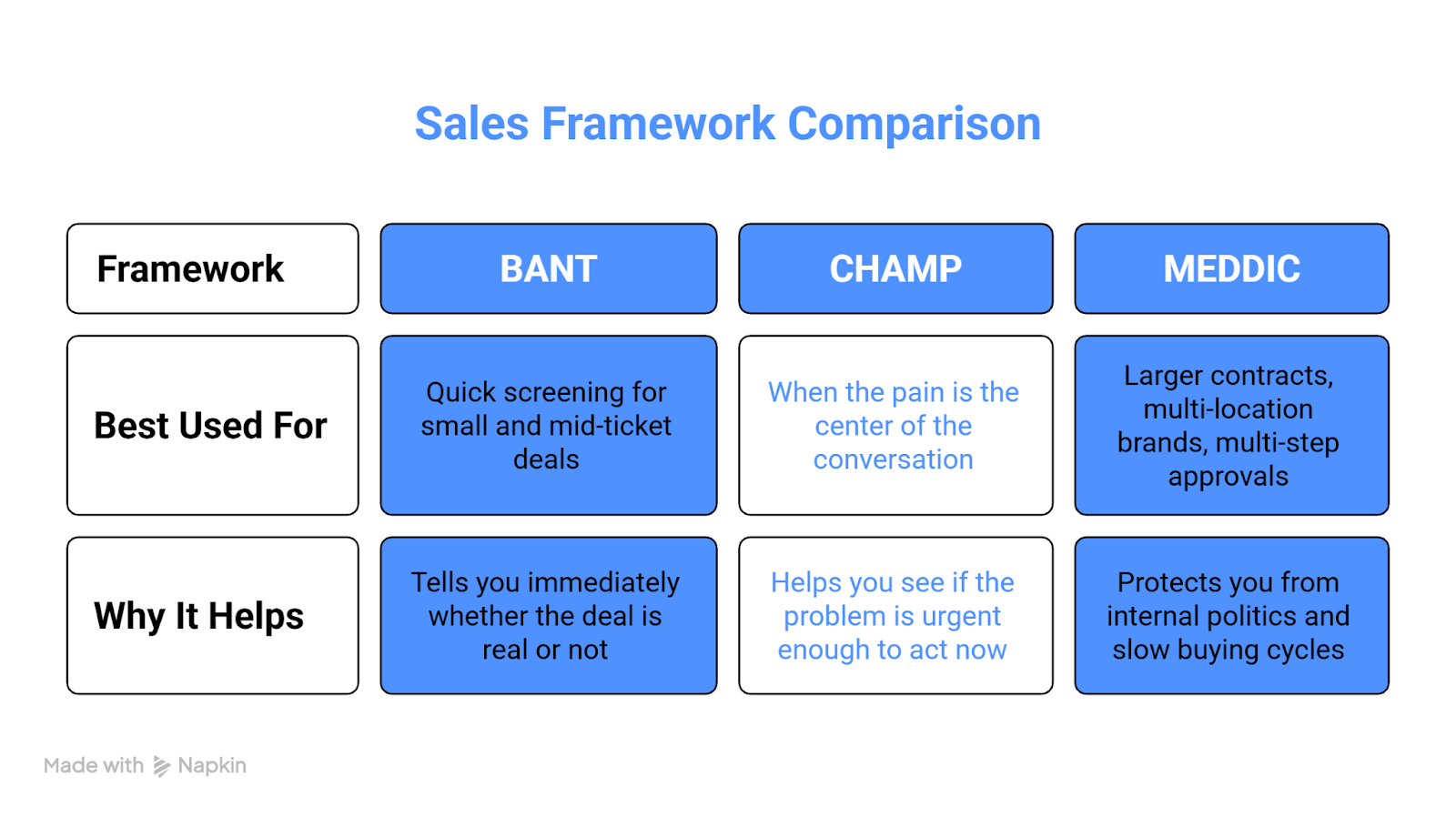
Choosing one is less important than using it consistently. Also, your entire agency's sales pipeline becomes easier to predict when every rep qualifies the same way. Plus, you’ll get cleaner CRM notes, which will make handoffs faster later. Another thing: clients respect agencies that ask smart questions early. It shows confidence.
The Discovery Call
After you qualify the lead, the discovery call is where you confirm the match. Think of it as your X-ray before prescribing anything. A lot of agencies treat discovery as their chance to “sound smart,” but discovery is really about listening. Your job is to uncover what they’re struggling with, where they’re trying to go, and what’s been holding them back.
A good discovery conversation usually covers five things:
- their goals,
- their pain,
- their previous attempts,
- their decision process,
- and their timeline.
For example, imagine you’re on a call with an e-commerce owner. Instead of going straight into “here’s what we can do,” ask simple, grounding questions:
- What have you tried already?
- What worked?
- What flopped?
- What kind of results would actually make this feel worth it for you?
- And just so we don’t waste time later, who signs off on this type of spend on your side?
Here’s how one agency handles things:
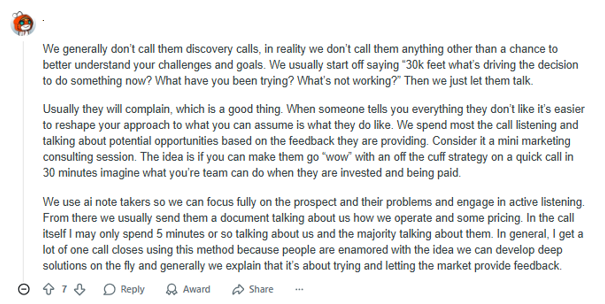
Questions like these can open doors for you. You’ll hear everything from internal disagreements to unrealistic expectations, to the painful truth that “we’ve worked with three agencies already and still aren’t seeing results.”
You should never be in a position where you’re hoping a client picks you. A good qualification makes the power dynamic healthier. You choose them as much as they choose you.
Step 4: Presenting Your Solution
Once discovery shows the prospect is real, you guide them into the next stage of your digital agency sales process.
It's like a tailored fitting. Anyone can buy a suit off the rack. But the one that fits perfectly wins. Also, presenting isn’t talking non-stop. It’s showing you actually listened.
Tailored Presentation vs Generic Pitch
Clients want to feel like you understand their exact business.
For example, if the prospect is a home services brand, show how you improved call campaigns across multiple cities.
Also, include a roadmap: “What happens in the first 30 days, 60 days, 90 days”
Present outcomes like: “Our goal is to increase your monthly qualified leads by 25% within the first quarter.”
Including a co-creation step reduces friction. Make the client feel involved. Besides, it shows them that the solution is built around them.
Showcasing Expertise: Case Studies, Testimonials, Data
You don’t need big brand names to impress. You need clarity, results, and relevance.
Use two or three short case summaries:
- one win with a similar client,
- one where you overcame a challenge.
Also, pull insights from reviews or comments clients have left publicly. Use metrics where you can, even basic ones like:
“We increased form submissions from 2 to 4% in eight weeks,” or “We grew organic leads by 30% in one quarter.”
Handling Objections
Every agency hears the same objections:
- “We don’t have the budget.”
- “We’ve worked with agencies before, didn’t go well.”
- “Who exactly will be managing our account?”
- “What guarantee do we have?”
Here’s how you respond without sounding defensive:
- Budget concern: “I completely understand wanting to spend carefully. Let’s prioritize what brings results fastest, and we can scale as revenue grows.”
- Bad past experience: “I hear this a lot. Many agencies overpromise and then fail or disappear. Our approach is structured: weekly updates, clear KPIs, and direct access to your account manager.”
- Who will manage this: “Your account will be managed by a dedicated strategist, not entry-level staff. You’ll meet them during onboarding.”
This approach aligns with advice found in many sales studies: agree with the concern, then guide the conversation toward clarity instead of pushing back.
Step 5: The Negotiation and Closing
After presenting, the conversation shifts from “what you do” to “how we work together.” This is where your proposal, pricing, and confidence matter.
You send a proposal that includes:
- clear deliverables,
- timelines,
- price options,
- expected outcomes.
Flexibility is okay, but know your minimum acceptable price. When a client asks for the same value at half the cost, you are no longer negotiating. You’re giving it away.
Let’s say your agency quotes eight thousand monthly. The prospect wants six. You can offer a six-month trial at the lower rate, but make sure you include a scheduled review and clearly state the return to full pricing afterward. This can keep the deal alive without shrinking your margins.
Track your proposal-to-close conversion rate. Many agencies aim for somewhere between 20% and 25% of qualified leads. The number matters less than knowing your baseline and improving it.
Pro tip: Always put things in writing. Check out our SEO Contract Templates for some inspiration.
Step 6: Onboarding and Follow-Up
Sales doesn’t end with the signature. A strong agency client onboarding process can turn a one-time deal into long-term revenue. Here's how your onboarding and hand-off should look:
Seamless Handoff
A smooth handoff is where clients start to feel the difference between a scrappy agency and a well-run one.
The flow usually looks something like this:
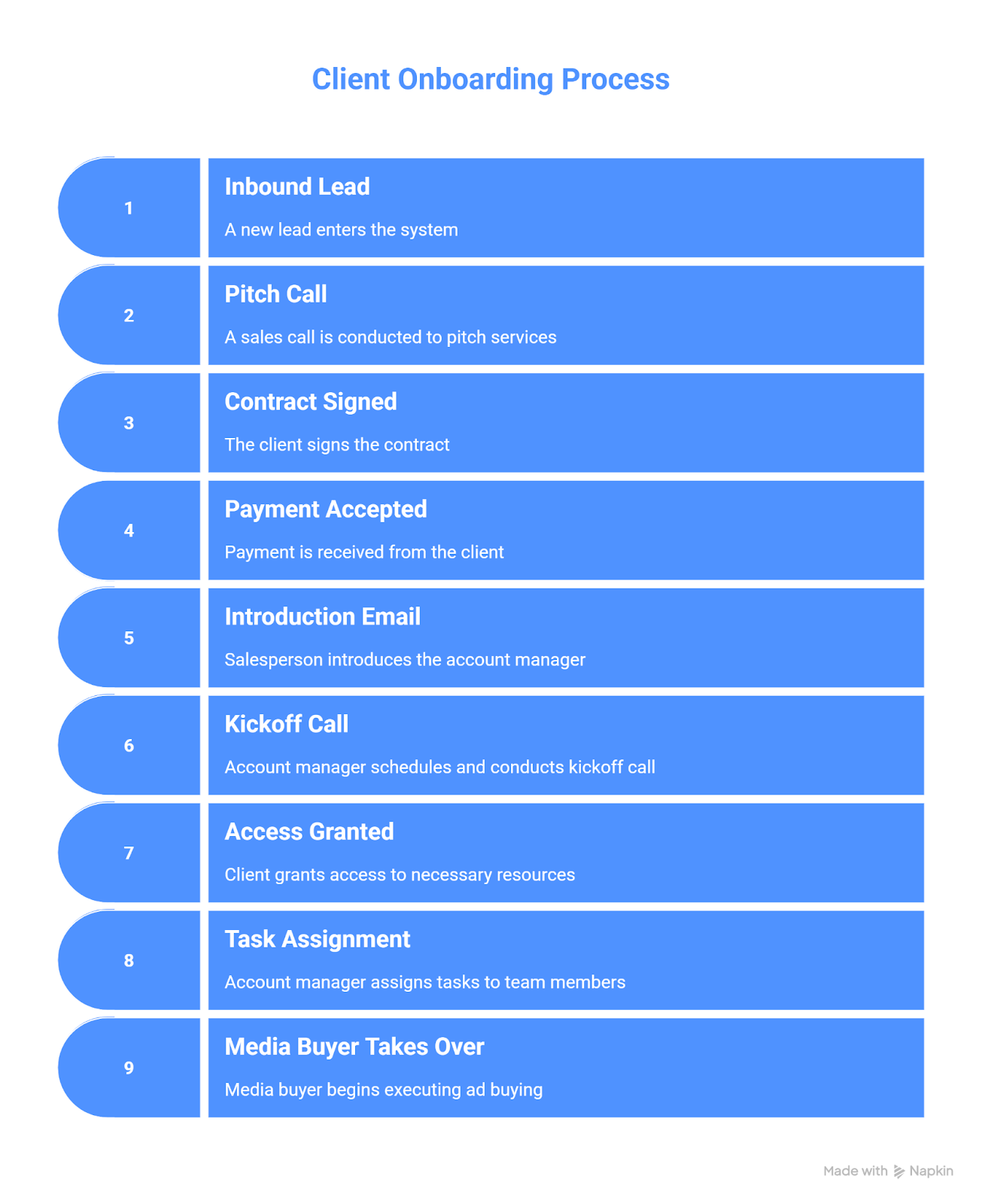
An inbound lead comes in, the pitch call goes well, the contract lands, and payment hits your account.
Right after that, the salesperson sends a warm introduction email to connect the client with their account manager.
From there, the account manager takes the wheel. They schedule the kickoff call, walk the client through what’s coming next, and collect access to every platform they’ll need. Also, they follow a checklist so no step is missed. Plus, they start assigning tasks to the people who will execute the work. The media buyer steps in shortly after and begins planning and launching campaigns..
That's a simple onboarding flow used by agencies.
On the client side, send a welcome pack, introduce the team, outline expectations, and set communication rules. This builds trust early.
Also Read: 8-Step Client Onboarding Process for Marketing Agencies (+ Checklist)
Nurture the Relationship
Onboarding isn’t the end. Keep checking in at thirty days, ninety days, and six months. Ask about satisfaction, gather feedback, and adjust your approach.
Research in multiple industries shows strong follow-up boosts retention. High retention increases revenue because upsells and referrals happen naturally with happy clients.
Use NPS or a short survey to measure sentiment. When a client gives positive feedback, ask for a testimonial or include them in a case story.
Happy clients sell your services better than any cold email.
Conclusion and Next Steps
By now, you have walked through every major stage of the digital marketing agency sales process. You understand qualification, discovery, presenting, negotiation, onboarding, and nurturing. This is not a collection of isolated actions. It is a system, and systems scale.
So choose one stage to sharpen this week. Refine your discovery checklist. Rewrite your proposal template. Strengthen a single part of the chain. As you grow, keep iterating and tightening your process.
That is how an agency stops winging it and starts compounding.
Also Check Out: Blueprint for a Successful Outreach Campaign for SMB Prospects
FAQs
- What is the average close rate for a digital marketing agency?
Close rates vary, but many agencies see around 20 to 27% with qualified leads. Track your own numbers to know what healthy looks like for your niche.
- How long should a sales cycle be?
Smaller retainers may close in four to eight weeks. Larger retainers or multi-location clients may take several months. Document your average cycle so you can forecast better.
- How many touch points does an agency's sales process usually take?
Multi-touch outreach wins. Many agencies see the best results with three to five touches across multiple channels. The common pattern is three touches, three days apart, using three channels.