SEO Pricing Guide: How Much to Charge for Agency SEO Services
Learn how to price your agency’s SEO services in 2026. This guide covers monthly retainers, local SEO costs, and per-location models for growing agencies.

The pricing gap in the SEO industry is getting wide and weird. You can hop onto a freelance site like Upwork or Fiverr and find someone offering comprehensive SEO per account for $300 a month. Meanwhile, some top firms in New York or Toronto won’t even pick up the phone for less than $15,000.
When a local roofing contractor sees one quote for $800 and yours for $2,500, they don’t see “quality difference.” They just see a $1,700 gap that they don’t understand.
The reality faced by agencies in the markets is that the middle ground is shifting. As AI transforms how people search through tools like ChatGPT or Google’s AI Overviews, the old-school checklist of just updating meta tags and building a few directory links on random sites is becoming obsolete.
To build a sustainable SEO agency in the US or Canadian market, you need to price for the “messiness” of search. This guide breaks down exactly how to structure your fees to cover overhead, tech stacks, the specialized labor, and, of course, your 15-30% profit margin.
TL;DR: SEO Pricing Guide (for Agencies)
- SEO pricing ranges widely, from $300 to $50,000+, because agencies sell very different levels of strategy, labor, and risk. Clients don’t see the difference unless you show it clearly.
- Most agencies use monthly retainers because SEO compounds over time and needs ongoing work.
- Common range: $2,000–$5,000/month
- Smaller agencies often start at $1,000–$2,500
- Retainers work best for local service businesses, franchises, and multi-location brands.
- Per-project SEO is best for one-off fixes like audits, migrations, or cleanups.
- Small projects: $500–$2,000
- Mid-size projects: $2,000–$10,000
- Large or complex work: $10,000–$30,000+
- Hourly consulting is for strategy and expert input only.
- Typical rate: $100–$200/hour
- Best used for audits, guidance, or second opinions, not execution.
- Most local SEO retainers land between $1,500 and $5,000/month.
- Pricing under $1,000 usually means maintenance-level work only.
- Some providers charge ~$300–$500, but that usually relies on automation and minimal human effort.
- Common local SEO pricing tiers
- Starter tier ($500–$1,000/month)
- Scaler tier ($1,200–$2,500/month)
- Dominator tier ($3,000+/month)
- What clients are actually paying for at each tier
- Under $1,000/month
- Mostly tools plus light human oversight
- Junior staff or automation-heavy workflows
- Works only in low-competition markets
- Easy to overwork yourself if not careful
- $1,200–$5,000/month (sweet spot)
- Real strategy + execution
- Custom local pages
- Outreach-based links
- Reputation management
- 20–30 hours of monthly team effort
- Strong ROI when one lead is worth $500–$2,000
- $5,000–$15,000+/month
- Dedicated pods or senior strategists
- Multi-location coordination
- Technical SEO + content + CRO
- Visibility across Google, Maps, and AI tools
- Revenue attribution and executive reporting
- Under $1,000/month
- What drives SEO cost
- Competition level
- Number of locations
- Business model
- Scope of work
- How smart agencies price for value
- Start with your true cost per hour, including tools and overhead
- Add a 30–50% margin to grow sustainably
- Tie pricing to client upside, not tasks
- Example: If one job is worth $15,000, a $3,000 retainer is easy to justify
The Three Primary SEO Pricing Models
Before talking numbers, you need to understand the containers those numbers live in. Pricing models shape client expectations, delivery pressure, and profit margins more than most people admit.
Monthly Retainer Model
This is still the default across the industry. 7 out of 10 agencies use a monthly retainer structure. That lines up with what most agency owners quietly confirm in peer groups.
A monthly retainer means ongoing work, ongoing accountability, and compounding results. It fits SEO because rankings, visibility, and conversions do not happen once. They build.
Typical Pricing Range
Most US agencies go between $2,000 and $20,000 per month, according to Clutch. Smaller agencies often charge as little as $1,000, especially when serving local businesses.
One agency owner shared that he charges between $1,000 and $2,500 per month, depending on workload. He builds a monthly plan, lists each task with time estimates, sends it to the client, and adjusts based on approval.

Since he does the work himself, his capacity sets the ceiling. That model is common and realistic.
Best fit: Monthly retainers work best for businesses that want steady growth. Local service companies, multi-location brands, and franchises benefit most because SEO compounds over time.
Also Read: Leveraging Retainers to Make Your Agency Revenue More Predictable
Per-Project Pricing: The One-Time Fix
Sometimes a client just wants one specific thing fixed, like a “technical audit” (finding out why the site is slow) or moving their old website to a new one. Think of this as the “Emergency Room” visit. The client has a mess, and they need it fixed now.
Pricing depends on:
- scope (technical audits, citation building, website design),
- provider (freelancer vs. agency),
- and location.
Common Per-Project Costs & Ranges
- Small Projects/Audits: $500 - $2,000 (e.g., specific keyword research, site audit, basic optimization).
- Medium Projects/Overhauls: $2,000 - $10,000 (e.g., comprehensive site audits, content migrations, initial setup for larger sites).
- Large/Complex Projects: $10,000 - $30,000+ (e.g., national campaigns, complex technical SEO fixes, large e-commerce sites).
Per-project pricing models are a great way to show a new client that you know what you’re doing without requiring them to sign a year-long contract.
An instance you may choose this can be for a “Google Business Profile Cleanup.” If a franchise has 10 locations and their addresses are all wrong on the web, that’s a project. Don’t roll that into a cheap retainer, or you’ll kill your team’s morale in month one.
Hourly Consulting: The Specialist Rate
This is mostly for the big brains. You’re charging for what you know, not what you do.
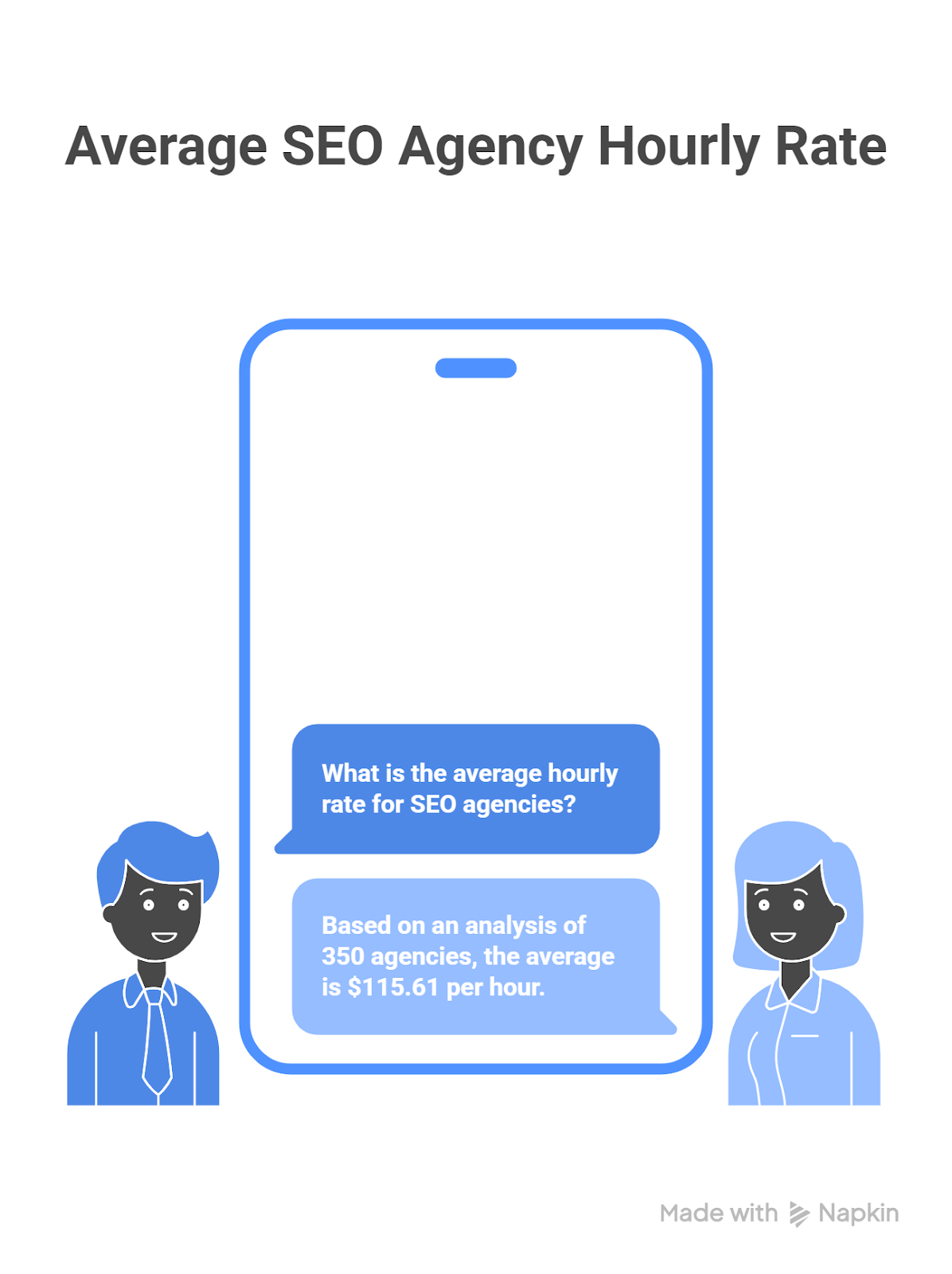
- Typical Agency Rate: $100 to $200 per hour is standard for professional agencies.
⚠️ Caution: Hourly billing should be avoided for ongoing delivery work. It creates tracking challenges and encourages clients to measure time rather than value. Use hourly rates only for short-term consulting or strategy engagements.
Local SEO Pricing Guide: Tiers and Deliverables
When you talk to a local business owner (someone running a roofing crew or a dental practice), they don’t care about “search intent” or “backlink profiles.” They care about one thing: leads. How many times a month are you able to make their phone ring?
The local SEO pricing math usually lands in a specific range. Generally, you’re looking at a range between $1,500 and $5,000. If you go lower than that, you’re basically just doing “maintenance” work.
But we’ve seen folks in Canada try to charge 500 CAD (about 370 USD) for a basic setup. They do a couple of blog posts, do link building, and fix a few map listings.
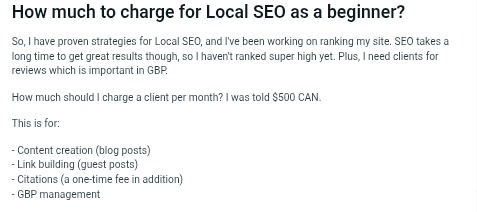
But honestly? That’s a hobby, not a business. If you have a team of ten, you need to price right so you can afford to pay your people, tech stack, and still have a little left over for yourself.
The Pricing Guide
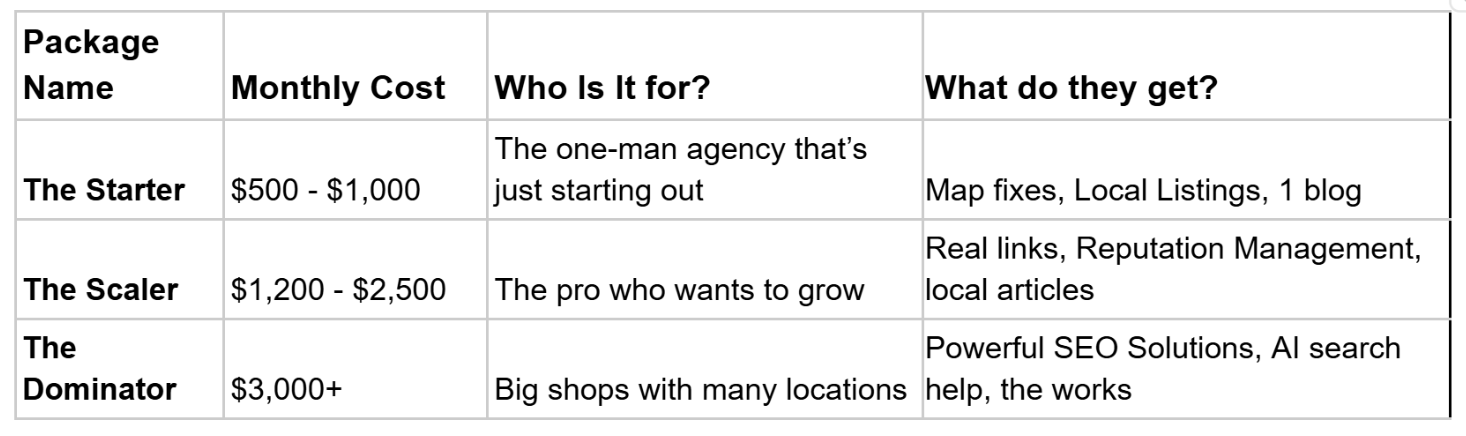
The Starter ($500 to $1,000/month)
If you are a solo founder just starting out, you aren’t paying a “worker” $35 an hour yet. You are the worker. But you still have to value your time like a boss, or you’ll end up working for less than minimum wage once you factor in your software and taxes.
When you sell a $700 “Starter” package, you have to look at your “take-home” profit after the tools are paid for. If you’re using a platform like Synup Local Listing Management for about $79 a month, that’s among your deductions. Here is how that money is spent:
- The tools: $79 (Synup for Local Listings and basic rank tracking).
- The Tax Man: ~$175 (Set aside roughly 25% for self-employment taxes).
- Software/Overhead: ~$50 (Your email, website hosting, and maybe a basic CRM).
- What’s left: $396.
Now, look at your time. Even if you don’t have an employee, you should “bill” yourself at a professional rate. If you want to make a decent living, your time is worth at least $75 an hour. That $396 “profit” only buys about 5 hours of your life.
Here is a realistic look at where a “starter” owner spends their time on a low-tier client like this:
- Monthly Reporting & “Hand Holding”: 1.5 hours. (Sending the report and the inevitable “Why am I not #1 yet?” phone call).
- Initial Setup & Fixing Info: 2 hours. (Verifying the Google Business Profile and making sure the Synup Invoicing Platform is set up).
- Content/GMB Posts: 1.5 hours. (Throwing up a couple of photos and a quick update).
Total: 5 hours. You are officially at your limit. If you spend even one extra hour on a “quick question” from the client, you are now making less per hour than you planned.
Why is it a “Danger Zone”?
If you stay in this $500–$700 range, you have to sign up a lot of clients to pay your rent. If you have 10 clients at $700, you’re “making” $7,000, but you’re also spending 50 hours a month just on basic tasks. You have zero time left to actually sell more clients or grow your agency.
The Logical Fix
If you want to survive the “starter” phase, you have to use automation to buy your time back.
- Stop doing manual work: If a tool like Synup costs $79 but saves you 4 hours of manual data entry, you just “bought” those 4 hours for about $20 each. Since your time is worth $75, that’s a massive win.
- Price for the Future: Price it so that one day you can pay that worker $35 an hour and still have a profit left over for the business.
The goal of a $700 package isn’t to stay there forever. It’s to get the client a few wins (get their phone ringing) so you can move them up to the $1,500 “Scaler” tier as fast as possible. That’s where you actually start building a real agency with 10+ employees.
The Scaler ($1,200 to $2,500/month)
This is where the real business happens. These clients have money to spend because one new customer is worth a lot to them.
Example: Think about a Roofer. One new roof could be $15,000 in their pocket. If they pay you $2,000 and you get them even one or two extra jobs a month, they’re happy.
The Work: You are doing the hard stuff now. You’re reaching out to local news sites or blogs to get them mentioned. You’re writing articles that answer local questions, like “How much does a new driveway cost in [Your City]?” Plus, you’re helping them get 5-star reviews and replying to the grumpy ones. That’s Reputation Management, and it’s worth its weight in gold.
The Dominator ($3,000+/month)
This is for the heavy hitters: the law firms, the big dental groups, or the guys with five different locations across town.
The Work: This is the high-level stuff. You’re making sure they show up in ChatGPT and other AI search apps. This is what people call AEO, and it’s a big deal now. Agencies are adding an extra $900 or $1,000 a month just for this. You’re also doing deep technical fixes and using SEO solutions to make sure they beat every competitor in a 20-mile radius.
Decoding the Tiers: What the Client Is Really Buying
Here is the logical breakdown of how the deliverables vary by tier and what it actually costs to run your professional shop.
Budget Tier (Under $1,000/month)
Most small agencies live here. It’s okay, but it’s a lot of work. At this price, you cannot afford a high-level strategy every day. You are selling a system and not a person’s brain.
- The Team: 1 Junior SEO Specialist handling 1–5 clients.
- The Specifics: You rely 90% on tools like Synup for Local Listings because manual data entry would kill your profit.
- The Context: This is for the local plumber or hair salon. They need the basics: citations, GBP updates, and maybe one generic blog post.
- The Logic: If you spend more than 8 hours a month here, you’re losing. You are basically a “software with a human helper” at this price point.
Mid-Market Tier ($1,200–$5,000/month)
This is the “sweet spot.” This is where you have the budget to actually think for the client.
- The Team: 1 Mid-level SEO Strategist who can also do content writing, and a Project Manager.
- The Specifics: You are doing “Neighborhood SEO.” You’re writing custom landing pages for different zip codes and doing real outreach for links. You may also be doing Online Reputation Management to keep their reviews looking good.
- The Context: This is for the high-competition local pro (Lawyers, HVAC, Dentists). A single lead for them is worth $500–$2,000, so your $3k retainer is a bargain if you bring in 5 leads.
- The Logic: You have about 20–30 hours of team time to play with. This is enough for a custom strategy that actually beats the guy down the street.
Premium Tier ($5,000–$15,000+)
This is for the big fish. At this level, the client expects you to be in their business meetings.
- The Team: A dedicated “Pod.” You’ve got a Senior Strategist, a Videographer/Social pro, a Technical SEO expert, and a high-touch Account Director.
- The Specifics: This is “Search Everywhere” territory. You aren’t just on Google. You’re making sure they show up on TikTok, in ChatGPT (AEO), and have SEO tools that track every single dollar from a click to a sale.
- The Context: Multi-location franchises or big-city plastic surgeons.
- The Logic: You’re selling a 5x or 10x return. If they give you $10k, they expect $100k in tracked revenue. You have the budget to fly to their office or do deep-dive video shoots once a month.
Also Read: Find the Ideal Marketing Agency Structure: 7-Step Guide & Best Practices
Key Factors That Drive SEO Service Costs
Don’t give every client the same price. Some jobs are much harder than others. Plus, your local SEO cost should change based on these three things:
- Competition: Ranking a plumber in a tiny village is easy. Ranking a lawyer in Toronto or New York is a fistfight. If the competition is high, your price has to be high too because it’s going to take ten times the work. If everyone else in their industry is spending $5k, they can't win with $500.
- Number of locations: If a client has ten offices, that’s ten different Google Maps spots to manage. Don’t do that for free! Most agencies charge a “base fee” and then an extra $200 or $300 for every location.
- Is it a shop or a service?: Selling products online (E-commerce) is a headache. You have to deal with thousands of pages and technical glitches. Local service SEO (like a maid service) is much simpler. Always charge more for online stores.
Why is it so expensive? (Explaining it to the client)
You will always get the client who says, “I saw a guy on Fiverr who can do this for $50.” You have to be ready to explain why that’s a bad move.
Cheap SEO is like a cheap tattoo. It’s going to hurt later and cost a lot more to fix. Low-cost providers often use “black hat” tricks that can get a business banned from Google. If a business loses its Google map listing, it is basically invisible. That’s the local SEO cost of going cheap.
Check Out: Track These Important Client Metrics Every Month to Improve Your Agency Services
Strategically Pricing Your Agency’s Value
To keep your 10+ employees happy and the lights on, you need to know your Burdened Labor Rate: the true hourly cost of employing someone. It accounts not just for salary, but also benefits, taxes, tools, and overhead. Simply put, it’s how much it actually costs you per hour to have that person sitting in that chair.
The Value-Based Method
If a new roof is worth $15,000 in profit to a contractor, and your SEO brings them two new customers a month, you just made them $30,000. Charging $3,000 for that work is a bargain! They get $27,000 in profit, and you get a happy client.
The Cost of Being Messy
If your team has to log into 20 different Google accounts manually, you are wasting money. Another thing to consider is using a tool like the Synup Agency Operating System, where you have features for sales, leads, prospecting, invoicing, and more, all rolled into one. This lets you see everything in one place, which cuts down the time your team spends on “busy work.”
Pricing for the “Search Everywhere” World
SEO is not just about the Google SERP anymore. People are using TikTok, Apple Maps, and even asking their AI apps where to go. Keeping up with all of this takes time and smart people. You aren’t just a “link builder” anymore; you are a “search everywhere” expert. Your local SEO pricing packages should include these new search strategies.
Conclusion
Pricing comes down to confidence and clarity. If you know your work actually helps businesses grow, you should not feel weird charging for it. When your SEO pricing is right, everything else in your agency starts to feel lighter. You can hire better people, pay them on time, invest in tools, and stop stressing about every invoice.
Stick to your guns on your rates. The clients who pay the most are almost always the ones who treat you the best. The ones who try to nickel and dime you over a hundred bucks will be your biggest headache.
Lastly, stop wasting your brainpower on manual busy work. Use a proven tool like Synup to handle the everyday stuff, like review management, so you can stay focused on the big work.
Also Read: How to Create a Marketing Agency Rate Card
FAQs
- How do I calculate SEO price?
Calculate what you pay your people to do the work, not just their salary, but payroll taxes, benefits, and the time they spend fixing things or answering clients. Then add your software costs. That includes tools for listings, rank tracking, reporting, outreach, email, and anything else you log into every day. Once you know that number, add a profit buffer of around 30 to 50 percent.
- Should I use a per-location model?
Yes, especially once a business has more than two or three locations. Per-location pricing is one of the easiest ways to keep things fair and simple on both sides. Each location has its own Google profile, its own reviews, its own address issues, and its own ranking problems.
- Why is local SEO so much cheaper than national SEO?
Local SEO is usually cheaper because the scope is smaller. You are not competing with the entire internet. You are competing inside one city or even one neighborhood. That means fewer competitors, fewer pages to manage, and fewer links needed to move the needle. But “local” does not always mean “easy.” If you are working with lawyers, roofers, dentists, or insurance companies in big cities, local SEO can get expensive fast. Everyone is spending money. Everyone wants to rank. Everyone is aggressive.